7. What is a salamander?

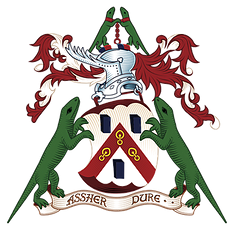
The arms of the Ironmongers’ Company

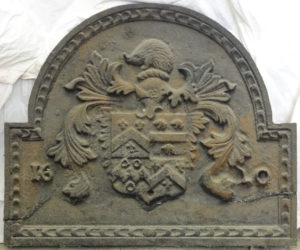
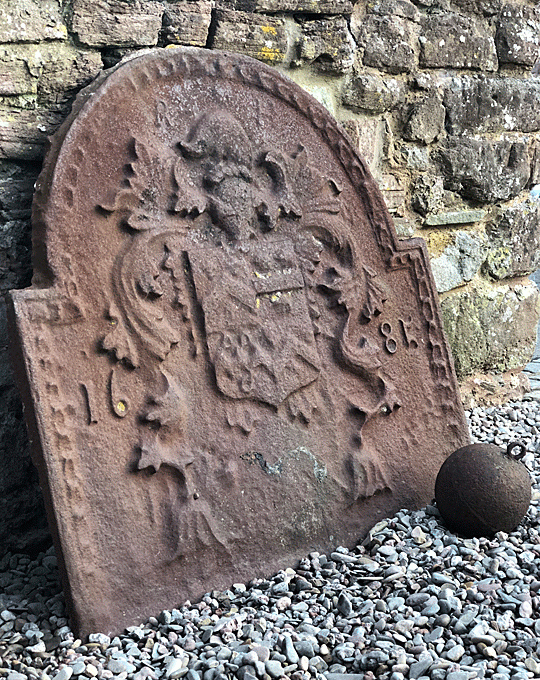
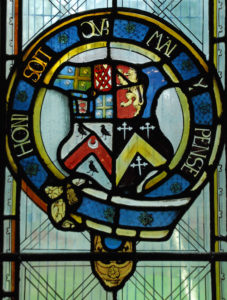
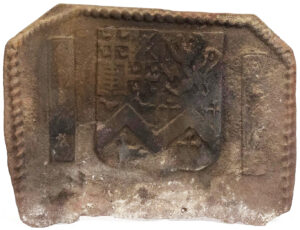
The coat of arms of the Worshipful Company of Ironmongers, one of the great twelve livery companies of London, has as both its supporters and its crest pairs of salamanders, amphibians related to newts. In folklore it was believed that they could survive in fire, which perhaps explains their presence in the Ironmongers’ arms. Heralds and woodcarvers in early modern England, however, had no concept of what a salamander looked like, the creatures not being indigenous to the British Isles. So in the few instances where they have been displayed on an English fireback they have been interpreted as dog-like creatures, as on the crest above the helmet in this representation of the arms of the Ironmonger’s Company.
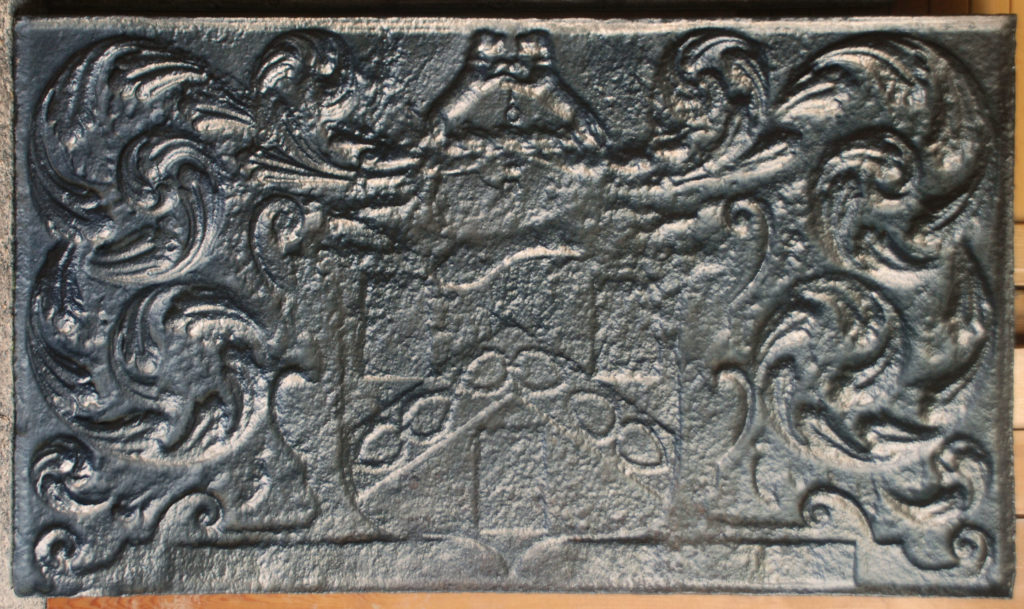
It is highly probable that the pattern for the fireback was a painted armorial for it can be seen that the motto scroll below the shield is blank, suggesting that one of the Company’s mottoes, ‘God is Our Strength’ or ‘Assher Dure’ (from the French Acier Dur – Hard Steel), would have been merely painted lettering. If the arms had been carved specifically as the pattern for the fireback one would have expected the motto to stand out in relief. The same anomaly has been observed on a few other backs. Ascribing a probable date to the fireback was assisted by an illustration in Country Life in 1946 of another casting of the same back that had been discovered near Chichester in Sussex. Helpfully, it had been cast with the date 1660 added to it, as well as a pair of initials, although in so doing part of the mantling of the helm was erased. I wonder where that fireback is now.

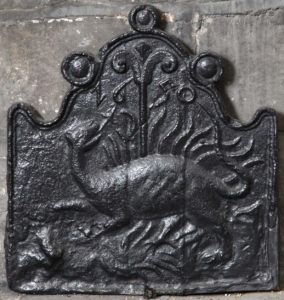
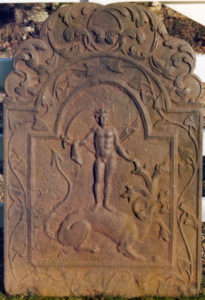
There is another fireback that has a salamander shown as a dog, this time with an arrow-like tongue and what appear to be hooves. It is shown as salamanders are traditionally portrayed, with flames rising around it. Used as a pattern, this same fireback, together with another one, was incorporated into a larger back which I recorded several years ago in a farmhouse at Ardingly in Sussex. In addition it has elements seen on other backs. There are a number of instances where smaller firebacks have been used as panels to decorate a larger casting and I call them composite firebacks. The practice was also frequently employed on French backs.

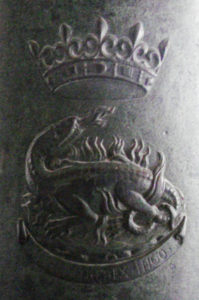
Salamander badge on a 16th century French cannon

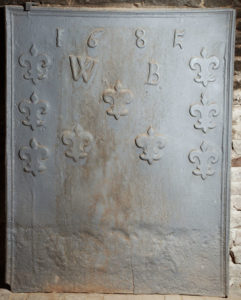
A 17th-century English craftsman who evidently had a better idea of what a salamander looked like was the one whose initials, IM, appear on some of the firebacks whose patterns he carved. Clearly he was familiar with French royal iconography, for the salamander was the badge of King Francis I (reigned 1515-1547), and the creature this otherwise anonymous pattern-maker placed on the small fireback he designed in 1650 (right) more closely resembles the French model.

There is a twist to this tale, however, for a casting of the same fireback is in the collection of the Sussex Archaeological Society at Anne of Cleves House, Lewes, in East Sussex, but on it the date is 1550, not 1650. The photograph shows that the first ‘5’, while exactly the same shape and size as the second one, is much more clearly defined and must have been substituted somehow at a much later date. In a short note written in 1957 Dr Hans Schubert, the historian of the British iron industry, quoted Professor William Lethaby who described this palimpsest as having been forged – in both senses of the word!
6. A royal badge

Anne Boleyn by Hans Holbein (Royal Collection)

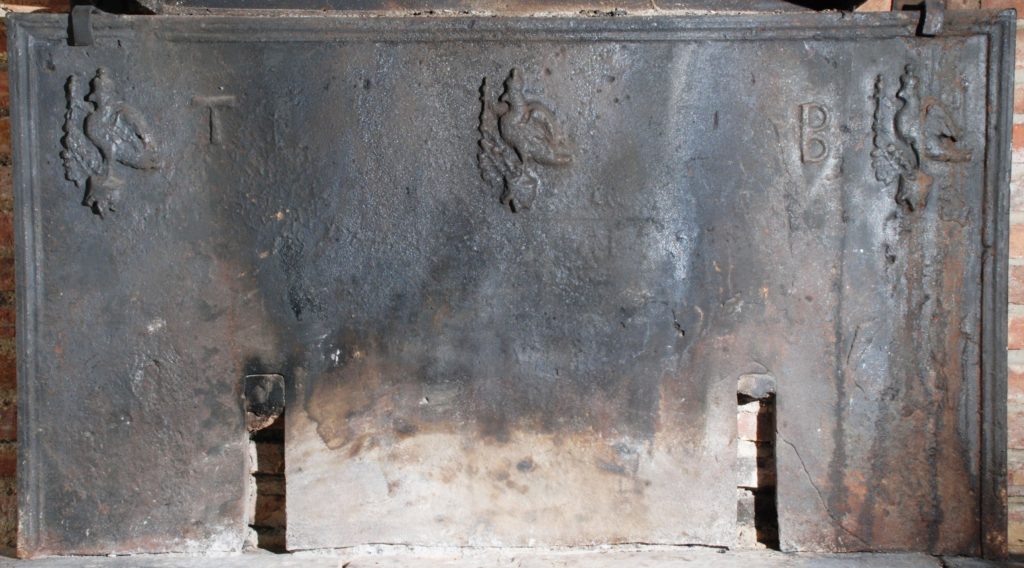
This fireback stands in a house in Woodchurch, in Kent. Its somewhat plain appearance belies a connection with one of the great dramas of Tudor England. For on its surface are three impressions of the badge of Anne Boleyn, which is first known from the Letters Patent raising Anne to the peerage as Lady Marquess of Pembroke in 1532, eight months before she married Henry VIII and became his second queen. Later, her daughter Queen Elizabeth I would also use it.

The badge shows a crowned falcon holding a sceptre and standing on an oak tree stump from which are issuing red and white roses. As with heraldic badges in general, Anne’s badge comprises several symbolic elements: the falcon represented the earldom of Ormonde to which her father, Thomas, was heir; the tree stump or ‘woodstock’ may refer to Henry VIII’s Plantagenet lineage, the manor of that name being a significant royal property for centuries; and the red and white roses signify the houses of Lancaster and York from which Henry was descended through his father, Henry VII, and his mother, Elizabeth, the daughter of Edward IV.

Hever Castle, Kent

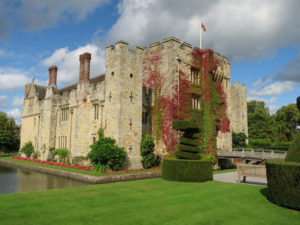
While the badges on the fireback had been placed carefully in the sand mould, the initials ‘T’ and ‘B’ appear to have been added as an afterthought, perhaps to a subsequent casting. The ‘B’ is a bit odd, and looks as though it could have been a pair of shackles were it not a mere 8.6cm high. Whatever was used it was certainly not from a traditional character set; other instances are known of objects being employed as a substitute for letters on firebacks. The obvious question is, whose initials were they? The ‘B’ invites the assumption that it stands for Boleyn, the ‘T’ perhaps for Anne’s father, and that this fireback once stood in the Boleyn family’s seat at Hever Castle, 40 miles from Woodchurch. But we will probably never know.

And finally the slots cut into the bottom of the fireback. They are seen in a variety of forms on a small number of backs, and are to accommodate andirons, or iron firedogs, on which burning logs would be placed.

5. A mystery solved

On their website Herefordshire Libraries have a black and white photograph of this fireback, which is at Fawley Court, Brockhampton. Taken in the early years of the last century by the antiquarian Alfred Watkins, it shows more clearly the crack across the lower part of the plate. Cracks across firebacks caused by temperature differentials are not uncommon. However this crack is more than it seems for it hides an entire missing portion of the fireback.

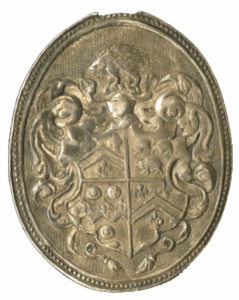
Medallion of 1647 with the arms of Kyrle (British Museum)

The arms on the fireback, which are of the Kyrle family of Much Marcle in the same county, are notable for their crest of the hedgehog, or urchin as it is sometimes called in heraldry. Sir John Kyrle may have operated an iron furnace at Whitchurch, between Monmouth and Ross, and so may have had the back cast there. The carver of the pattern for the fireback was also responsible for a couple of other firebacks that I have noted. The date on the fireback, however, is suspicious as the ‘2’ seems stylistically different to the other numbers and may indicate that it was changed, from a ‘1’ perhaps, before this casting was made.

Down to the south-east, in Gloucestershire, lies the village of Flaxley where there was another iron furnace that, in the late-17th century, was owned by William Boevey. He lived at Flaxley Abbey where there were a couple of firebacks that bear his initials (one was sold recently). Both have the date 1685 of which the ‘5’ is particularly distinctive, having a minimal curve at the bottom.

Early-17th century fireback with the Kyrle arms copied at Flaxley Furnace in 1685 with additional initials RH

The same date with the curious number five turned up on a Kyrle fireback recently which solves the question of the missing portion of the one at Fawley Court. Trailing tassels from the heraldic mantling are missing from the Fawley Court casting, a cunning bit of blacksmithing having rejoined the broken parts. Evidently the original pattern for the Kyrle fireback, or more probably an existing fireback, was used to make another casting, but this time at Flaxley for it would have been at that furnace that the stock of numbers included the distinctive ‘5’.

4. “Call me Risley” (revised)

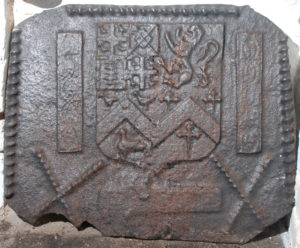
I first came across what I thought was this fireback in a scrapbook compiled by John Starkie Gardner, an early and well-informed writer on firebacks, who had been Keeper of Metalwork at what was then the South Kensington Museum but is now the Victoria and Albert Museum – the V&A. He had assembled hundreds of photographs, sketches and cuttings from publications and pasted them into several of these scrapbooks which were then at the Beecroft Gallery in Westcliff-on-Sea in Essex. They are now in the V&A Archive of Art and Design. The cutting gave no clue as to where it had been taken from. I saw the actual fireback when I visited a lovely house in Huddington, Worcestershire, to record an interesting collection there. I had no idea at the time whose elaborate arms were displayed on its surface and I feared it would be a difficult task trying to identify them given the indistinct detail on the casting. Its irregular shape also suggested it might have once been a larger fireback cut down, perhaps to fit in a smaller hearth.

The Wriothesley arms at South Warnborough church

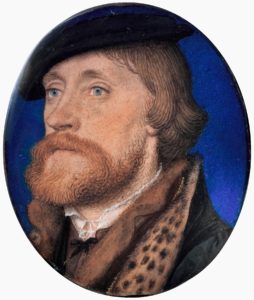
As is so often the case when I have tried to identify arms on firebacks, luck played its part and I spotted the shield on a 17th century map of Hampshire. They were the arms of the Earls of Southampton, whose most distinguished member, and likely subject of the fireback, was Thomas Wriothesley, Lord Chancellor at the end of Henry VIII’s reign. In Hilary Mantel’s best-selling novels on the life of Thomas Cromwell, Bring up the Bodies and The Mirror and the Light, she has him announcing himself with “Call me Risley” to explain the pronunciation of his name. He was drawn and painted by Holbein, and his arms are displayed on his 1545 Garter stall plate in St George’s Chapel, Windsor, and on a window in the parish church at South Warnborough, Hampshire.

As to the source of the fireback it was not until I had made the acquaintance of a collector at Wigmore in Herefordshire, who sent me photographs of the backs in his possession, that I was able to associate the Huddington fireback with a known series. As well as Wriothesley’s arms, on the Wigmore fireback are 13 little figures that are stamps frequently seen on what I have termed the ‘Royal’ series of firebacks. Some writers have described them as ‘mummers’ or ‘imps’, their postures suggesting mischief-making, and they can be seen in three forms on different backs in the series.

I subsequently discovered where Starkie Gardner had found the clipping that had alerted me to this fireback. It was in an article he had written on ‘Old Wealden Ironwork at Warnham Court’ in Country Life in 1907. Warnham Court in Sussex, then the property of Mr C. J. Lucas, had a collection of firebacks that appeared as illustrations in several of Starkie Gardner’s published works. But the fireback at Warnham was not the same one as I had seen at Huddington, for the twisted rope edging was different and the rope crosses below the shield, presumably apotropaic, or intended to avert evil, were a different shape too, although the overall shape of the back was very similar and presumably not trimmed, as I had previously thought. So there had been at least two similar castings with Wriothesley’s shield in addition to the Wigmore one.

The Wriothesley fireback at Warnham Court, Sussex (Country Life, 25 May 1907)

POST SCRIPT:
Since writing the above another Wriothesley fireback appeared on an American auction website. It appears to be identical to the Warnham Court casting, and it has the vestige of a cross at the bottom left. Is it one and the same? There is no record of what happened to the firebacks there; the Lucas family still live in Warnham Park and I have asked them.

3. My Ashburnham fireback

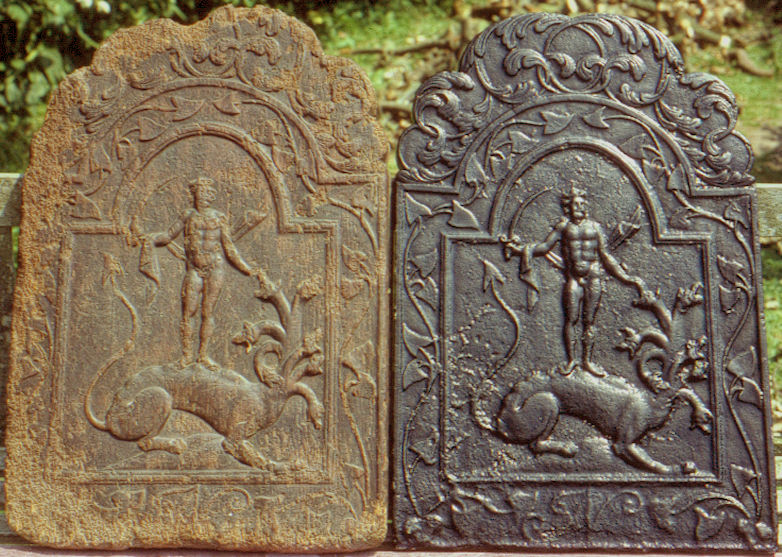
If I remember correctly, my mother told me that, back in the 1950s, she and my father were driving through the village of Hooe, near where we lived in Bexhill, in Sussex, when they spotted an iron fireback amongst some builder’s rubble outside a cottage that was being renovated. They stopped and enquired of the builder what was to happen to the fireback and were told that it was no longer wanted. Asking if they could buy it, the builder let them have it for a couple of pounds. For years it stood in a rusted state in our garage until my father decided to have it cleaned up and painted. When, in the 1970s, they moved house, the fireback was brought indoors and displayed in front of a redundant chimney breast. After my parents died and their house was sold I inherited the fireback, and it is what sparked my interest in these, often enigmatic, domestic relics. What attracts me to this fireback, and I suspect attracted my father in particular, was the strong connection it had with the area where we lived for, almost uniquely, we know without any shadow of a doubt where it was made.

In 1883 passed away William Hobday who, as a ten-year-old boy, 70 years earlier, had been witness to the end of iron smelting in Sussex with the blowing out of Ashburnham Furnace. He had continued to live near where the old furnace had stood and had been custodian of two of the original wooden patterns, or models, that had been used at the furnace to form the moulds from which firebacks had been cast. Such patterns are very rare; I know of only five of British origin that have survived. Crucially, one of the patterns William Hobday kept had been used to make my fireback.

The fireback bears an image of the classical hero Herakles ready to slay the seven-headed Hydra, one of the twelve labours that he had been tasked with by his master, Eurystheus. The particular design on the fireback was probably derived from a book illustration or a set of engravings, but I have not been able to identify it yet. At the bottom of the casting, below the picture, is the monogram TAN, which will have been the initials of the pattern maker, as the same monogram appears on two other firebacks.

Being moulded from a pattern, it was, of course, a simple matter for any number of examples of the fireback to be made, and several castings are known to exist and have been illustrated in books and articles. At an exhibition of the Wealden iron industry that I helped to organise at the Priest House in West Hoathly in the 1980s, I included both the Herakles fireback and its pattern, which I borrowed from the Sussex Archaeological Society. Both of the patterns that William Hobday had kept had been presented to the society by their owner, The Earl of Ashburnham. So, fireback and pattern were reunited for the first time, I suspect, since the one was cast from the other maybe two centuries earlier.

2. One of Charles Tyler’s firebacks

The arms of Ayloffe impaling Sulyard

Back in 2018 the Kent Archaeological Society published a short article that I had written in which I proposed that the initials seen on most dated examples of a group of firebacks bearing shields with the arms of the 16th century judge, William Ayloffe, and his wife Jane were those of a founder, Charles Tyler. Tyler’s working life almost exactly matched the date range of the firebacks and suggested they had been cast at a succession of furnaces where he worked in west Kent during the first three decades of the 17th century. With one exception, all the reported examples were large castings, in excess of 4ft, or 1.22m, wide and all but two had been decorated with at least 13 identical shields.

While smaller castings with fewer shields, but without dates or initials, are more frequently encountered, I regarded the likelihood of coming across other dated ones as remote. Imagine my surprise, therefore, when my late wife and I called in for a lunchtime snack at The Crown Inn, in Horsted Keynes, recently re-opened after a disastrous fire, and what should I see in the fireplace but a small, dated Ayloffe fireback. Only 2ft 6ins wide and with a mere five shields, it nevertheless bore the initials, CT and a date of 1609. I made an appointment to go back a few days later and record its details. That was in February 2019.

The fireback I bought, as advertised

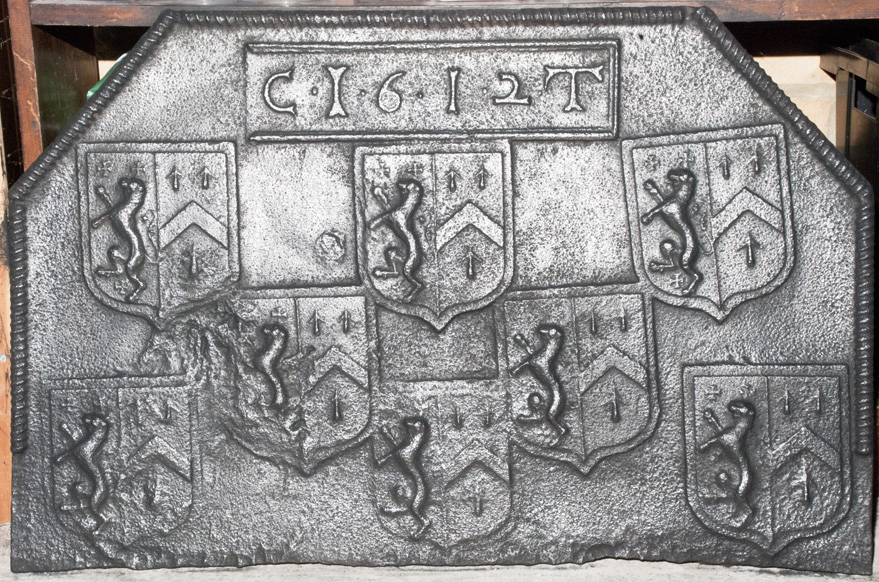
Since then the pandemic and other misfortunes have curtailed the search for firebacks, until a few weeks ago when vaccination began to give one a renewed sense of freedom. I was browsing the internet for firebacks, as I do from time to time, and I lighted upon one for sale on eBay. What excited me was that it was another dated Ayloffe back. The photograph was unprepossessing but it looked ‘period’ and in reasonable condition, and the price was good. Having a modern house without space for more than the one fireback I already owned, and which I had inherited from my parents, I had always resigned myself to not being a collector. But this was too good to miss. I paid the price without making an offer and arranged to collect it the following day; at 2ft 10ins wide it fitted comfortably on a pallet in the boot of my car (raising it on a pallet makes it easier to lift out). What I brought home after a 150 mile round trip was a 1612 casting with eight shields and, once again, Charles Tyler’s initials. After writing the article about him it only seemed right that I should own one of his creations.

Restoring it was a three-stage process. After a stiff brushing to remove all the surface particles I used a paint brush to apply a dose of a proprietary rust-remover called Scale-X (there are other products that will do the same job, I daresay), agitating the brush as I did so. Discolouration of the liquid as I applied it showed that it had begun to eat into the rust. After a while I washed the liquid off and reapplied it, repeating this several times. When I was satisfied that the bulk of the surface rust had been removed, I began work on the surface with a rotating wire brush attached to an electric drill. You can buy sets of wire brushes of different sizes and it is useful to have a range of shapes and sizes to work around the varied forms of the decorative relief on the fireback. This is laborious work and a disadvantage with modern battery-powered hand drills, compared with mains-powered ones, is that you exhaust the batteries faster than they recharge. This eventually brings the surface of the fireback to a clean polish. Finally, to protect it and to give it a pleasing metallic finish, I brushed on a blacklead product such as Stovax, working it in to all the corners and crevices, and rubbing it all over with a cloth to burnish it. Beware, this is dirty work, but the result is worth it.

1. Charles Dawson and a fireback

A woman sitting at a fireplace containing a fireback

On the home page of this website is the picture of a girl sitting in front of an inglenook in which there stands an impressive fireback with a motley collection of images upon its surface. The photograph appeared as the frontispiece of an article on ‘Sussex Iron Work and Pottery’ in volume 46 of the Sussex Archaeological Collections, published in 1903. The author of the article, and seemingly of the photograph, was Charles Dawson, who was later to achieve notoriety from the ‘scandal’ of the Piltdown Man. Dawson gave no clue as to the fireback’s whereabouts.

In 2000 I had given a couple of talks on the Wealden iron industry in the village of Waldron as part of their Millennium Festival, and the organisers kindly presented me with a copy of a recently published book on the village. I had not, at that time, begun in earnest my research into firebacks, so it was consigned to my bookcase without it being given much attention.

Several years later, when I had begun to leaf through the pages of books on Wealden villages in search of references to firebacks, I returned to it and found in its pages a different photograph of the same fireplace and with the same fireback, but this time with an elderly couple, Caleb and Philadelphia Newnham, sitting beside it. In the text it gave the location as Heronsdale, a farm within the parish. I duly contacted the owners of Heronsdale and arranged a visit, but I was disappointed to discover that the fireback was no longer there, and the then owners could not recall to where exactly it had been removed.

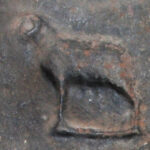
During the next year I had traced the fireback to Wickham Manor, a property belonging to the National Trust near Winchelsea. I arranged a visit and, sure enough, there it was but, frustratingly, a wood-burning stove had been placed in front of it so I was unable to photograph it for the database. What I was able to confirm, however, was that it bore decoration formed from a variety of stamps that I had recorded on other firebacks in several collections (see the Pounsley series in the database), including those in the museums at Hastings and Lewes, and one particular stamp I have yet to see on any other fireback – an image of a horned sheep.

The fireback in Charles Dawson’s Country Life article

About five years later, an Honorary Research Fellowship at Exeter University gave me access to a wide range of digital resources, among them the recently scanned copies of Country Life magazine, and I took the opportunity to seek out all the references to firebacks in its pages back to the last years of the 19th century. Among them was a 1901 article on ‘Sussex Iron’ by none other than Charles Dawson, and among his illustrations was one of the fireback then at Heronsdale, but it was not of the whole fireback. One thing seemed certain, though, several photographs of the fireback had been taken in 1901 or earlier. Would I ever find what I was seeking, a picture of the entire fireback?

I try to obtain copies of all books and articles written about British firebacks. In an article published in 1911, reference had been made to an earlier one, which I had not seen, written by Miller Christy but the precise citation was not quoted. After some lengthy detective work I tracked this down to the now-largely-forgotten The Crown, the Court and County Families’ Newspaper, and its penultimate issue in May 1908, in which there was the piece on firebacks by the aforementioned Mr Christy. More importantly, not only was one of the illustrations a different image of Mr and Mrs Newnham sitting in their fireplace, but there was a complete photograph of the elusive fireback, now here for all to see.