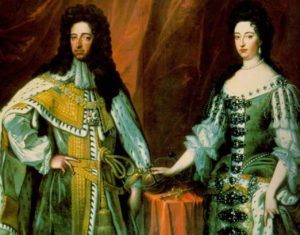
Writing in Old Furniture in 1929, G. B. Hughes noted the absence of firebacks bearing the arms of King William III and Queen Mary II, a statement which my cataloguing of over 800 backs has failed to disprove. Together, and from 1694 William alone, they reigned for 14 years and the strong Dutch influence that William’s tenure of the throne stimulated saw the importation of a distinctive style of firebacks that had been popular in the Netherlands since that country gained its independence from Spain in 1648. Furthermore, English pastiches of the Dutch style were also being produced in some quantity, and continued to do so throughout the first quarter of the eighteenth century.

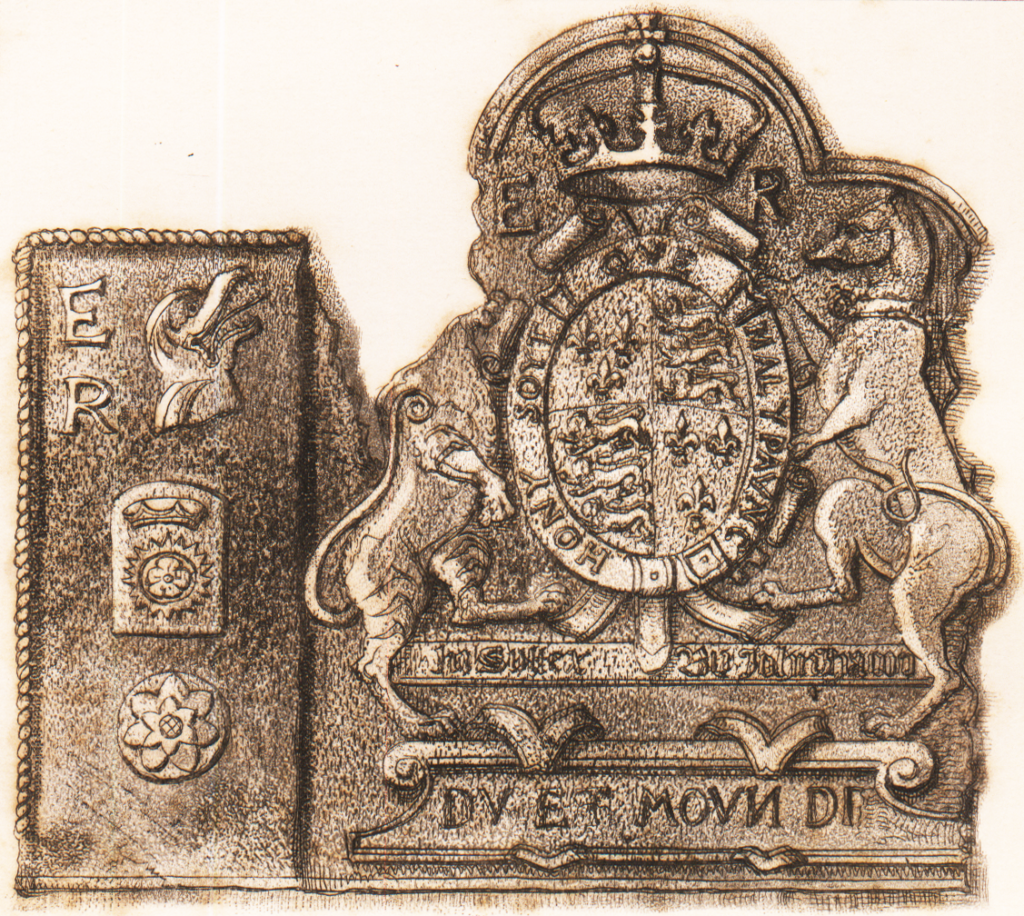
So this continental fireback with William and Mary’s arms is of great interest. It is a handsome casting, albeit a copy, but close examination reveals that, as might be expected, the arms displayed should be interpreted from a Dutch perspective, not an English one. The arms displayed are, in fact, those of William as Prince of Orange rather than as King of England, Scotland and Ireland, though they date from when he was king.
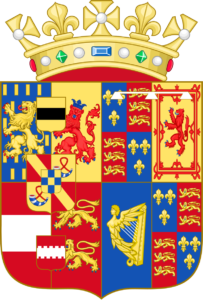
When was the fireback made? As a princess, Mary’s arms will have been a variation of those of her father, James, Duke of York, the difference being a label across the top. When her father was crowned king in 1685, he had no sons so Mary became heir presumptive, and her coat of arms reflected this change in status with a simple label of three points. However, the arms on the fireback show William’s arms as Prince of Orange impaling (i.e. next to) Mary’s arms without the label, suggesting that it dates to the period between 1689, when Mary had become queen, and her death in 1694.

As king and queen of England the combined arms of William and Mary were different. King William’s arms were the same as Mary’s save for the addition of an escutcheon of Nassau, the Dutch royal house, and as before they were impaled with Mary’s arms. The Scottish version of the arms was almost the same, though the red lion rampant was given precedence. It is a fireback with this combination of arms that seems never to have been made. Perhaps the intricacy of the carving made pattern makers baulk at the prospect of rendering the shield effectively, though their continental counterpart seems to have done a pretty good job.
POSTSCRIPT 12 October 2026
Since writing the above, I have come across another fireback bearing the arms of William III, seemingly made in a part of north-west Germany that, until 1702, when William died, had been part of his Dutch territory.
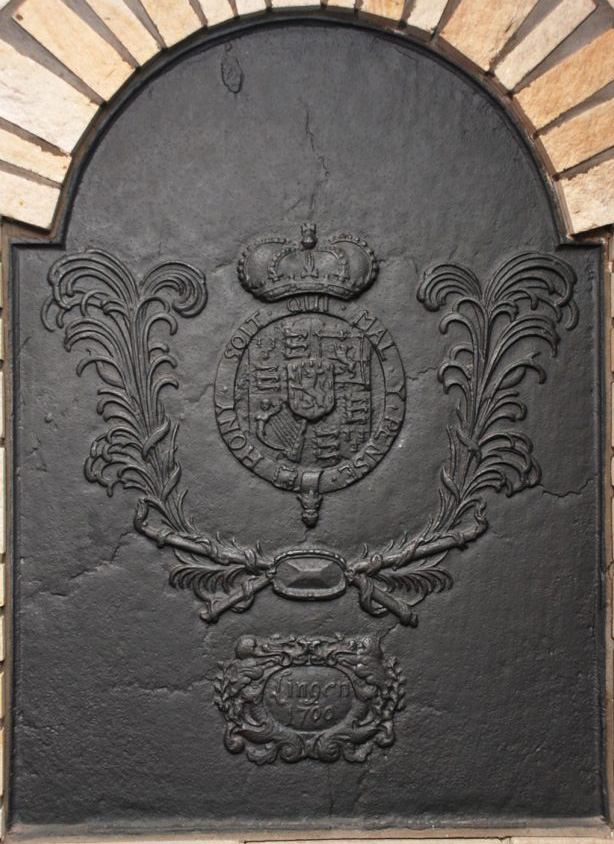
On the website of the Emslandmuseum+ at Lingen, in the state of Niedersachsen, is an article on a fireback from a former miller’s house in the nearby village of Schapen. On it, within palm leaves, is the shield of William III, as king of Great Britain – the quartered arms of England, Scotland and Ireland superimposed by an inescutcheon of Nassau – below a regal crown and encircled by the Garter. Beneath is an oval cartouche within ‘auricular’ decoration bearing the phrase ‘Lingen 1700’.
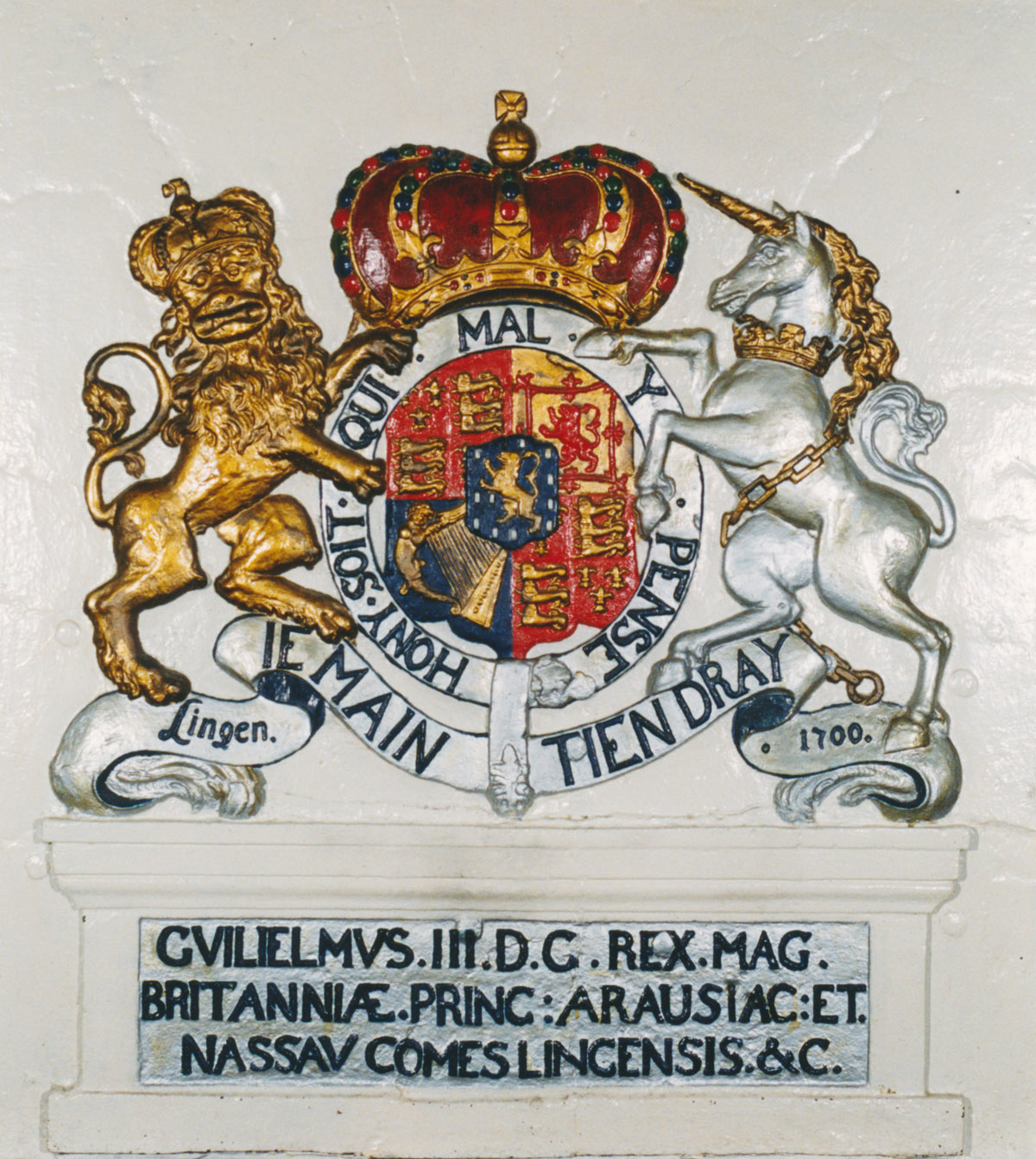
An almost identical fireback, but without the date 1700, that was formerly in the Osterfinke farmhouse at Schale, a village a few miles to the south-east of Lingen, is now in the village community centre. And in Ibbenbüren, 20 miles from Lingen in the adjoining county of Tecklenburg, is a different fireback (right) that has a full achievement of King William’s arms, and with the additional inscription: GVILIELMUS.III.D.G.REX.MAG.BRITANNIAE.PRINC:ARAUSIAC:ET.NASSAV COMES LINGENSIS. &C.” – William III, D[ei] G[ratia] King of Great Britain, Prince of Orange and Nassau, Count of Lingen, etc. These arms also include the phrase, ‘Lingen 1700’ as well as William’s royal motto, Je Maintiendray.
Coal had been mined in the county of Lingen since the 16th century and, later, iron ore was discovered near Recke leading to the building of a furnace at Ibbenbüren, with William III’s Rentmeister, Jacob de Famars, visiting the Sauerland to learn smelting techniques. By 1702 a number of products were being made at the furnace, but the firebacks of 1700 would seem to have been some of the earliest castings. It is unlikely that the firebacks were made initially for use in the agricultural dwellings whence they were recovered. Instead, it is probable that they would have been installed in civic buildings.
*W. C. Sellar and R. J. Yeatman, 1066 and all that (London, Methuen, 1930), ch. 38.
+With acknowledgement to the Emslandmuseum, Lingen