This is that rarest of firebacks, on which the person who made it did not merely place their initials but identified themselves with their full name. The raised strip bearing the inscription had been carved on the original model or pattern from which it and several others have since been cast. John Harvo was an iron founder who lived in Sussex in the mid-sixteenth century and operated the iron furnace at Pounsley in the parish of Framfield. There he cast guns and round shot (i.e. cannon balls) for the Crown for which there are surviving records of payments he received in 1547 and 1550, even being referred to at the time as ‘the kinges gonnstone maker of Iron’. Perhaps somewhat late in life, he married Anne Bennys at Framfield in 1558. An official copy of John Harvo’s will, which he made in 1562, has survived. From it we can surmise that he had no children, or if he had they predeceased him, for his bequests went to his brothers or his nephews, and to colleagues and friends. To his wife he left the lease of his house and land, and his furnace and mill, and we know from other records that the furnace was subsequently operated by Robert Hodgson, who was both a beneficiary of, and a witness to, the will. John Harvo was buried at Framfield in 1562 but probate was not granted to his wife as executrix until January 1566. We do not know how old he was when he died but to have reached a position by 1547 of supplying guns for the royal service he is likely to have been at least in his thirties then, and possibly in his fifties by the time of his death.
The pattern or model for the fireback was evidently made specifically for John Harvo; why else would he have had his name carved on it? It was clearly not an afterthought as the strip bearing the inscription passes beneath the strap end of the Garter that encircles the royal shield. Had being a contractor to the Crown brought him a commission to cast some firebacks with the royal arms on them? The arms are actually those of Henry VII, with the quartered shield of France and England, in use since the time of Henry V, supported by a dragon and a greyhound. Henry VIII continued to use the same supporters during his reign, so the original pattern will have dated from then. The superior quality of the carving suggests that whoever made the pattern worked at a ‘professional’ level and was probably aware of the latest changes in royal heraldry, and would have avoided designing arms that were out of date.

The initials E and R would not have been part of the original pattern. It has been shown by their use on a couple of other firebacks that they were separate stamps, presumably added to later castings in an attempt, perhaps, to honour King Edward VI or, less probably, Queen Elizabeth, and they have been on copies ever since. No example of the fireback without those letters has been recorded.

Many examples of this fireback have extension panels to make the casting wider. John Starkie Gardner, the first to write about firebacks with some authority, recognised its importance but did not believe that it was intended as a fireback in its own right as it was not wider than it was high, which he saw as a prerequisite for backs of its period. Instead he assumed that it was always meant to have additional side panels, left blank for other decoration. He was not aware of John Harvo’s role as an iron founder so could not appreciate his deliberate intention implicit in identifying himself on the pattern.
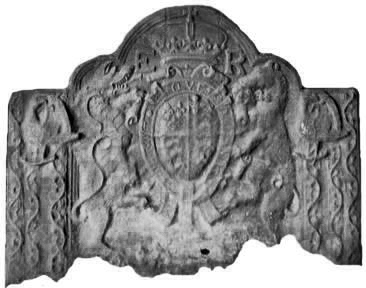

Two more examples with extension panels of different designs.
To find out about a spurious example of this fireback, read the note, “O what a tangled web we weave…”