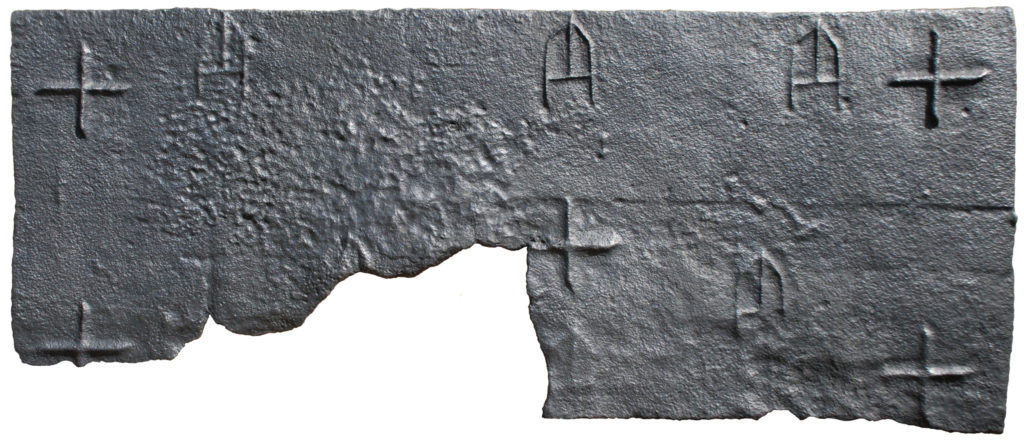
20. A pre-Reformation fireback?

Warbleton Priory, pictured in 1861

Sir John Pelham (d.1429) had grown up in modest circumstances in Warbleton in Sussex, but rose to become a senior figure in the governments of Henry IV and V and constable of Pevensey Castle, so he was in a position to provide 100 acres of land in his home parish for the canons of the Augustinian Priory at Hastings when their premises became uninhabitable. The new priory was dedicated in 1417. One hundred and twenty years later it would be closed down as a result of the dissolution of religious houses during the reign of Henry VIII. The priory was destroyed but a farmhouse which was constructed soon after, using stone from the demolished buildings, survives to this day.

Rev. Turner’s image of the fireback stamps

In 1861 a lengthy paper was published in the Sussex Archaeological Collections tracing the history of the priory at Hastings and its successor at Warbleton. In it the author, the Reverend Edward Turner, noted an iron fireback in one of the fireplaces and included an illustration of the repeated markings on it which were a cross and a Pelham buckle. The use by the Pelhams of a buckle as their badge dates back to an alleged incident at the Battle of Poitiers in 1356 when John de Pelham was among those who captured King John of France, the buckle representing the surrendered sword of the French king.

A branding iron, of the sort that might have been used for the buckle stamp

Pelham buckles appear in a variety of forms on buildings, coats of arms, firebacks (see Pelham family firebacks) and even milestones. The ones on this fireback are unlike any of the others; they are formed of very thin lines, which would be hard to carve as a wooden stamp. The crosses are a bit more substantial and could have been impressed into the casting sand simply as two lengths of wood. My suggestion is that the buckles could have been impressed using a cattle branding iron, a tool that could have been fabricated by a blacksmith and which would necessarily have slender lines to minimise contact with the animal being branded.

What of this fireback’s age? The association of the priory with the Pelhams goes back to the early-15th century but smelting to make cast-iron was not introduced into England until about 1490, so if the fireback had been in the priory buildings before dissolution it would have to have been cast in the early-16th century. It could, of course, have been brought to the priory from another Pelham property elsewhere but the combination of crosses and buckles suggests that it might have been intended for a religious house that was associated with the Pelham family and, as such, could be one of the oldest English firebacks.

I first came across the fireback in 2009. It had been acquired by Ripley Forge and Fireplaces Ltd. of Robertsbridge. I immediately recognised it as the one Turner had illustrated. Having suffered considerable corrosion since the photograph above was taken, it was no longer in a state suitable for resale. They offered it to me in 2015. I cleaned it up and in so doing discovered a mass of iron slag on the reverse of the plate. This had resulted from slag floating on the iron in the furnace hearth not being tapped off completely before the metal was cast, causing some of it to end up on the upcast side of the fireback. Following basic restoration, I gave the fireback to the Sussex Archaeological Society for their museum at Anne of Cleves House, Lewes.
19. An early Sackville fireback

This heavily-worn fireback is in a house near Horsted Keynes in Sussex. The house was built in the late-Tudor period but part of it was demolished in the 1780s and then considerably restored in the 1930s. It seems likely, though, that there was an earlier house on the same site so it is not known whether the fireback was original to the property.

Firebacks with armorial shields are always intriguing and the small size of the shield did not make identification easy, but the dexter (or left) side had a distinctive feature – a bend vair – i.e. a diagonal stripe with a pattern representing squirrel pelts. In heraldry these are customarily coloured blue and white alternately, though other tinctures can also be used, as with the arms of the Farnden family which I showed on my note, ‘It’s not as old as it seems’. I had seen the bend vair before on the arms of the Sackville family which are widely found in eastern Sussex and Kent. The shield on this fireback seemed to belong to one of the Sackvilles, impaled with that of a couple of other families.

In the past the Sackvilles were a very influential family in east Sussex and west Kent, owning large numbers of manors and estates which included Ashdown Forest. They have, for many centuries, been based at Buckhurst in Withyham, although they also came to own Knole, outside Sevenoaks, now a National Trust property.

The arms of Fane impaling Colepeper in Mereworth church

The clue as to the identity of the two other families on the fireback shield came from one of the many magnificent stained glass windows in the church of St Lawrence in Mereworth, Kent. The window in question, in the Despencer Chapel, shows the arms of John Fane, 7th Earl of Westmoreland, who had the church rebuilt in the 18th century, surrounded by arms of his forebears. Among them is this small quarry (a diamond-shaped pane of glass) with the arms of Fane impaling Colepeper. In the top row are two ‘quarters’ with the same arms as on the right, or sinister, half of the shield on the fireback. Consulting Papworth’s Ordinary of Arms I found that they were the arms of Colepeper (Argent a bend engrailed gules) and Hardreshull (Argent a chevron sable between nine martlets gules, six and three). From that I was able to find out that Christopher, one of the sons of Richard Sackville of Withyham, had married Constance, daughter of Thomas Colepeper of Bedgebury in Kent.

The arms of Hardreshull

But where did Hardreshull come into this? Apparently, some seven generations earlier, in the 14th century a John Colepeper had married Elizabeth Hardreshull who was an heiress, entitling her family’s arms to be quartered with those of Colepeper thereafter.

The arms on Christopher Sackville’s fireback c.1541-59

So what do we know about Christopher Sackville and his wife? He had been born by 1519 and probably brought up at Chiddingly in Sussex. After his marriage to Constance, which had occurred by 1541, he gained a place at Court and also served in Henry VIII’s campaign in France. In 1558 he became MP for Heytesbury in Wiltshire. He was present at Queen Mary’s funeral in December 1558 but must have died shortly after. When he made his will in August of that year he was living in Worth, Sussex. Constance, with whom he had at least three children, survived him. Her family had been influential in Kent for several centuries, firstly at Bayhall in Pembury and later at Bedgebury in Goudhurst. Her father’s younger brother, also (curiously) named Thomas, was executed in 1541 for his romantic entanglement with Henry VIII’s fifth queen, Katherine Howard.

Christopher Sackville’s connection with Horsted Keynes is somewhat tenuous. His older brother Richard occupied the iron furnace there, leasing it from Sir William Barrantyne, so it is possible that the fireback was cast at the local furnace. Wherever it was made, it would have been a unique casting and since Christopher and Constance Sackville were only together as husband and wife between about 1541 and 1559 the fireback must date from then, making it one of the earliest datable British firebacks.