47. Same design, different fireback*

In the late-17th-century Petworth House there is a fine fireback dated 1608. It may have been one of the 21 backs noted in an inventory of the earlier house on the site that was drawn up in 1632 on the death of Henry Percy, the ninth Earl of Northumberland. It is not an uncommon fireback as many copies exist, but it is a curious one nevertheless and interpretation of the various elements of its design is open to debate. In the centre, between two classical pilasters, is a cabled anchor. This is traditionally associated with the office of Lord High Admiral. Prior to his death in 2021 the post was held by Prince Philip, Duke of Edinburgh. In 1608, though, it was Charles Howard, Earl of Nottingham, who had been commander of the fleet when the Spanish Armada was sent packing. And from 1638 the post was held by Henry Percy’s son, Algernon, the 10th Earl of Northumberland.
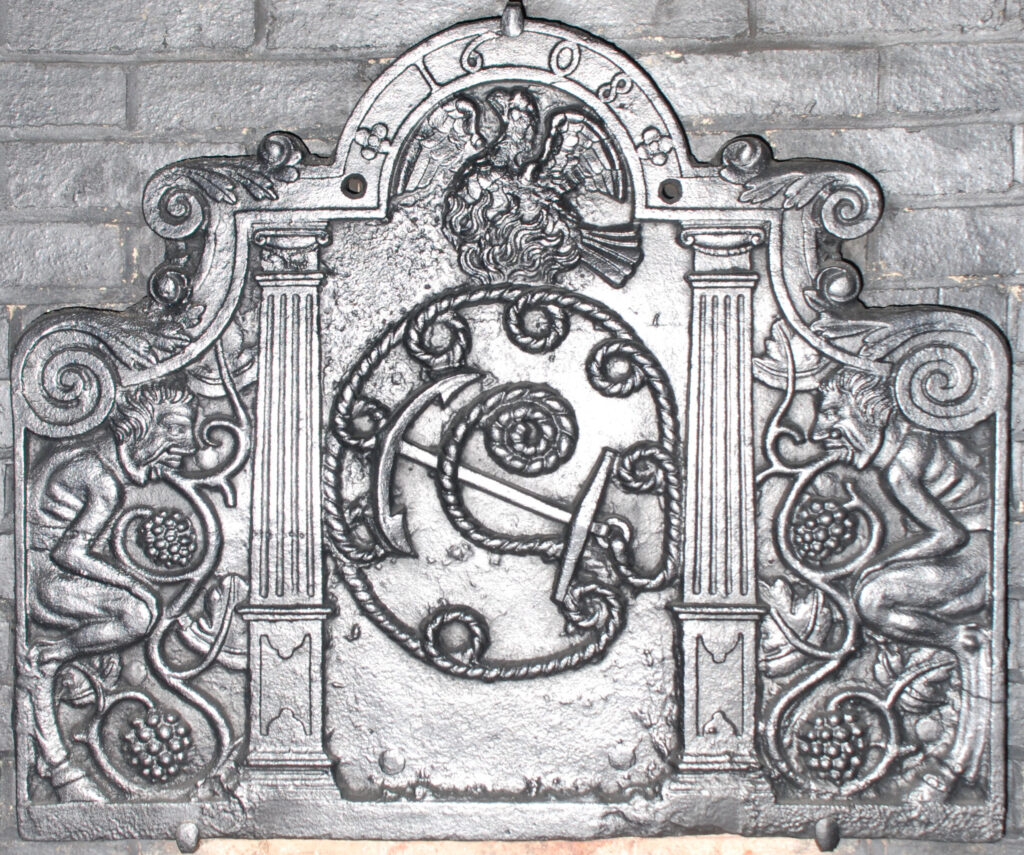
The 1608 fireback at Petworth House, Sussex (width 3 ft. or 91cm)

A symbol of rebirth, resurrection or revival, the phoenix rising from the flames above the anchor cable has no known significance for Howard but may have done for Henry Percy. In 1605 he had been sent to the Tower of London for his somewhat tenuous association with the Gunpowder Plot, so perhaps the phoenix symbolises his hope for release. It did not work, if that was its purpose, for the Earl remained in the Tower until 1621, although in comfortable confinement.

On each side of the anchor is a faun – half human, half goat – disgorging a vine. Fauns were mythological, woodland creatures and symbolic of peace and fertility, hence perhaps the vine. What prompted their inclusion in the design, who can say. Whatever its meaning, the original wooden pattern, with which the mould was formed, had been executed with great skill and precision, for the casting is very fine, with all the elements crisply detailed and suggesting that it is in all probability original.

A curiosity is the 4-foot-wide fireback, below, of 1633, which was discovered in the 1960s walled up behind a later grate in a farmhouse in Dunsfold, Surrey. It is a pastiche of the Petworth back. Executed in an altogether more, dare one say, ‘modernistic’, style, but characteristic of strapwork designs in the Jacobean period, it has all of the same elements but deliberately more crudely modelled. Some of the elements, such as the pilasters, have been changed and the phoenix no longer has flames beneath it. Was it intended as a satire on the 1608 fireback? for even then it would probably have been easy enough to obtain a casting from its pattern. It is, nevertheless, a fine casting and also likely to be original.
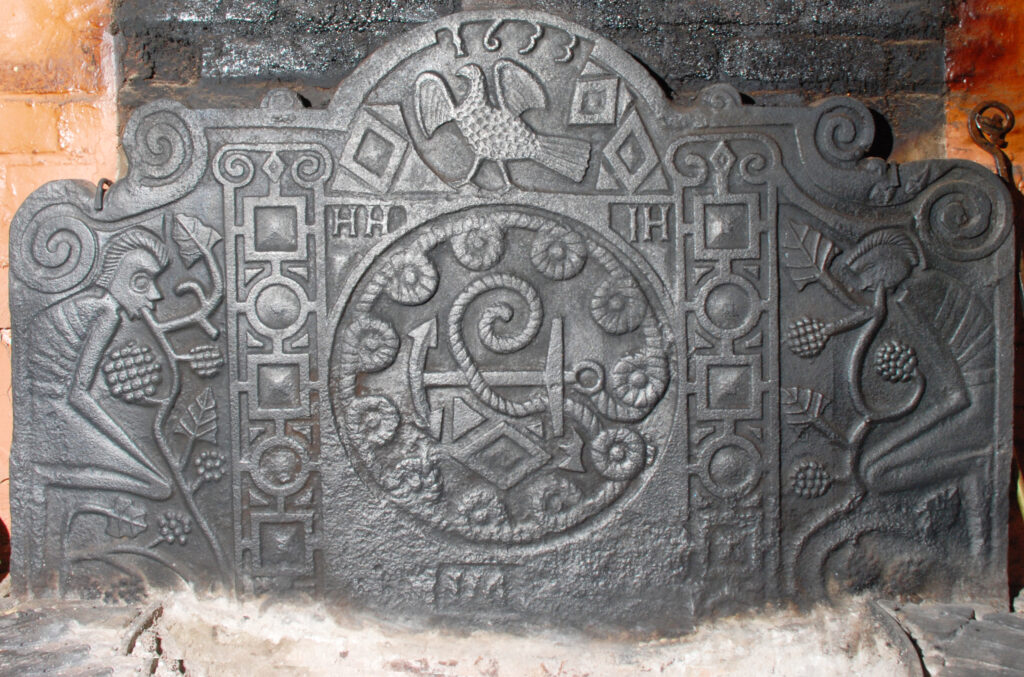
The 1633 pastiche of the 1608 fireback, with initials HH and IH and, at the bottom, IM, at a farmhouse in Dunsfold, Surrey (width 4 ft. 2 in. or 1.27m)
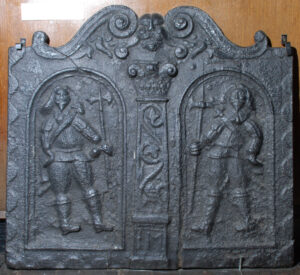
A fireback, probably dating to the 1630s, with the initials IM; Guildford Museum, Surrey

The two pairs of initials in the spandrels above the anchor are presumably for a husband and wife. Below are the recessed initials, IM, which are themselves of interest because several other firebacks in the next decade were also the work of someone with the same initials, some of whose earlier work, although largely unsigned, demonstrates a similarly naïve style.

Firebacks that ape the basic designs of other backs are not uncommon, such as early-18th century English versions of late-17th century ‘Dutch’ ones, but to go to the trouble of copying a distinctive fireback, three-quarters of its width, in a different style a quarter of a century later is puzzling and begs the question, why?

*This article first appeared in the Newsletter of the Wealden Iron Research Group in Spring 2026

24. Some firebacks at Petworth

The letter seen here on the right that Mr W. Slade Mitford of Petworth in Sussex wrote to the countryside and outdoor pursuits magazine, The Field, was published in its issue of 17th April 1940. When, about ten years later, the Mitfords sold Pitshill, which is in the next-door parish of Tillington, the collection of firebacks that he was writing about were loaned for display in Petworth House. They are still there and can be viewed in the Servants’ Corridor where an illustrated guide to them that I have written is available for visitors to find out more about them.

German fireback at Petworth illustrating Jesus and the Samaritan woman at the well (John ch. 4)

It is interesting that he wrote that the collection had been assembled from local farms and cottages, for more than two-thirds of the firebacks in the Mitford collection at Petworth are of continental designs, although it is probable that at least some of them had been cast in Britain, copied from German originals. The designs of ‘Water into Wine’, ‘Susanna and the Elders’, ‘Woman at the Well’ and ‘Adam and Eve’ that Mr Mitford mentioned are all typical of designs that found their way into England from the Netherlands in the second half of the 17th century. The fireback of ‘King Charles’s Oak’ is a common English type, and the ones with the motif illustrating ‘Killing the Golden Egg Goose’ are of English origin too, but they also have a particular connection with Petworth House.

Noted as having been among items from the Cowdray estate, near Midhurst, that had been sold in 1898, these two firebacks both date from earlier in that century and although they were cast with a motley group of stamps the presence of the ‘golden goose’ group at the top of each indicates that they had a common origin. The early-19th century was a lean time for the production of firebacks. Improvements in the design of fireplaces and the general reliance on coal for heating in domestic situations, a trend that had begun as far back as the late-17th century, meant that few can be dated to this period.

Æsop’s fable tells of the farmer whose goose laid a single golden egg every day, and who, greedy for more, thought that by killing the goose he would find more such eggs inside its body, only to discover that it did not, the eggs magically appearing one at a time. The stamp portraying the killing of the goose was an iron mantelpiece ornament, about nine inches (23cm) wide, which shows a table on which the dead goose has been laid surrounded by a family of adults and children distraught by the sudden realisation that they have deprived themselves of a fortuitous source of untold wealth. Quite why the ornament was chosen to decorate the two firebacks is not known for it is the only stamp that is common to both castings.

‘Killing the goose that laid the golden eggs’; early-19th century iron mantelpiece ornament (photo: G. Smaldon)

The connection with Petworth House is that the same mantelpiece ornament was used to decorate the iron casings that support the roasting spits in front of the fire in the kitchen just along the corridor from where the firebacks are now displayed, and were thus products of the same foundry. Most of the cast-iron kitchen equipment at Petworth was supplied in the 1870s by the firm of C. Jeakes & Co. of Great Russell Street, London, and the royal coat of arms of Queen Victoria features on some of the panels. However, the small royal coat of arms in the centre of one of the firebacks with the ‘golden goose’ group is of an earlier date and, although the detail is poor, the inescutcheon of Hanover can be discerned in the centre of the shield; this dates it to between 1801 and 1837. Also on the same fireback is a repeated stamp of a pineapple plant in a pot. This stamp also appears on the same kitchen casings as the ‘golden goose’ stamp, indicating that the cast-iron spit assemblage must also date from before 1837. At the bottom of one of the casings is the word ‘CHORLEY’, identifying it as having been cast at Robert Chorley’s iron foundry at Cocking, south of Midhurst. The foundry had been in existence since at least 1818, and it can be presumed that the firebacks had been cast there as well.

Of the other stamps on these two firebacks little can be said of the motive behind their inclusion as decorative elements. If anything, one has a more formal theme, with a repeated George and Dragon stamp as well as the royal arms and pineapples, while the other has a more leisurely theme with its jugs and glasses and churchwarden clay pipes, and a couple of small stamps portraying farm animals.