-
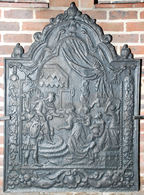
489
Description: Arched rectangular central panel with additional arch above; bead and fillet edging; pictorial scene of Solomon, rising from a scallop-backed, canopied throne, greeting the Queen of Sheba, with other figures in attendance; identical shaped border with cavetto-moulded edging; a vase on top with descending swags of drapery; at the sides, overlapping bunches of foliage suspended from ribbon bows; at the bottom, a central cartouche between fruit bunches; on top, a pomegranate with a descending serpent on each side, and a pomegranate on each shoulder of the plate.
Notes: Several contemporary paintings are of similar scenes; this design may have been derived from one of two by Erasmus Quellinus. Close observation shows that the scene depicted, and some other decorative elements, are different to those on a similar fireback, no. 1289.
Copies of this fireback are known.
Manufactured: in the mid- to late-17th century in the Siegerland area of Germany.
Current location: Michelham Priory, Arlington, East Sussex, England.
(part of the Sussex Archaeological Society museum group)
-
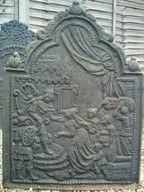
610
Description: Arched rectangular central panel with additional arch above; bead and fillet edging; pictorial scene of Solomon, rising from a scallop-backed, canopied throne, greeting the Queen of Sheba, with other figures in attendance; identical shaped border with fillet edging; on top, a cockle shell with a descending serpent on each side, and a cockle shell on each shoulder of the plate.
Notes: Several contemporary paintings are of similar scenes; this design may have been derived from one of two by Erasmus Quellinus.
Copies of this fireback are known.
Manufactured: in the mid- to late-17th century in the Siegerland area of Germany.
Current location: Mark Ripley Forge & Fireplaces, Northbridge Street, Robertsbridge, East Sussex, England.
-
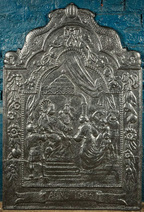
1326
Description: Arched rectangular central panel with additional arch above; bead edging; pictorial scene of Solomon, seated on a scallop-backed, canopied throne, greeting the Queen of Sheba, with other figures in attendance; identical shaped border with fillet edging; a vase on top with descending vines with leaves and fruit; at the sides, festoons of flowers suspended from ribbon bows; at the bottom, a symmetrical folded motto scroll with 'ANNO 1603' in the centre; on top, a Roman Imperial crown between a descending serpent on each side.
Notes: The date is spurious, this style of fireback not being made until after 1650. Several contemporary paintings are of similar scenes; this design may have been derived from a Dutch engraving of a drawing by an anonymous French artist after Maarten van Heemskerck. The same central panel can be seen on no. 1289.
Inscription: ANNO 1603
Manufactured: in the mid- to late-17th century in the Siegerland area of Germany.
Current location: not known.
-
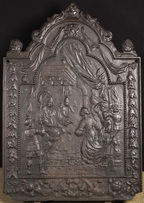
1289
Description: Arched rectangular central panel with additional arch above; bead edging; pictorial scene of Solomon, rising seated on a scallop-backed, canopied throne, greeting the Queen of Sheba, with other figures in attendance; identical shaped border with cavetto-moulded edging; a vase on top with descending swags of drapery; at the sides, festoons of flowers suspended from ribbon bows; at the bottom, a central cartouche between fruit bunches; on top, a bunch of three flowers with an ascending serpent on each side, and a bunch of flowers on each shoulder of the plate.
Notes: Several contemporary paintings are of similar scenes; this design may have been derived from a Dutch engraving of a drawing by an anonymous French artist after Maarten van Heemskerck. The same central panel can be seen on no. 1326. Wilkinsons auction, Doncaster, 25 Mar 2024, lot 606 (£200).
Manufactured: in the mid- to late-17th century in the Siegerland area of Germany.
Current location: not known.