-
1001
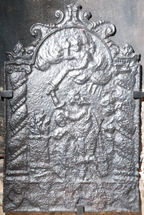
Description: Arched rectangular panel with a Salomonic column on each side enclosing a scene of Abraham about to sacrifice Isaac but being restrained by an angel; below, bottom panel of indeterminate decoration (due to corrosion); above each column a burning torch, with symmetrical floriate scrolls over the arch.
Notes: Given the biblical subject, this is probably of German manufacture although the Salomonic columns are more often encountered on English pastiches of the 'Dutch' style.
- Decoration tags:
- 'Dutch' (shape)
- fillet (edging)
- whole carved pattern
- pictorial
- biblical
- architectural
- humans
- objects
Manufactured: in the late-17th to early-18th century possibly in the Siegerland area of Germany.
Current location: Ashmolean Museum Broadway, 65 High Street, Broadway, Worcestershire, England.
(part of the Ashmolean Museum museum group)
- Attached to series:
- Old Testament & Apocrypha firebacks
- 'Dutch' Miscellaneous Firebacks
-
843
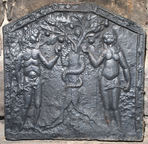
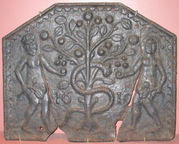
Description: Canted rectangular shape; double fillet edging (top and sides) with alternating roses and diamonds between the fillets; pictorial scene of Adam and Eve, both naked, taking fruit from the Tree of Knowledge, between them, around which is entwined the serpent.
Notes: Boldly sculpted, stylised figures; the serpent is shown with a human face.
Copies of this fireback are known.
- Decoration tags:
- rectangular with canted top corners (shape)
- double fillet (edging)
- whole carved pattern
- planklines
- pictorial
- biblical
- animals
- humans
- plants
Manufactured: in the late-16th to early-17th century possibly in the Lorraine area of France.
Current location: Old Manor House, Ilkley, West Yorkshire, England.
(part of the Bradford Museums and Art Galleries museum group)
- Attached to series:
- Old Testament & Apocrypha firebacks
- Adam & Eve firebacks
-
408
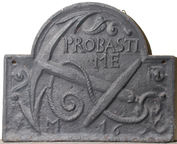
Description: Arched rectangular shape; cavetto moulded edge all round; holes pierced in top corners; a fouled anchor with one fluke resting on the base, a scroll below each top corner, foliage above the text, which is above the anchor; the initials either side of the lower fluke.
Notes: The inscription is a quotation from Psalms 139, v. 1: ‘Domine, probasti me et cognovisti me’ (Lord, thou hast searched me and known me).
Copies of this fireback are known.
Inscription: PROBASTI / ME / I M 16 5[0?]
- Decoration tags:
- rectangular with round arch (shape)
- cavetto (edging)
- whole carved pattern
- individual numbers
- planklines
- pictorial
- biblical
- text
- objects
Manufactured: in the mid-17th century possibly at Brede Furnace in the Weald area of England.
Current location: Anne of Cleves House, Southover High Street, Lewes, East Sussex, England.
Museum number: LH000.908 (part of the Sussex Archaeological Society museum group)
Citation: Dawson, C., 1903, 'Sussex Iron Work and Pottery', Sussex Archaeological Collections, 46, pp. 1-54.
-
413
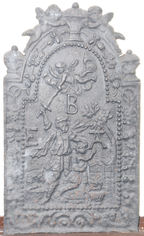
Description: Arched rectangular central panel with bead edging; standing figure of Abraham about to sacrifice a kneeling Isaac, Abraham's raised right hand holding a sword is retrained by an angel; behind Abraham is a ram; initials are placed in a triangle above behind and in front of the group; arched rectangular border with fillet edging and descending floral and fruit bunches on a ribbon, hanging from rings, foliate swirls at base; vases on rectangle shoulders and at top, between two putti
Notes: The initials appear to have been added subsequently.
Inscription: B / E A
- Decoration tags:
- 'Dutch' (shape)
- fillet (edging)
- whole carved pattern
- individual letters
- pictorial
- biblical
- text
- humans
Manufactured: in the mid- to late-17th century possibly in the Siegerland area of Germany.
Current location: Anne of Cleves House, Southover High Street, Lewes, East Sussex, England.
Museum number: LH000.946 (part of the Sussex Archaeological Society museum group)
-
481
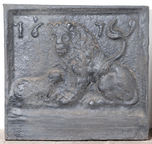
Description: Rectangular; cavetto edging all round; seated lion on right, its tail rising above its back and its head turned to face the viewer; a seated sheep on the left; at the bottom, a plain rectangular extension panel; date split across top.
Notes: Intended to represent the saying, ‘The lion shall lie down with the lamb’, a popular misquotation of Isaiah 11: 6.
- Decoration tags:
- rectangular (shape)
- cavetto (edging)
- whole carved pattern
- individual numbers
- extension panels
- pictorial
- biblical
- text
- animals
Manufactured: in 1679 in the Weald area of England.
Current location: in private hands, Maresfield, East Sussex, England.
- Attached to series:
- Small cavetto series
- Old Testament & Apocrypha firebacks
-
624
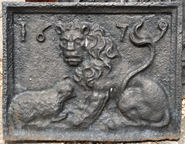
Description: Rectangular; cavetto edging all round; seated lion on right, its tail rising above its back and its head turned to face the viewer; a seated sheep on the left; date split across top.
Notes: Intended to represent the saying, ‘The lion shall lie down with the lamb’, a popular misquotation of Isaiah 11: 6.
Copies of this fireback are known.
Inscription: 1679
- Decoration tags:
- rectangular (shape)
- cavetto (edging)
- whole carved pattern
- individual numbers
- pictorial
- biblical
- text
- animals
Manufactured: in 1679 in the Weald area of England.
Current location: Mark Ripley Forge & Fireplaces, Northbridge Street, Robertsbridge, East Sussex, England.
- Attached to series:
- Small cavetto series
- Old Testament & Apocrypha firebacks
-
696
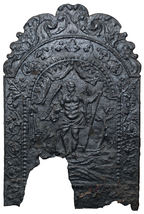 ? x ? mmImage subject to copyright
Description: Arched rectangular central panel with nutshell edging on a broad fillet; pictorial scene of a standing, winged male figure draped with a cloth, holding a staff in his left hand, above a ground, and with drapery over; arched rectangular border with fillet edging; alternating acanthus leaves with swirled tendrils; on top, two mirrored sea serpents.
Notes: Presumably intended to represent an angel; similarities in the design and execution of the pattern suggest the work of the pattern-maker identified as ‘N’ (q.v.); the missing segment had been filled with a piece from another fireback (removed in this photo).
Manufactured: in the early-18th century in England.
Current location: Nash's House, Stratford-upon-Avon, Warwickshire, England.
(part of the Shakespeare's Birthplace Trust museum group)
- Attached to series:
- British 'Dutch' style firebacks
- New Testament firebacks
-
697
Description: Canted rectangle; embattled, cavetto moulded edging; central tree with fruit and leaves, a snake, facing right, with a human face in profile entwined, in ‘S’ shape, around the trunk and lower branches; to the left, a naked, bearded male figure holding an apple in his left hand and a branch in his right for modesty; to the right a naked female figure with apple and branch also; the date split either side of the snake and tree trunk.
Notes: Similarities with an armorial in the date, numerals and edging suggest a common pattern-maker.
Copies of this fireback are known.
Inscription: 16 19
- Decoration tags:
- rectangular with canted top corners (shape)
- embattled cavetto (edging)
- whole carved pattern
- pictorial
- biblical
- text
- animals
- humans
- plants
Manufactured: in 1619 in England.
Current location: Stroud District Museum, Stroud, Gloucestershire, England.
Museum number: STGC 2371 (part of the Stroud Museum museum group)
- Attached to series:
- 1619 series
- Old Testament & Apocrypha firebacks
- Adam & Eve firebacks
-
94
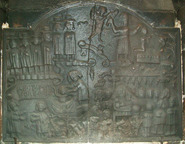
Description: Arched rectangular shape; ovolo moulded edge all round; the fireback is divided, unequally, into three Old Testament scenes. Centre left: Joseph is pushed into a well shaft by one of his brothers; above, six other brothers, wearing cloaks and sober puritan hats, look on; below, one of Joseph’s brothers presents Jacob with Joseph’s coat; Joseph utters the words, ‘Ah it is my son’s coat’ in a speech bubble above. Top right: Isaac kneels on a wooden pyre; behind him, Abraham holds Isaac’s head with his left hand, and raises a cleaver above his head with his right hand; above Abraham, an angel stays his hand; to the right of Isaac a ram stands beside a bush. Bottom right: beneath a pergola Jacob lies on his deathbed; his twelve sons gather round his bed.
Notes: The scenes depicted are derived from, respectively, Genesis 38: 20-24 & 32-33, Genesis 22: 6-13, and Genesis 49. The distinctive pictorial subject, the naïve figuration, as well as a number of minor features, such as the use of an ‘S’ scroll, draw parallels with the Lenard fireback, and the pattern may have been the work of the same wood carver, suggesting that it may share the same source. Another, probably contemporary, example is at Hampton Court.
Copies of this fireback are known.
Inscription: AH IT IS MY SONES COT [Genesis 38: 33]
- Decoration tags:
- rectangular with round arch (shape)
- cavetto (edging)
- whole carved pattern
- pictorial
- biblical
- text
- humans
Manufactured: in the early- to mid-17th century possibly at Brede Furnace in the Weald area of England.
Current location: Squerryes Court, Westerham, Kent, England.