-
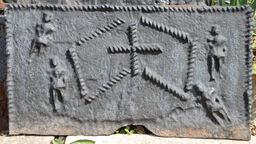
628
Description: Rectangular; twisted rope edging (top and sides); twisted rope length stamped eight times in a mirrored double rhombus pattern with a central cross; a crude human figurine stamped irregularly four times, two on each side of the rope design.
Notes: An uncharacteristically small fireback for its likely period.
- Decoration tags:
- rectangular (shape)
- rope (edging)
- simple stamps
- carved stamps
- apotropaic
- objects
Manufactured: in the mid- to late-16th century possibly in the Weald area of England.
Current location: Mark Ripley Forge & Fireplaces, Northbridge Street, Robertsbridge, East Sussex, England.
- Attached to series:
- Miscellaneous stamp firebacks
- Figurine firebacks
- Rope design firebacks
-
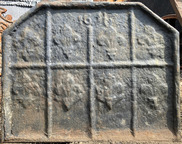
1265
Description: Canted rectangular shape; ?fillet edging; eight fleurs-de-lys (4 and 4) equally spaced and divided by vertical and horizontal fillets, the middle vertical over-stamped at the top with the numerals.
Notes: Only poor quality castings have been noted of this design, with different dates.
Inscription: 16[?]1
- Decoration tags:
- rectangular with canted top corners (shape)
- fillet (edging)
- whole carved pattern
- individual numbers
- heraldic
- text
Manufactured: in the early-17th century possibly in the Weald area of England.
Current location: Ripley Forge and Fireplaces, North Street, Robertsbridge, Salehurst, East Sussex, England.
- Attached to series:
- Miscellaneous stamp firebacks
-
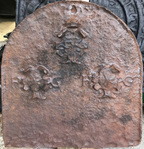
1306
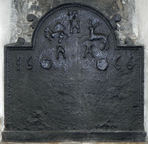
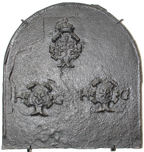
Description: Arch shaped; rope edging (top and sides); top centre, crowned cartouche with initials F S linked with twisted cord; below, two cartouches, each bearing a 7-pointed star, and each separating the paired initials HG.
Notes: The national origin of this fireback is a little uncertain. A variant of this fireback (no. 767) has slightly different proportions and relative positions of the stamps.
Inscription: F S / H G H G
- Decoration tags:
- rounded arched (shape)
- rope (edging)
- carved stamps
- heraldic
- text
Manufactured: in the 16th century possibly in the Lorraine area of France.
Current location: Ripley Forge & Fireplaces, Northbridge Street, Robertsbridge, Salehurst, East Sussex, England.
- Attached to series:
- Miscellaneous stamp firebacks
- Cord-linked initials firebacks
-
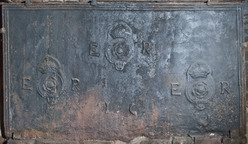
1147
Description: Rectangular shape; triple fillet moulded edging (top and sides); overpressed stamp, repeated three times (top centre and below, to left and right) of a crowned rose within a circular garter, each with the initials ER to left and right respectively; lower centre, the initials IC.
Notes: The rose and crown stamp bears striking similarities to rose and crown designs used to mark some bronze cannon of the Tudor period. The initials ER could refer to Edward VI (1547-53) or Elizabeth I (1558-1603). The initials IC most probably relate to the person for whom the fireback was made.
Inscription: ER [thrice] / I C
- Decoration tags:
- rectangular (shape)
- triple fillet (edging)
- carved stamps
- individual letters
- heraldic
- royal
- text
Manufactured: in the mid- to late-16th century in the Weald area of England.
Current location: in private hands, Rolvenden, Kent, England.
- Attached to series:
- Miscellaneous royal firebacks
- Miscellaneous stamp firebacks
-
974
Description: Arched rectangular shape on a plain plinth; scalloped cavetto-moulded edging (top and sides); initials in triad within arch; date split in top corners; unidentified stamp top centre; hound stamp above letter 'R', stag stamp above letter 'A'; annulet stamp repeated inside each half of the date; flat scrolled protuberance on each side of arch; smaller protuberance above each shoulder.
Notes: The initials are likely to be those of a husband and wife, possibly Robert Hawkesworth, who married Anne Bright in 1656. The protuberances are seen in different forms on few firebacks of the same period.
Inscription: RHA / 16 66
- Decoration tags:
- rectangular with round arch (shape)
- scalloped cavetto (edging)
- carved stamps
- individual letters
- individual numbers
- text
- animals
- objects
Manufactured: in 1666 in England.
Current location: Bishop's House, Norton Lees Lane, Sheffield, South Yorkshire, England.
(part of the Museums Sheffield museum group)
- Attached to series:
- Miscellaneous stamp firebacks
- Loop edged firebacks
-
903
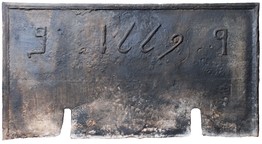
Description: Rectangular; ovolo-moulded edging (top and sides); date between split initials across upper half of plate; two notches cut away for insertion of firedogs.
Notes: The ‘6s’ appear to have been moulded from a type of jemmy.
Inscription: g 1669 P [reversed]
- Decoration tags:
- rectangular (shape)
- ovolo (edging)
- simple stamps
- carved stamps
- individual letters
- individual numbers
- text
- objects
Manufactured: in 1669 possibly in the Weald area of England.
Current location: George & Dragon Inn, Speldhurst Hill, Speldhurst, Kent, England.
- Attached to series:
- Andiron slot firebacks
- Metalware stamp firebacks
- Miscellaneous stamp firebacks
-
1167
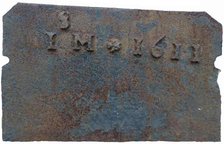
Description: Canted quasi-rectangular shape; no edging; parallel with top edge, initials in triad to left, separated from date by a small, ill-defined flower stamp.
Notes: The serifed character set is boldly impressed, although the S is indistinct, suggesting that some of the moulding sand may have filled the impression before casting. The indentations on each side were cut to accommodate mouldings. Tennants Auctioneers sale, Leyburn, North Yorkshire, 20 March 2015, lot 781.
Inscription: ISM [triad] 1611
- Decoration tags:
- rectangular with canted top corners (shape)
- none (edging)
- individual letters
- individual numbers
- text
- plants
Manufactured: in 1611 in England.
Current location: not known.
- Attached to series:
- Miscellaneous stamp firebacks
-
1103
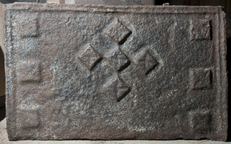
Description: Rectangular shape; double astragal edging (top and sides); arrangement of repeated square stamps with indented saltires: three down each side, five in a diamond pattern top centre.
Notes: The lines around the edge may well have been formed from impressing a straight edge of some sort.
- Decoration tags:
- rectangular (shape)
- double astragal (edging)
- carved stamps
- objects
Manufactured: in the mid- to late-16th century in the Weald area of England.
Current location: not known.
- Attached to series:
- Miscellaneous stamp firebacks
-
982
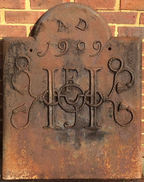
Description: Arched rectangular shape with demi-bullnose edging (top and sides); 'AD' curved in arch, with straight date below; central letter 'H' in the form of a horse's bit, with initials 'F' and 'J' respectively above and below; two lengths of rope with tasselled ends looped and tied symmetrically around the 'H' and on each side.
Notes: A finely moulded personal fireback with an equestrian connection.
Inscription: AD / 1909 / HFJ
- Decoration tags:
- rectangular with round arch (shape)
- demi-bullnose (edging)
- whole carved pattern
- monogram
- text
- objects
Manufactured: in 1909 in England.
Current location: not known.
- Attached to series:
- Personal firebacks
- Miscellaneous stamp firebacks
-
767
Description: Arch shaped; rope edging (top and sides); top centre, slightly over-pressed crowned cartouche with initials F S linked with twisted cord; below, two cartouches, each bearing a 7-pointed star, and each separating the paired initials HG.
Notes: The national origin of this fireback is a little uncertain. A variant of this fireback (no. 1306) has slightly different proportions and relative positions of the stamps.
Inscription: F S / H G H G
- Decoration tags:
- rounded arched (shape)
- rope (edging)
- carved stamps
- heraldic
- text
Manufactured: in the 16th century possibly in the Lorraine area of France.
Current location: Victoria & Albert Museum, Cromwell Road, Kensington & Chelsea, Greater London, England.
Museum number: 888.1901 (part of the Victoria & Albert Museum museum group)
- Attached to series:
- Miscellaneous stamp firebacks
- Cord-linked initials firebacks