-
440
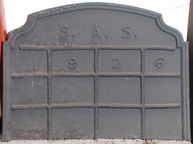
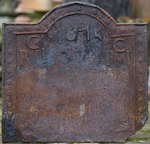
Description: Rectangle joined to low arch with cyma recta curves; ovolo-moulded edging (top and sides); grid of twelve rectangles (4 columns of 3) with twisted rope borders; initials in arch, date in top line of rectangles.
Notes: A fireback cast specially to mark the 60th anniversary of the Sussex Archaeological Society, and donated to the society by Mr John Every.
Inscription: S.A.S. / 1926
- Decoration tags:
- rectangular with canted top corners and round arch (shape)
- ovolo (edging)
- simple stamps
- individual letters
- individual numbers
- text
- objects
Manufactured: in 1926 at Phoenix Foundry, Lewes in the Weald area of England.
Current location: Anne of Cleves House, Southover High Street, Lewes, East Sussex, England.
Museum number: 1944.24.093 (part of the Sussex Archaeological Society museum group)
- Attached to series:
- Miscellaneous stamp firebacks
-
453
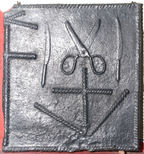
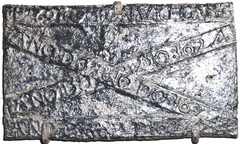
Description: Rectangular; twisted rope edging; irregular arrangement of three rope lengths at top left; rope cross above ‘V’ at middle bottom; impression of a pair of scissors between two impressions of a domestic table knife.
Notes: The knife is early-17th century in date or perhaps a bit earlier, just into Elizabeth I’s reign. The pommels date them from around this time and the long and narrow blades are right for the end of Elizabeth/early James I. The irregular rope lengths suggest this is probably part of a larger fireback.
- Decoration tags:
- rectangular (shape)
- rope (edging)
- simple stamps
- apotropaic
- objects
Manufactured: in the late-16th to early-17th century in the Weald area of England.
Current location: Anne of Cleves House, Southover High Street, Lewes, East Sussex, England.
Museum number: LH000.939 (part of the Sussex Archaeological Society museum group)
Citation: Moore, S., 1999, Cutlery for the Table (Sheffield, The Hallamshire Press).
-
964
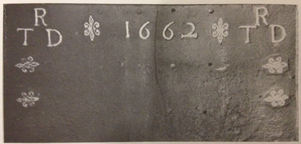
Description: Rectangular; Twisted rope edging (top and sides); top centre, date; initials in triad in top corners; a double fleurs-de-lys between date and each set of initials, and two rotated down each side of the plate.
Notes: Formerly at a cottage in Bradford's Lane, Newent, Gloucestershire. Illustration from Bick 1987.
Inscription: TRD / 1662 / TRD
- Decoration tags:
- rectangular (shape)
- rope (edging)
- carved stamps
- individual letters
- individual numbers
- heraldic
- text
Manufactured: in 1662 in the Forest of Dean area of England.
Current location: The Glasshouse Inn, May Hill, Longhope, Gloucestershire, England.
Citation: Bick, D. E., 1987, The Mines of Newent and Ross, (Newent, The Pound House), p. 35.
- Attached to series:
- Miscellaneous stamp firebacks
- Fleur-de-lys firebacks
-
864
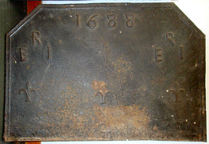
Description: Canted rectangle; double fillet edging (top and sides); top centre, date; initials in triad, repeated on each side, with a fleur-de-lys between; three fleurs-de-lys evenly spaced below initial groups.
Notes: The initials are believed to be those of Edward Robinson, a bookseller, and his wife of 16 King Street, Ludlow, where the fireback was discovered.
Inscription: 1688 / ERI ERI [both triads]
- Decoration tags:
- rectangular with canted top corners (shape)
- double fillet (edging)
- carved stamps
- individual letters
- individual numbers
- heraldic
- text
Manufactured: in 1688 possibly in the Shropshire area of England.
Current location: Ludlow Museum. The Buttercross, Ludlow, Shropshire, England.
(part of the Ludlow Museum museum group)
Citation: Moran, M., 2003, Vernacular Buildings of Shropshire (Almeley, Logaston Press).
- Attached to series:
- Ludlow series
- Miscellaneous stamp firebacks
-
484
Description: Fragment (right side only); rectangular; twisted rope edging (top and sides); concentrically grooved disc repeated four times in a square arrangement, with a rope cross between (probably mirrored on the missing half).
Notes: It has not been established from what the circular disc stamp has been derived.
- Decoration tags:
- rectangular (shape)
- rope (edging)
- simple stamps
- apotropaic
- objects
Manufactured: in the mid- to late-16th century in the Weald area of England.
Current location: in private hands, Hadlow Down, East Sussex, England.
- Attached to series:
- Miscellaneous stamp firebacks
-
490
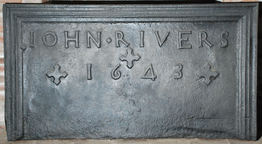
Description: Rectangular; multiple moulding on top and sides; inscription below moulding at top; three pointed crosses, one between inscription and date, one each side of date.
Notes: Purchased by J. H. Every in a sale at Groombridge Place, Kent in 1919. John Rivers was the husband of Isabella Packer, whose father Sir Thomas Packer, owned Groombridge Place. Bequeathed to the Sussex Archaeological Society in 1944.
Inscription: IOHN·RIVERS / 1643
- Decoration tags:
- rectangular (shape)
- complex, furniture-derived (edging)
- carved stamps
- individual letters
- individual numbers
- text
Manufactured: in 1643 in the Weald area of England.
Current location: Michelham Priory, Arlington, East Sussex, England.
Museum number: 1944.24.431 (part of the Sussex Archaeological Society museum group)
Citation: Hughes, G. B., 21 Apr 1955, 'Old English Firebacks', Country Life, 117, pp. 1056-60.
Citation: Hughes, G. B., May 1940, 'Old English Firebacks', Apollo, 31, 185, pp. 117-120.
- Attached to series:
- Personal firebacks
- Miscellaneous stamp firebacks
-
846
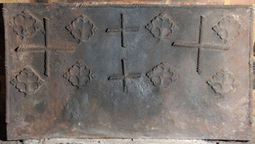
Description: Rectangular; twisted rope edging (top and sides); floriated trefoil stamp repeated in two rows of four in the upper two-thirds of the plate; between the middle four stamps, two small crosses of twisted rope, one above the other; between each outer group of four stamps a large cross of twisted rope.
Notes: The floriated trefoils may have been derived from a metal ornament.
- Decoration tags:
- rectangular (shape)
- rope (edging)
- simple stamps
- apotropaic
- objects
Manufactured: in the mid- to late-16th century in the Weald area of England.
Current location: in private hands, Barcombe, East Sussex, England.
- Attached to series:
- Miscellaneous stamp firebacks
- Metalware stamp firebacks
-
1293
Description: Rectangular shape; no edging; raised fillets along the top and bottom, and diagonally in both directions between them, upon each of which are embossed ANO DO ANO DO 1624, although the spacing differs on each fillet, the certainty of this repetition is concealed in some parts by indistinct casting, and in at least one instance a colon is inserted before the date. The inscription on the top edge is inverted. Behind the intersection of the two diagonal fillets is what might be a figure holding a linear object over its right shoulder.
Notes: Clearly intended to be commemorative although for what is not known. Its small dimensions indicate that could have been intended as a plaque rather than a fireback, although the indistinct inscription on the bottom edge could have resulted from corrosion by fire.
Inscription: ANO DO ANO DO [:] 1624 [x4]
- Decoration tags:
- rectangular (shape)
- none (edging)
- carved stamps
- individual letters
- individual numbers
- text
- humans
Manufactured: in 1624 possibly in the Weald area of England.
Current location: Parham House, Parham, West Sussex, England.
- Attached to series:
- Miscellaneous stamp firebacks
-
559
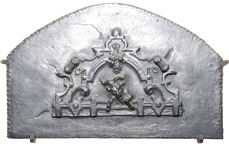
Description: Arched rectangle with crude scalloping around the edges; elaborate, symmetrical strapwork frame with scrolls top left and right, and below, a bunch of grapes hanging from the top, and the head and forelegs of a goat climbing through; inside each upper scroll, a small astragel edged oval.
Notes: This strap-work stamp, characteristic of late-16th and early-17th century architectural drawings and engravings and derivative of the work of artists like Hans Vredeman de Vries, was probably derived from interior carving on a fireplace overmantel or similar. The goat and bunch of grapes suggest an allusion to Bacchus. Marks round the edge of this fireback suggest that it may have been reduced from a larger size. Mitford collection, Petworth House.
- Decoration tags:
- rounded arched (shape)
- scalloped (edging)
- simple stamps
- architectural
- animals
- plants
- objects
Manufactured: in the late-16th to early-17th century possibly in the Weald area of England.
Current location: Petworth House, Petworth, West Sussex, England.
Museum number: NT/PET/M/53 (part of the National Trust museum group)
- Attached to series:
- Miscellaneous stamp firebacks
-
978
Description: Arched rectangular shape; twisted rope edging with inaccurately parallel arched rectangular fillet inside, enclosing repeated small fleur-de-lys stamps along sides and top; initials in triad in each of the internal top corners; date in arch.
Notes: The initials probably relate to a couple whose surname begins with C, the husband's forename initial being R and the wife's I (or J).
Inscription: RCI/ 1675 / RCI
- Decoration tags:
- rectangular with round arch (shape)
- rope (edging)
- simple stamps
- carved stamps
- individual letters
- individual numbers
- heraldic
- text
Manufactured: in 1675 in England.
Current location: not known.
- Attached to series:
- Miscellaneous stamp firebacks