-
602
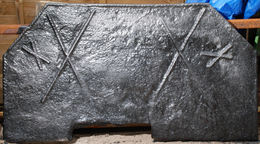
Description: Canted rectangle; twisted rope edging (top and sides); roughly symmetrical arrangement of two large saltires formed of twisted rope inside and below the top corners, with two small saltires, also of rope, between the large ones and the lower ends of the canting.
Notes: The simple arrangement, while likely to be early, is difficult to date with any precision. Christie's Masters and Makers Sale, South Kensington, 30 Nov 2010, lot 532 (£500).
- Decoration tags:
- rectangular with canted top corners (shape)
- rope (edging)
- simple stamps
- apotropaic
- objects
Manufactured: in the 16th century possibly in the Weald area of England.
Current location: not known.
- Attached to series:
- Rope design firebacks
-
615
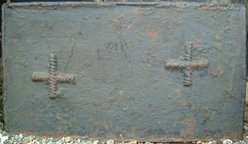
Description: Rectangular; twisted rope edging (top and sides); two irregularly spaced crosses formed of short, thick twisted lengths of rope.
Notes: The crosses may have been formed by twisting thinner rope around a short length of dowel, and are likely to have Christian significance.
- Decoration tags:
- rectangular (shape)
- rope (edging)
- simple stamps
- apotropaic
- objects
Manufactured: in the 16th century possibly in the Weald area of England.
Current location: Mark Ripley Forge & Fireplaces, Northbridge Street, Robertsbridge, East Sussex, England.
- Attached to series:
- Rope design firebacks
-
628
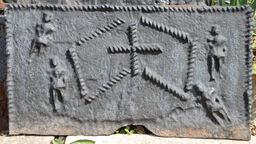
Description: Rectangular; twisted rope edging (top and sides); twisted rope length stamped eight times in a mirrored double rhombus pattern with a central cross; a crude human figurine stamped irregularly four times, two on each side of the rope design.
Notes: An uncharacteristically small fireback for its likely period.
- Decoration tags:
- rectangular (shape)
- rope (edging)
- simple stamps
- carved stamps
- apotropaic
- objects
Manufactured: in the mid- to late-16th century possibly in the Weald area of England.
Current location: Mark Ripley Forge & Fireplaces, Northbridge Street, Robertsbridge, East Sussex, England.
- Attached to series:
- Miscellaneous stamp firebacks
- Figurine firebacks
- Rope design firebacks
-
642
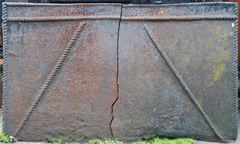
Description: Rectangular; twisted rope edging (top and sides); length of twisted rope parallel with, and equal to, top edge; length of rope, equal to side edge, repeated twice slanting from near top middle to bottom corners.
Notes: Very simple design using only two lengths of rope.
- Decoration tags:
- rectangular (shape)
- rope (edging)
- simple stamps
- objects
Manufactured: in the 16th century in the Weald area of England.
Current location: Mark Ripley Forge & Fireplaces, Northbridge Street, Robertsbridge, East Sussex, England.
- Attached to series:
- Rope design firebacks
-
683
Description: Rectangular; twisted rope edging (top and sides); top left and right, Tudor rose surmounted by a crown (separate stamps); right of centre, irregular pentagram formed of a repeated length of twisted rope enclosing a Tudor rose; on either side of top point of pentagram, a triple-loop stamp irregularly spaced.
Notes: The pentagram has both Christian and occult symbolism. The fleur and the rose and crown have been seen on another fireback.
Copies of this fireback are known.
- Decoration tags:
- rectangular (shape)
- rope (edging)
- simple stamps
- carved stamps
- heraldic
- apotropaic
- objects
Manufactured: in the late-16th century possibly in the Weald area of England.
Current location: in private hands, Sevenoaks, Kent, England.
- Attached to series:
- Rope design firebacks
- Looped fleur series
- Fleur-de-lys firebacks
-
892
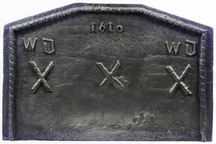
Description: Canted rectangular shape; plain edging with inset ?leather strap twisted round dowel (top and sides); top centre, date probably in stamped numerals; twisted leather strap saltire repeated three times across middle of plate; pair of stamped initials, formed of a Roman 'W' and a Gothic 'd', above each outer saltire.
Notes: Sotheby's sale London 27 November 2006, lot 324; formerly at Brunger, Kent (near Tenterden).
Inscription: 1610 / WD WD
- Decoration tags:
- rectangular with canted top corners (shape)
- none (edging)
- simple stamps
- individual letters
- individual numbers
- apotropaic
- text
- objects
Manufactured: in 1610 in England.
Current location: not known.
- Attached to series:
- Date & initials firebacks
- Rope design firebacks
-
958
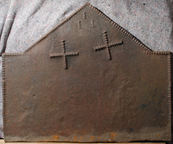
Description: Rectangle with triangular arch; twisted rope edging (top and sides); centre top, initials in triad, E above; two twisted rope crosses irregularly spaced below initials.
Notes: The initials, probably of a husband and wife, show minimal extension in the horizontal, although the 'I' has a stud halfway; the crosses almost certainly have an apotropaic purpose; the depth of the casting varies between the top, where it is thickest, and the bottom. Bellman's auction, Wisborough Green, 13 Oct 2021, lot 589 (£420).
Inscription: IEL [triad]
- Decoration tags:
- rectangular with triangular arch (shape)
- rope (edging)
- simple stamps
- carved stamps
- apotropaic
- text
Manufactured: in the late-16th to early-17th century in England.
Current location: not known.
- Attached to series:
- Rope design firebacks
-
1202
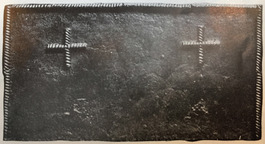 ? x ? mm
Description: Rectangular shape; twisted rope edging (top and sides); upper centre, two evenly-spaced, medium-sized twisted rope crosses.
Notes: Formerly (1950) at Maidstone, Kent. Illustration from Schubert, 1950.
- Decoration tags:
- rectangular (shape)
- rope (edging)
- simple stamps
- apotropaic
- objects
Manufactured: in the late-16th to early-17th century possibly in the Weald area of England.
Current location: not known.
Citation: Schubert, H. R., Aug 1950, ‘Old English Iron Firebacks’, Steel News, 2, 2, p. 8.
- Attached to series:
- Rope design firebacks
-
725
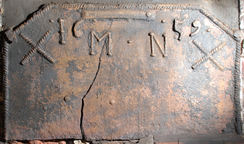
Description: Canted rectangle with twisted rope edging; uneven, individually stamped letters and numerals, the initials separating the two parts of the date, which are raised slightly higher; dots are stamped on each side of each half of the date and between the initials; a twisted rope saltire at each end of the inscription.
Notes: The distinctive form of the number '5' has been seen on other firebacks indicating a common source. The plate above the inscription is a repair, as are the rivets either side of the crack.
Inscription: ·16· M · N ·59·
- Decoration tags:
- rectangular with canted top corners (shape)
- rope (edging)
- simple stamps
- carved stamps
- individual letters
- individual numbers
- apotropaic
- text
- objects
Manufactured: in 1659 in the Weald area of England.
Current location: in private hands, Upper Beeding, West Sussex, England.
- Attached to series:
- Rope design firebacks
- Shortened '5' series
-
728
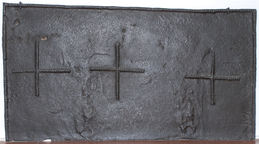
Description: Quasi-rectangular; twisted rope edging (top and sides); across the centre, three crosses formed of the repeated stamping of a length of twisted rope.
Notes: The edging appears to have been formed of the same length of rope. The crosses almost certainly have Christian significance.
- Decoration tags:
- rectangular (shape)
- simple stamps
- apotropaic
- objects
Manufactured: in the 16th century possibly in the Weald area of England.
Current location: Victoria & Albert Museum, Cromwell Road, Kensington & Chelsea, Greater London, England.
Museum number: 887.1901 (part of the Victoria & Albert Museum museum group)
- Attached to series:
- Rope design firebacks