-
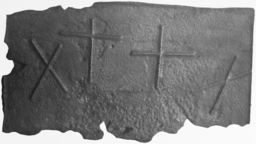
441
Description: Sub-rectangular; edged with a repeated length of helically-turned dowel (top and sides); apparently random arrangement of same piece of dowel repeated ten times, including a saltire and cross.
Notes: Apart from the Christian significance of the cross, the other arrangements of rope lengths may be apotropaic in their purpose, the double V being a possible invocation of the Virgin. The blemishes at the base are caused by the casting sand being disturbed by the pouring of the metal.
- Decoration tags:
- rectangular (shape)
- rope (edging)
- simple stamps
- apotropaic
- objects
Manufactured: in the 16th century in the Weald area of England.
Current location: Anne of Cleves House, Southover High Street, Lewes, East Sussex, England.
Museum number: LH000.799 (part of the Sussex Archaeological Society museum group)
Citation: Dawson, C., 1903, 'Sussex Iron Work and Pottery', Sussex Archaeological Collections, 46, pp. 1-54.
Citation: Gardner, J. S., 1898, 'Iron Casting in the Weald', Archaeologia, 56, 1, pp. 133-164.
- Attached to series:
- Rope design firebacks
-
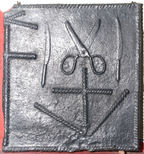
453
Description: Rectangular; twisted rope edging; irregular arrangement of three rope lengths at top left; rope cross above ‘V’ at middle bottom; impression of a pair of scissors between two impressions of a domestic table knife.
Notes: The knife is early-17th century in date or perhaps a bit earlier, just into Elizabeth I’s reign. The pommels date them from around this time and the long and narrow blades are right for the end of Elizabeth/early James I. The irregular rope lengths suggest this is probably part of a larger fireback.
- Decoration tags:
- rectangular (shape)
- rope (edging)
- simple stamps
- apotropaic
- objects
Manufactured: in the late-16th to early-17th century in the Weald area of England.
Current location: Anne of Cleves House, Southover High Street, Lewes, East Sussex, England.
Museum number: LH000.939 (part of the Sussex Archaeological Society museum group)
Citation: Moore, S., 1999, Cutlery for the Table (Sheffield, The Hallamshire Press).
-
455
Description: Canted rectangle; twisted rope edging (top and sides); a rope saltire in each top corner.
Notes: The edging is made from the same, short lengths of rope as the saltires.
- Decoration tags:
- rectangular with canted top corners (shape)
- rope (edging)
- simple stamps
- apotropaic
- objects
Manufactured: in the 16th century in the Weald area of England.
Current location: Hall Place, Bexley, Kent, England.
Museum number: 1944.24.049 (part of the Sussex Archaeological Society museum group)
- Attached to series:
- Rope design firebacks
-
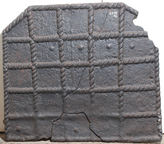
461
Description: Canted rectangle; twisted rope edging; irregularly spaced, 5 x 5 rope grid; damage to top right corner.
Notes: A 5 x 3 variant is also known.
- Decoration tags:
- rectangular with canted top corners (shape)
- rope (edging)
- simple stamps
- objects
Manufactured: in the mid- to late-16th century in the Weald area of England.
Current location: Anne of Cleves House, Southover High Street, Lewes, East Sussex, England.
Museum number: 1944.24.046 (part of the Sussex Archaeological Society museum group)
- Attached to series:
- Rope design firebacks
-
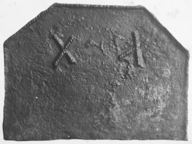
1048
Description: Canted rectangular shape; twisted rope edging (top and sides); two saltires formed of twisted rope irregularly arranged.
Notes: The small size suggests a 17th rather than a 16th century date. Formerly part of the J. H. Every collection.
- Decoration tags:
- rectangular with canted top corners (shape)
- rope (edging)
- simple stamps
- apotropaic
- objects
Manufactured: in the late-16th to early-17th century in the Weald area of England.
Current location: Anne of Cleves House, Southover High Street, Lewes, East Sussex, England.
Museum number: LH000.919 (part of the Sussex Archaeological Society museum group)
- Attached to series:
- Rope design firebacks
-
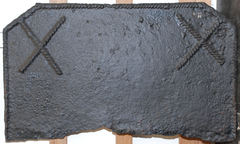
1046
Description: Sub-rectangular shape; twisted rope edging (top and sides); two crosses between two saltires, all formed of straight lengths of twisted rope and irregularly arranged.
Notes: A poorly cast, and probably early, fireback. Formerly part of the J. H. Every collection.
- Decoration tags:
- rectangular (shape)
- rope (edging)
- simple stamps
- apotropaic
- objects
Manufactured: in the early- to mid-16th century in the Weald area of England.
Current location: Anne of Cleves House, Southover High Street, Lewes, East Sussex, England.
Museum number: LH000.917 (part of the Sussex Archaeological Society museum group)
- Attached to series:
- Rope design firebacks
-
946
Description: Canted rectangle; twisted rope edging (top and sides); initials in triad to left of date (7 reversed), all between two twisted rope saltires.
Notes: The distinctive form of the number '5' has been seen on other firebacks indicating a common source.
Inscription: RAE [triad] 1657
- Decoration tags:
- rectangular with canted top corners (shape)
- rope (edging)
- simple stamps
- individual letters
- individual numbers
- apotropaic
- text
- objects
Manufactured: in 1657 in the Weald area of England.
Current location: in private hands, Lindfield, West Sussex, England.
- Attached to series:
- Rope design firebacks
- Shortened '5' series
-
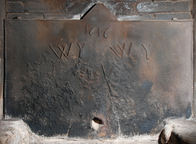
471
Description: Rectangular with small central triangle on top; twisted rope edging (top and sides) and across base of triangle; top centre, date, centrally positioned above the separated pairs of initials, WY; below and right of centre, rope saltire; bottom centre, a hole apparently puncturing the plate from behind.
Notes: The initials are those of William Yalden (1580-1659), an ironmaster who was active in north-west Sussex and south-west Surrey where this and other similar firebacks have been noted. The saltire is likely to have had an apotropaic purpose. Although undoubtedly connected with the builder of the house wherein it rests, the fireback pre-dates the building, which was erected in 1640.
Inscription: 1616 / WY WY
- Decoration tags:
- rectangular with triangular arch (shape)
- rope (edging)
- simple stamps
- individual letters
- individual numbers
- apotropaic
- text
Manufactured: in 1616 in the Weald area of England.
Current location: in private hands, Lodsworth, West Sussex, England.
- Attached to series:
- William Yalden series
- Rope design firebacks
-
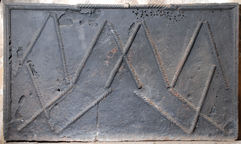
485
Description: Rectangular; ovolo moulded edging (top and sides), except for middle section on top, where twisted rope is used; quasi-symmetrical arrangement of twisted rope lengths in two rows of alternate diagonals, crossing in the middle on the top row, and crossing on the outside on the bottom.
Notes: The section of rope edging on the top suggests that an arch had been removed from the base pattern board. The arrangement of rope lengths may have apotropaic significance, the double 'v' alluding to the Virgin Mary.
- Decoration tags:
- rectangular (shape)
- ovolo (edging)
- simple stamps
- apotropaic
- objects
Manufactured: in the mid- to late-16th century in the Weald area of England.
Current location: in private hands, Mayfield, East Sussex, England.
- Attached to series:
- Rope design firebacks
-
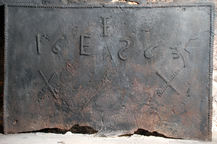
505
Description: Rectangular; twisted rope edging (top and sides); inscription (‘S’ reversed) across upper middle of plate, with superscripted central ‘I’ (crossed) ; below each part of the date is a twisted rope saltire (145mm lengths).
Notes: A personal fireback, made to order; a similar commission by Giles Moore, Rector of Horsted Keynes, Sussex, in 1657, cost 13 shillings.
Inscription: I / 16 E S 63
- Decoration tags:
- rectangular (shape)
- rope (edging)
- simple stamps
- individual letters
- individual numbers
- apotropaic
- text
- objects
Manufactured: in 1663 in the Weald area of England.
Current location: in private hands, Ockley, Surrey, England.
- Attached to series:
- Date & initials firebacks
- Rope design firebacks