-
1227
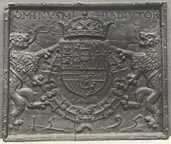
Description: Rectangular shape with ovolo-moulded edging; within the collar of the Order of the Golden Fleece, a central shield of the arms of Spain: quarterly Castile and Leon, Aragon and Aragon-Sicily, with an escutcheon of Portugal; in base Austria, Burgundy ancient, Burgundy modern and Brabant with an escutcheon of Flanders impaling Tyrol; above, a crown; supporters: two golden lions rampant; below the shield, the date, 1595; above the crown, the inscription: Dominus mihi adiutor (the Lord is my helper).
Notes: The arms of King Philip II of Spain following the unification with Portugal, as used in the Spanish Netherlands. Part of the bequest to the Victoria and Albert Museum by Lieut. Colonel G. B. Croft-Lyons in 1926.
Copies of this fireback are known.
Inscription: DOMINVS MIHI ADIVTOR
Arms: King Philip II of Spain (Spanish Netherlands)
- Decoration tags:
- rectangular (shape)
- ovolo (edging)
- whole carved pattern
- heraldic
- armorial
- royal
- text
- animals
Manufactured: in 1595 possibly in the Ardennes area of Belgium.
Current location: Science Museum, Exhibition Road, Kensington & Chelsea, London, England.
Museum number: M.624.1926 (part of the Victoria & Albert Museum museum group)
- Attached to series:
- Foreign armorial firebacks
-
1326
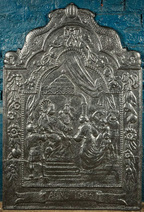
Description: Arched rectangular central panel with additional arch above; bead edging; pictorial scene of Solomon, seated on a scallop-backed, canopied throne, greeting the Queen of Sheba, with other figures in attendance; identical shaped border with fillet edging; a vase on top with descending vines with leaves and fruit; at the sides, festoons of flowers suspended from ribbon bows; at the bottom, a symmetrical folded motto scroll with 'ANNO 1603' in the centre; on top, a Roman Imperial crown between a descending serpent on each side.
Notes: The date is spurious, this style of fireback not being made until after 1650. Several contemporary paintings are of similar scenes; this design may have been derived from a Dutch engraving of a drawing by an anonymous French artist after Maarten van Heemskerck. The same central panel can be seen on no. 1289.
Inscription: ANNO 1603
Manufactured: in the mid- to late-17th century in the Siegerland area of Germany.
Current location: not known.