It is well established that many early firebacks are embellished with marks and symbols that have an apotropaic, or evil-averting, purpose. The chimney was the one opening in the house that could not be closed to keep out malevolent spirits, witches or other manifestations of evil. You could close the doors and shutter the windows but having a fire that needed to be kept burning for heating and food preparation meant that the smoke had to be allowed to escape. And while a chimney allows the smoke to get out it also is the means for letting something else in. Accidents caused by fires also fuelled superstitions that malignant forces might have been the cause. Sparks setting light to clothing, scalding liquids resulting in injuries and falling soot ruining food could all be attributed to outside forces if an unkind word or threat had been directed at someone living in the house.
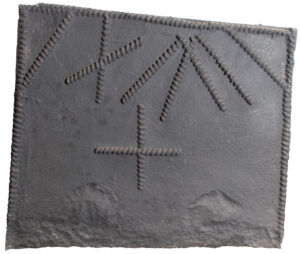
So householders could resort to invocations of Jesus or the Virgin Mary to seek protection, and crosses formed of rope wound around wooden dowel or metal rods could easily be imprinted into the sand from which the mould for a fireback was to be prepared. Double V shapes or Ms could be similarly arranged, just as scratched marks could on mantel beams above the fireplace. Despite the efforts of Reginald Scot, whose The discoverie of witchcraft of 1584 set out to debunk many superstitious beliefs, they persisted, and most notably after the Reformation, and were kept alive by no less a person than King James VI and I, whose Daemonologie in 1597 encouraged belief in the supernatural and its dangers.
Iron itself was regarded as a protection against the Devil, so metal objects hung by the door or an iron slab used as a threshold were thought to be effective; the fireback with apotropaic decoration could be regarded as doubly so, and the addition of a cross or initials of the Virgin added to a fireback otherwise adorned with a coat of arms or inscription was regarded as some assurance of protection.
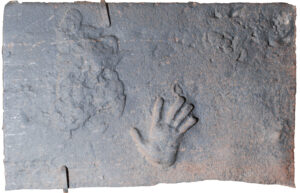
A lesser known protective device was the hand print. Five firebacks with a hand print have been noted in Britain, four with other forms of decoration and one with just the print alone. In all instances a left hand has been used, and this in itself has apotropaic significance. The majority of humans are right handed so that hand is traditionally the hand of welcome and authoritative action. In the Bible, the favoured sat on the right hand of God. It is the hand that wields the pen or the sword, that greets people, while the left hand is defensive; it holds the shield or bars entry. Thus the left hand would be perceived as more appropriate for denying access to whatever was intent on doing harm in the home.
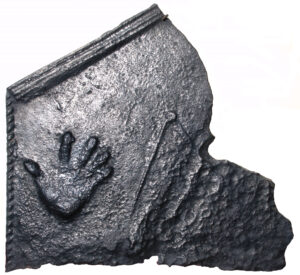
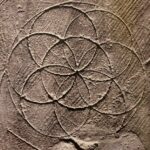
The solitary hand print is on a fireback in a cottage at Groombridge in Kent. It is a crudely executed fireback with a large excrescence caused by the molten iron, poured from a ladle, disturbing the casting sand and forming a hollow, which translated into a mound in relief. The surviving part of a broken fireback in Anne of Cleves House in Lewes may have had another hand print on the right side if the decoration had been symmetrical. A pair of dividers may indicate that the fireback had been intended for the home of a builder, and perhaps the print is of the builder’s hand. There are circular apotropaic designs seen on wood and stonework that would have been made with dividers. The mixture of twisted rope and wooden moulding for the frame of the fireback is unusual.
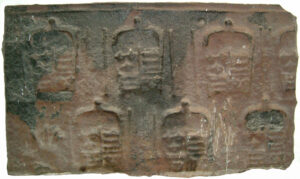
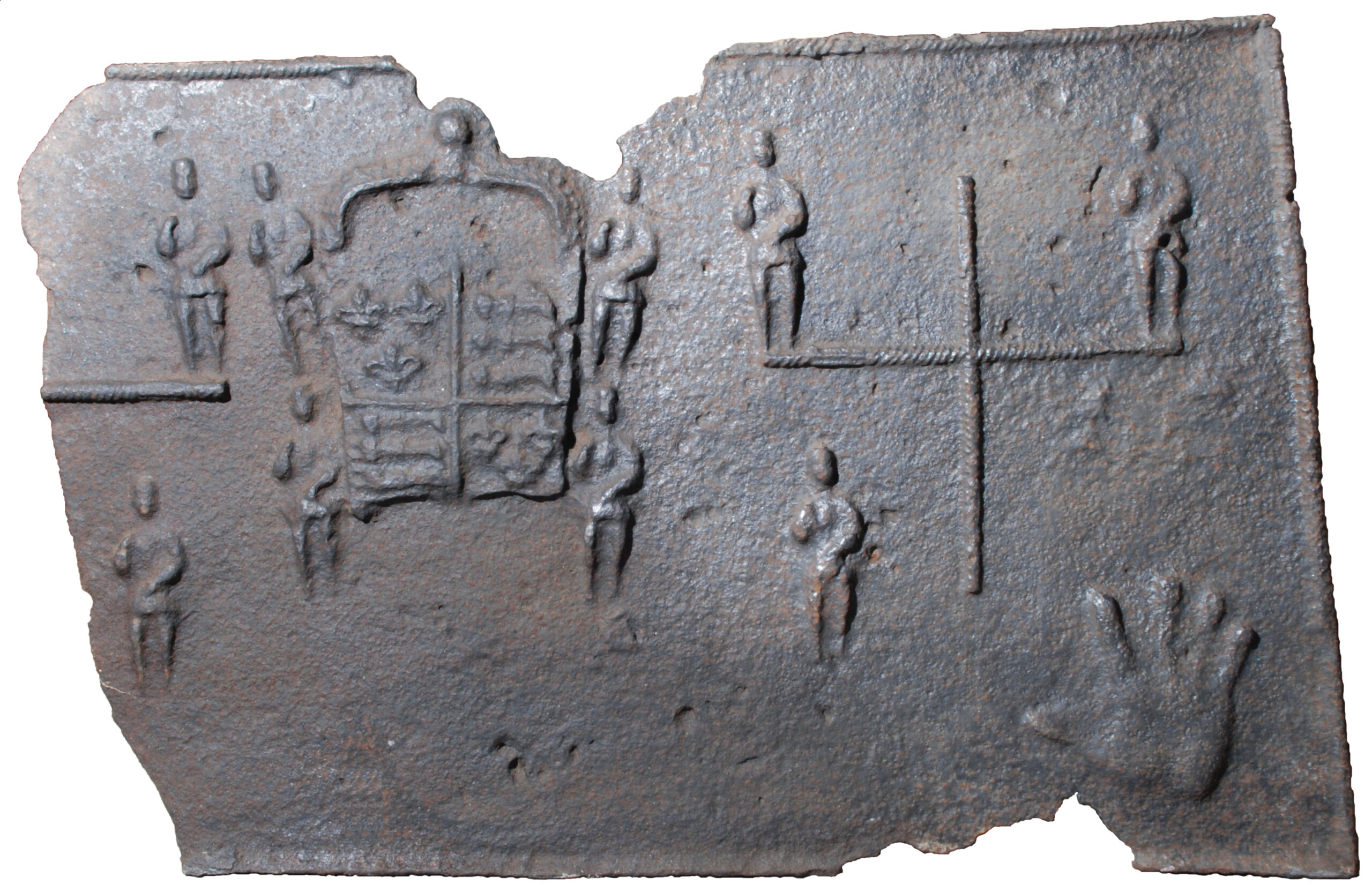
Two firebacks decorated with the same rudimentary Tudor shield and crown have hand prints in opposite corners, which suggests that on each the prints were repeated in both of the bottom corners. Both would have been cast at the same iron furnace, and the crown and shield stamp would have been part of a stock of decorative items for this purpose. Also, the hand on each may have been the same hand, possibly that of the founder. The one from Etchingham clearly has a short section missing on the right side (the right-most shield has been truncated) and has been severely corroded by fire, while the casting from Rolvenden, which was slightly trapezoidal in shape is decorated with a repeated simple figurine, possibly a child’s toy. The twisted crosses – another protective symbol – each has a flattened section which suggests that they could have been made from wire twisted around a rod and then hammered to preserve the shape.
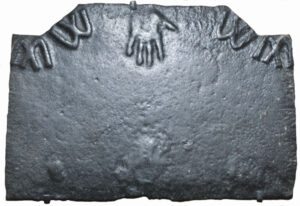
The final one, from a house in Crowborough, Sussex, has the hand between two arrangements of double Vs and Ms. Their position at the top of the fireback with the hand inverted might be interpreted as an attempt to confront a malevolent spirit attempting to enter the house from above.
A more detailed consideration of the use of apotropaic symbols on firebacks can be read HERE (40Mb).