-
1147
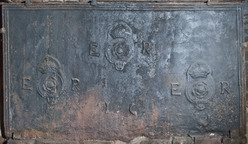
Description: Rectangular shape; triple fillet moulded edging (top and sides); overpressed stamp, repeated three times (top centre and below, to left and right) of a crowned rose within a circular garter, each with the initials ER to left and right respectively; lower centre, the initials IC.
Notes: The rose and crown stamp bears striking similarities to rose and crown designs used to mark some bronze cannon of the Tudor period. The initials ER could refer to Edward VI (1547-53) or Elizabeth I (1558-1603). The initials IC most probably relate to the person for whom the fireback was made.
Inscription: ER [thrice] / I C
- Decoration tags:
- rectangular (shape)
- triple fillet (edging)
- carved stamps
- individual letters
- heraldic
- royal
- text
Manufactured: in the mid- to late-16th century in the Weald area of England.
Current location: in private hands, Rolvenden, Kent, England.
- Attached to series:
- Miscellaneous royal firebacks
- Miscellaneous stamp firebacks
-
806
Description: Rectangle with curved shoulders and low arch joined with concave curves; fillet and ogee moulded edging; central Tudor royal shield surrounded by garter, with crown above and lion and dragon supporters; royal initials either side of crown; lower right, inclined rectangular stamp of a dog; extended variant.
Notes: On clearer examples the garter motto has ‘EQVI’ instead of ‘HONI’, making it meaningless; possibly ‘EQVI’ was a mis-transcription of ‘HONI’; the crown is distinctly continental in form; a much-copied fireback.
Copies of this fireback are known.
Inscription: E R [Garter motto illegible]
Arms: Tudor royal - Elizabeth I
- Decoration tags:
- rectangular with round arch (shape)
- fillet and ogee (edging)
- carved stamps
- individual letters
- armorial
- royal
- text
- animals
Manufactured: in the mid- to late-16th century possibly in the Forest of Dean area of England.
Current location: in private hands, Salfords, Surrey, England.
-
368
Description: Canted rectangle; twisted rope edging (top and sides); Tudor royal shield within a Garter, supported by lion and dragon stamps, a crown above, between separate ‘E’ and ‘R’ stamps; fleur de lys stamp irregularly repeated four times below right and to left of lion.
Notes: The shield, garter and crown stamps appear on many firebacks, usually with left-facing lion and greyhound supporters; the presence of the shield and crown indicate the fireback is derived from the same source; the supporter stamps, which are over-pressed, are clearly derived from blocks intended to represent standing models. Formerly at Kirby Frith Hall, Leicestershire. Illustration from Schubert, 1957, pl. 7.
Inscription: HONE SOYT qVEY MAL Y PENSE
Arms: Tudor royal - Edward VI or Elizabeth I
- Decoration tags:
- rectangular with canted top corners (shape)
- rope (edging)
- carved stamps
- individual letters
- heraldic
- armorial
- royal
- text
Manufactured: in the mid- to late-16th century possibly at Pounsley Furnace, Framfield in the Weald area of England.
Current location: Newarke Houses, Leicester, Leicestershire, England.
Museum number: H.101.1930.0 (part of the Leicester City Museums museum group)
-
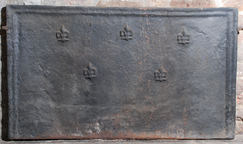
830
Description: Rectangular; stepped fillet moulded edging (top and sides); small fleur-de-lys stamp repeated five times, three centred across the top, two centred across the middle.
Notes: The fleur-de-lys stamp appears to have been constructed using wire.
- Decoration tags:
- rectangular (shape)
- stepped fillet (edging)
- carved stamps
- heraldic
- objects
Manufactured: in the mid- to late-16th century in the Weald area of England.
Current location: in private hands, Iford, East Sussex, England.
- Attached to series:
- Fleur-de-lys firebacks
-
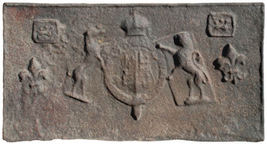
470
Description: Rectangular; twisted rope edging (top and sides); central Tudor royal shield with encircling garter (motto reversed), separate greyhound and lion supporters, separate crown; rectangular bordered stamp with an animal facing to the right, repeated once above and on each side of the armorial; bold fleur-de-lys stamp repeated once on each side of the armorial below the other stamp; all irregularly positioned.
Notes: The armorial and fleurs-de-lys are seen together on a plate at Alfriston Clergy House.
Copies of this fireback are known.
Arms: Tudor royal (prob. Elizabeth I)
- Decoration tags:
- rectangular (shape)
- rope (edging)
- carved stamps
- heraldic
- armorial
- royal
- objects
Manufactured: in the mid- to late-16th century possibly at Pounsley Furnace, Framfield in the Weald area of England.
Current location: not known.
Citation: Lloyd, N., 1925, 'Domestic Ironwork I', Architectural Review, 58, pp. 58-67.
-
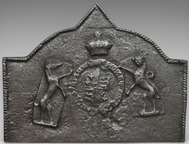
51
Description: Arched rectangular shaped, topped with a triangle; twisted rope edging (top and sides only); inverted Tudor royal shield and Garter, crown above, greyhound and lion supporters (see example at Alfriston Clergy House). Two horizontal planklines.
Notes: A uniquely shaped fireback, the inverted shield and Garter indicate that they formed a separate stamp from the crown; other firebacks with these stamps have the shield and Garter the correct way round. A frequently copied fireback; a larger version has a bottom extension. Inferior copies of this fireback were advertised in Kings Worthy Foundry's (Winchester) catalogue in the mid-20th century.
Copies of this fireback are known.
Inscription: HONE SOVT QUEY MAL Y PENSE
Arms: Tudor royal (prob. Elizabeth I)
- Decoration tags:
- rectangular with round arch and triangle above (shape)
- rope (edging)
- carved stamps
- planklines
- heraldic
- armorial
- royal
Manufactured: in the mid- to late-16th century possibly at Pounsley Furnace, Framfield in the Weald area of England.
Current location: Courtlands, Taunton, Somerset, England.
- Attached to series:
- Pounsley series
- Tudor royal armorial firebacks
- Elizabethan royal greyhound series
-
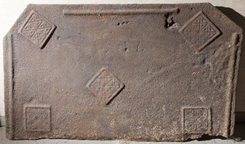
1089
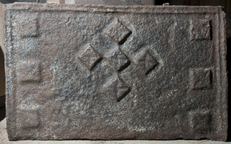
Description: Canted quasi-rectangular shape with no edging; straight length of ?dowel placed parallel to top and to each side; square stamp with fillet edge and four diagonally quartered squares repeated five times, three rotated with sides 45 degrees to the vertical in top corners and slightly left of lower centre, and two, unrotated, repeated twice in bottom corners.
Notes: The square stamps may be pastry moulds.
- Decoration tags:
- rectangular with canted top corners (shape)
- none (edging)
- simple stamps
- carved stamps
- objects
Manufactured: in the mid- to late-16th century in the Weald area of England.
Current location: Authentic Reclamation, Lymden Lane, Ticehurst, East Sussex, England.
- Attached to series:
- Crossed square Wealden series
- Food mould stamp firebacks
-
1103
Description: Rectangular shape; double astragal edging (top and sides); arrangement of repeated square stamps with indented saltires: three down each side, five in a diamond pattern top centre.
Notes: The lines around the edge may well have been formed from impressing a straight edge of some sort.
- Decoration tags:
- rectangular (shape)
- double astragal (edging)
- carved stamps
- objects
Manufactured: in the mid- to late-16th century in the Weald area of England.
Current location: not known.
- Attached to series:
- Miscellaneous stamp firebacks
-
977
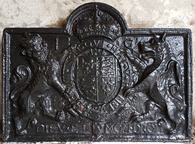
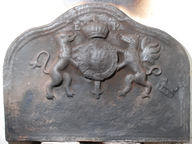
Description: Arched rectangular shape; ovolo moulded edging; Tudor royal shield, garter, crown, motto and supporters (crowned lion and dragon), temp. Elizabeth I; initials in space on either side of top of garter; the top of the lion's crown and the dragon's ear overlap the edging.
Notes: The initials have been added to an early recasting; another version has a rose and portcullis either side of the crown, and the top of the lion's crown and the dragon's ear do not overlap the edging.
Copies of this fireback are known.
Inscription: I G / [Garter] HONI SOIT QVI MAL E PENSE / [motto] DIEV ET MON DROIT
Arms: Tudor royal
- Decoration tags:
- rectangular with round arch (shape)
- ovolo (edging)
- whole carved pattern
- individual letters
- planklines
- armorial
- royal
- text
Manufactured: in the mid- to late-16th century possibly in the Weald area of England.
Current location: not known.
- Attached to series:
- Tudor royal armorial firebacks
- Tudor royal armorial (plain) series
-
1164
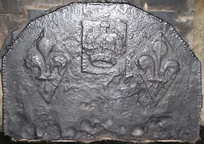
Description: Rectangular with 5-facetted arch; twisted rope edging; centre top, rectangular stamp, over-pressed, with crown above initials in bottom corners; diamond shaped stamp with fleur-de-lys repeated each side of crown, both over-pressed.
Notes: Notable for the large size of the fleur-de-lys stamp; this casting differs from another (no. 486) in the placement of the stamps. Formerly at Parsonage Farm, Steeple Bumpstead, Essex.
Inscription: E R
- Decoration tags:
- multi-facet arched (shape)
- rope (edging)
- simple stamps
- carved stamps
- heraldic
- royal
- text
- objects
Manufactured: in the mid- to late-16th century in the Weald area of England.
Current location: in private hands, Newmarket, Suffolk, England.
- Attached to series:
- Large diamond fleur series
- Fleur-de-lys firebacks
 01.jpg)