-
292
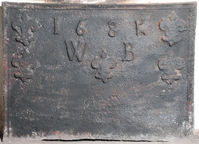
Description: Rectangular; cavetto-moulded edging; top centre, date, above initials; two low-relief fleurs de lys down each side from top corners, and central fleur below and between the initials.
Notes: The initials may relate to William Boevey who was owner of Flaxley furnace from 1683-92. Another fireback with the same date and initials, and more fleurs, is also known.
Inscription: 1685 / W B
- Decoration tags:
- rectangular (shape)
- astragal with cavetto (edging)
- carved stamps
- heraldic
- text
Manufactured: in 1685 at Flaxley Furnace in the Forest of Dean area of England.
Current location: Flaxley Abbey, Flaxley, Gloucestershire, England.
Citation: Bick, D. E. [incorrectly printed as Bick, R.], Sept 1985, 'Firebacks', Period Homes, pp. 21-4.
- Attached to series:
- Boevey series
- Fleur-de-lys firebacks
-
1343
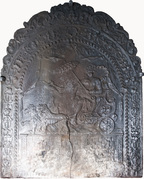
Description: Arched rectangular central panel with ‘nutshell’ edging on a broad fillet; figure with a floral headdress, holding a parasol in his left hand, sitting in a chariot, with foliate seat-back, drawn to the left by two lions; the whole upon a masonry causeway with pilasters; a heron flying to the left; above, swagged drapery; arched rectangular shaped border with fillet edging, symmetrical tendrils descending from a scallop shell; on top, symmetrical plant tendrils.
Notes: The design is derived from a personification of Africa, one of a set of playing cards entitled 'Jeu de la Géographie', designed by Stefano della Bella (1677); the flying heron has been copied from a print by Wenceslaus Hollar c.1658 of an etching by Francis barlow. Design elements at the bottom of the plate seen on other firebacks in this series, such as plant tendrils and a probable SHR monogram, are absent, the fireback probably having been reduced in height when cast, possibly to fit the fireplace.
- Decoration tags:
- 'Dutch' (shape)
- fillet (edging)
- whole carved pattern
- pictorial
- allegorical
- animals
- humans
- objects
Manufactured: in the late-17th to early-18th century in England.
Current location: Godinton House, Great Chart, Kent, England.
- Attached to series:
- SHR series
- British 'Dutch' style firebacks
-
1239
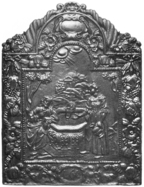
Description: Arched rectangular central panel with bead-on-fillet edging; pictorial scene of Jesus sitting at the well with the woman of Samaria standing opposite, a rural scene behind, trees on each side and clouds with sunrays above; arched rectangular border with fillet edging; central cartouche at top, with festoons of fruit, flowers and leaves suspended on each side from ribbons supported by rings; at the bottom, swirled ribbon around an oval compartment bearing the inscription 'L6C'; on top, a central cartouche from which descend a cornucopia on each side of the arch.
Notes: The scene, seen on many German firebacks and stoveplates, is from St John's gospel, chapter 4; the inscription at the bottom indicates the style of border; other firebacks with the same inscription have the same border; similar inscriptions (e.g. L7C and L8G) indicate different borders.
Copies of this fireback are known.
Inscription: L6C
Manufactured: in the mid- to late-17th century possibly in the Siegerland area of Germany.
Current location: Vreden, Nordrhein-Westfalen, Germany.
Citation: Elling, W. & Winkler-Borck, S., 1992, Ofen- und Kaminplatten (Vreden, Hamaland-Museum).
- Attached to series:
- 'Dutch' LC/G series
-
828
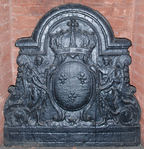
Description: Upon a rectangular base plinth with an inscribed rectangle, to each side, a wide foliate scroll; central cartouche behind an oval shield bearing three fleurs-de-lys over a horizontally textured ground, supported on each side by a draped male figure, the whole surmounted by a French royal crown; on top, an arch rising from horizontal moulding on each side.
Notes: Characteristic of designs illustrated by architects such as Daniel Marot; the texturing on the shield indicates the azure tincture.
Arms: French royal
- Decoration tags:
- rectangular with round arch (shape)
- complex individual (edging)
- whole carved pattern
- planklines
- armorial
- royal
Manufactured: in the late-17th to early-18th century in France.
Current location: in private hands, Lewes, East Sussex, England.
- Attached to series:
- Foreign armorial firebacks
-
398
Description: Rectangular; cyma curve and fillet edging; crowned Tudor rose within a pediment resting on Tuscan pilasters and pedestals.
Notes: The rose and crown are more finely modelled than other versions.
Copies of this fireback are known.
- Decoration tags:
- rectangular (shape)
- cyma curve and fillet (edging)
- whole carved pattern
- heraldic
- architectural
- royal
Manufactured: in the mid- to late-16th century in the Weald area of England.
Current location: Anne of Cleves House, Southover High Street, Lewes, East Sussex, England.
Museum number: LH000.942 (part of the Sussex Archaeological Society museum group)
- Attached to series:
- Miscellaneous royal firebacks
- Pedimented rose and crown series
-
1103
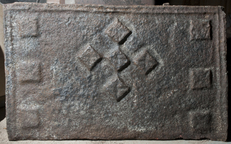
Description: Rectangular shape; double astragal edging (top and sides); arrangement of repeated square stamps with indented saltires: three down each side, five in a diamond pattern top centre.
Notes: The lines around the edge may well have been formed from impressing a straight edge of some sort.
- Decoration tags:
- rectangular (shape)
- double astragal (edging)
- carved stamps
- objects
Manufactured: in the mid- to late-16th century in the Weald area of England.
Current location: not known.
- Attached to series:
- Miscellaneous stamp firebacks