-
10
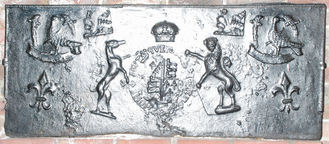
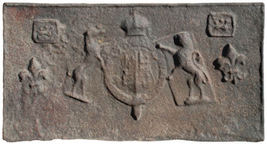
Description: Rectangular; rope edging (top and sides); central Tudor royal shield with encircling garter (motto reversed: HONE SOVT QVEY … PEN), separate greyhound and lion supporters, separate crown; a bird, repeated in each top corner, its wings displayed and inverted and its head facing behind and to the left, standing on a scroll; a fleur de lys repeated in the bottom corners; inside the birds is a repeated stamp, half of one similar to a stamp on a fireback in Hastings Museum.
Notes: The particular form of the Tudor arms and supporters is encountered on other firebacks, as are the distinctive style of fleurs de lys and the birds (probably swans, a Lancastrian icon). The plain scroll upon which the bird is perched suggests that there might have been a painted inscription on it originally and that the stamp had not been made specifically for the decoration of firebacks but was, perhaps, redundant from interior domestic decoration. Formerly at Framfield, East Sussex.
Arms: Tudor royal (prob. Elizabeth I)
- Decoration tags:
- rectangular (shape)
- rope (edging)
- carved stamps
- heraldic
- armorial
- royal
- objects
Manufactured: in the mid- to late-16th century possibly at Pounsley Furnace, Framfield in the Weald area of England.
Current location: The Clergy House, Alfriston, East Sussex, England.
Museum number: 200044 (part of the National Trust museum group)
-
1226
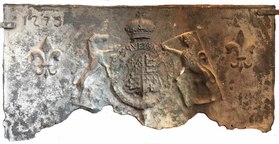
Description: Rectangular; rope edging (top & sides); in centre, Tudor shield, garter, crown and supporters (greyhound and lion) between two fleurs-de-lys; date top left.
Notes: A badly corroded fireback. The armorial achievement is seen on other firebacks and was formed from four separate stamps; the supporters are consistent with the date; the style of the numerals is uncharacteristic of the period. The sharpness of the detail on the crown and upper part of the Garter indicates that the fireback is contemporary with the date, and not older as similar examples seem to be. The same date in identical form is on a similar fireback at Penshurst Place, Kent (no. 515).
Inscription: 1579 / [Garter motto incomplete]
Arms: Tudor royal (prob. Elizabeth I)
- Decoration tags:
- rectangular (shape)
- rope (edging)
- carved stamps
- date stamp
- heraldic
- armorial
- text
- animals
Manufactured: in the late-16th century in the Weald area of England.
Current location: Groombridge Place, Speldhurst, Kent, England.
-
189
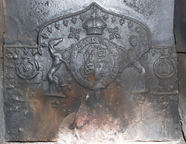
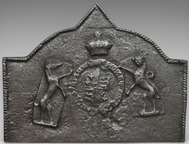
Description: Rectangular with an ogee arch; twisted rope edging (top and sides); line of small fleurs-de-lys around the top and sides, inside the edging; Tudor rose inside each top corner (overstamped on the left); below each rose an escarbuncle of twisted rope with fleur de lys terminals (understamped); top centre, a Tudor royal shield within an oval garter - HONE SOVT QUEY MAL Y PENSE - with greyhound and lion supporters, and crown above; cross of small fleurs inclined to each side of the crown; inverted 'Y' shape in twisted rope below each supporter, a fleur at the top end of each.
Notes: An oft-used achievement of arms; twisted rope with fleur de lys terminals are seen on other firebacks from the same source; it is a form paralleled on firebacks from the Champagne area of France. The escarbuncle was the principal charge on the arms of the Duchy of Cleves, the same charge on this fireback possibly associating it with the brief marriage of Henry VIII and Anne of Cleves.
Inscription: HONE SOVT QUEY MAL Y PENSE
Arms: Tudor royal (prob. Elizabeth I)
- Decoration tags:
- rectangular with ogee-arch (shape)
- rope (edging)
- carved stamps
- heraldic
- armorial
- royal
- text
- objects
Manufactured: in the mid- to late-16th century possibly at Pounsley Furnace, Framfield in the Weald area of England.
Current location: in private hands, Hatfield, Hertfordshire, England.
-
347
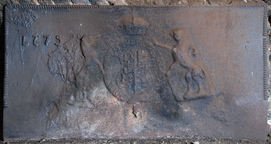
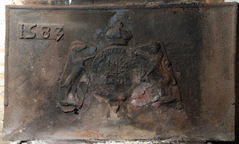
Description: Rectangular; twisted rope edging (top and sides); central Tudor shield, garter, crown and supporters (greyhound and lion), formed from separate stamps; date on a single stamp in top left corner.
Notes: The worn appearance of the central arms, compared with the clarity of the date, suggests that this is an early example of a fireback being used as a pattern, with the addition of a subsequent date. The same stamps forming the arms can also be seen on other firebacks. The extension of the lower part of the ‘3’ on the date stamp suggests that the numbers may have been fixed to the backing block, rather than the date being carved as a whole. Another variant of this fireback (no. 1041) has the rope edging extending only three-quarters of the way down the sides.
Inscription: 1583
Arms: Tudor royal (prob. Elizabeth I)
- Decoration tags:
- rectangular (shape)
- rope (edging)
- carved stamps
- date stamp
- armorial
- royal
- text
Manufactured: in the late-16th century in the Weald area of England.
Current location: Ightham Mote, Ightham, Kent, England.
Museum number: 825358 (part of the National Trust museum group)
-
515
Description: Rectangular; rope edging (top & sides); in centre, Tudor shield, garter, crown and supporters (greyhound and lion); date top left.
Notes: The armorial achievement is seen on other firebacks and was formed from four separate stamps (one example has the shield and garter inverted); the supporters are consistent with the date; the style of the numerals is uncharacteristic of the period. The same date in identical form is on a similar fireback at Groombridge Place, Speldhurst, Kent (no. 1226).
Inscription: 1579 / HONE SOVT qVEY MAL Y PENSE
Arms: Tudor royal (prob. Elizabeth I)
- Decoration tags:
- rectangular (shape)
- rope (edging)
- carved stamps
- date stamp
- armorial
- royal
- text
Manufactured: in the late-16th century in the Weald area of England.
Current location: Penshurst Place, Penshurst, Kent, England.
-
470
Description: Rectangular; twisted rope edging (top and sides); central Tudor royal shield with encircling garter (motto reversed), separate greyhound and lion supporters, separate crown; rectangular bordered stamp with an animal facing to the right, repeated once above and on each side of the armorial; bold fleur-de-lys stamp repeated once on each side of the armorial below the other stamp; all irregularly positioned.
Notes: The armorial and fleurs-de-lys are seen together on a plate at Alfriston Clergy House.
Copies of this fireback are known.
Arms: Tudor royal (prob. Elizabeth I)
- Decoration tags:
- rectangular (shape)
- rope (edging)
- carved stamps
- heraldic
- armorial
- royal
- objects
Manufactured: in the mid- to late-16th century possibly at Pounsley Furnace, Framfield in the Weald area of England.
Current location: not known.
Citation: Lloyd, N., 1925, 'Domestic Ironwork I', Architectural Review, 58, pp. 58-67.
-
51
Description: Arched rectangular shaped, topped with a triangle; twisted rope edging (top and sides only); inverted Tudor royal shield and Garter, crown above, greyhound and lion supporters (see example at Alfriston Clergy House). Two horizontal planklines.
Notes: A uniquely shaped fireback, the inverted shield and Garter indicate that they formed a separate stamp from the crown; other firebacks with these stamps have the shield and Garter the correct way round. A frequently copied fireback; a larger version has a bottom extension. Inferior copies of this fireback were advertised in Kings Worthy Foundry's (Winchester) catalogue in the mid-20th century.
Copies of this fireback are known.
Inscription: HONE SOVT QUEY MAL Y PENSE
Arms: Tudor royal (prob. Elizabeth I)
- Decoration tags:
- rectangular with round arch and triangle above (shape)
- rope (edging)
- carved stamps
- planklines
- heraldic
- armorial
- royal
Manufactured: in the mid- to late-16th century possibly at Pounsley Furnace, Framfield in the Weald area of England.
Current location: Courtlands, Taunton, Somerset, England.
- Attached to series:
- Pounsley series
- Tudor royal armorial firebacks
- Elizabethan royal greyhound series
-
1041
Description: Rectangular; twisted rope edging (top and upper three-quarters of sides); central Tudor shield, garter, crown and supporters (greyhound and lion), formed from separate stamps; date on a single stamp in top left corner.
Notes: This is an early example of a fireback being used as a pattern, with the addition of a subsequent date. The same stamps forming the arms can also be seen on other firebacks. The extension of the lower part of the ‘3’ on the date stamp suggests that the numbers may have been fixed to the backing block, rather than the date being carved as a whole. Another variant of this fireback (no. 347) has the rope edging extending further down the sides.
Inscription: 1583 / HONE SOVT qVEY MAL Y PENSE
Arms: Tudor royal (prob. Elizabeth I)
- Decoration tags:
- rectangular (shape)
- rope (edging)
- carved stamps
- date stamp
- armorial
- royal
- text
Manufactured: in the late-16th century in the Weald area of England.
Current location: in private hands, West Hoathly, West Sussex, England.