-
907
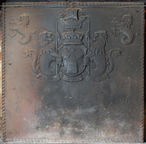
Description: Rectangular; simulated twisted rope edging; top centre, shield, baron's coronet, supporters and crest; in each top corner, heraldic badge - a Sea Lion holding an anchor.
Notes: The arms are of Sir Hudson Ewbanke Kearley, Bt., 1st Baron Devonport (1856-1934); created 1910, he was elevated to Viscount in 1917, thus the fireback would have been cast between 1910 and 1917. Blazon: Azure in chief two Mitres Argent garnished Or and in base a Square Tower of the second, a baronet's badge in chief; Supporters: On either side a Sea Lion Argent crined finned and tufted Or each gorged with a Collar Gules charged with three Roses of the second and each supporting a Spear erect proper; Crest: An Ancient Ship Or the Mainsail Azure charged with a Sea Lion of the first; Motto: Fit Via Vi (The way is made through strength). A version with the same arms and badges has an arched rectangular shape and plain edging.
Inscription: FIT VIA VI
Arms: Hudson Ewbanke Kearley, 1st Baron Devonport (later 1st Viscount)
- Decoration tags:
- rectangular (shape)
- simulated rope (edging)
- carved stamps
- heraldic
- armorial
Manufactured: in the early-20th century in England.
Current location: in private hands, Penhurst, East Sussex, England.
- Attached to series:
- Personal armorial firebacks
- Devonport arms series
-
583
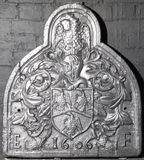
Description: Arch-shaped, with rounded-arched extension at top; cavetto moulded edge all round; five vertical planklines; arms of the Francis (or Franceis) family of Derbyshire: Argent a Chevron gules between three Eagles displayed of the same; Crest: an eagle displayed on a crowned knight’s helm; initials in bottom corners; date below shield.
Notes: Probably the arms of Sir Edward Francis, who was Seneschal of the Petworth House estate and took overall charge in 1606 when the 9th Earl of Northumberland was committed to the Tower of London for his alledged involvement in the Gunpowder Plot.
Copies of this fireback are known.
Inscription: E 1606 F
Arms: Sir Edward Francis
- Decoration tags:
- arched with arch above (shape)
- cavetto (edging)
- whole carved pattern
- planklines
- armorial
- text
Manufactured: in 1606 probably at Frith Furnace, Northchapel in the Weald area of England.
Current location: Petworth House, Petworth, West Sussex, England.
Museum number: NT/PET/M/41.1 (part of the National Trust museum group)
Citation: Gardner, J. S., 1898, 'Iron Casting in the Weald', Archaeologia, 56, 1, pp. 133-164.
- Attached to series:
- Personal armorial firebacks
-
924
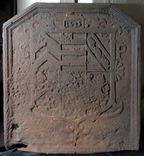
Description: Canted rectangle; elaborate cavetto moulded edging (top and sides); strapwork shield with a demi-flower at each side, between initials; arms quarterly of six, 1st Or two chevronels Gules, on a canton of the last a mullet of the first (Pope); 2nd Argent three bars Gules, on a canton ermine a bend of lozenges of the second (Walshe); 3rd Sable three laurel leaves in bend Or between two bendlets Argent (Waller); 4th Azure a chevron between three crosses Moline Argent (Lansdale); 5th Ermine on a bend Gules three lions' heads erased Or (Weston); 6th Azure a lion rampant Or supporting a cross patée fitchée of the second (Pichingham).
Notes: The lower part of the shield is revealed more clearly in another casting. The date above the shield has been inserted before casting and differs slightly from another example of the same back.
Copies of this fireback are known.
Inscription: 1625 / S P
Arms: Pope (Sackevile Pope (b. 1589) of Hendall, in Buxted, Sussex)
- Decoration tags:
- rectangular with canted top corners (shape)
- complex individual (edging)
- whole carved pattern
- date stamp
- armorial
- text
Manufactured: in 1625 in the Weald area of England.
Current location: not known.
- Attached to series:
- Low relief armorial series
- Personal armorial firebacks
-
1191
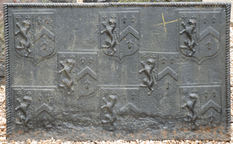
Description: Rectangular; twisted rope edging (top and sides only); eight shields of Ayloffe impaling Sulyard in three rows, 3-2-3; Ayloffe: sable, a lion rampant Or, collared gules, between three crosses formy of the second; Sulyard: argent, a chevron gules between three pheons inverted sable.
Notes: William Ayloffe (c1535-1584) of Bretons, Hornchurch, Essex, Justice of the Court of Queen’s Bench, married (c1560) Jane, dau. of Sir Eustace Sulyard, of Runwell, Essex. Illustrated in Lloyd (1925).
Arms: Ayloffe impaling Sulyard (William Ayloffe of Bretons, Hornchurch)
- Decoration tags:
- rectangular (shape)
- rope (edging)
- carved stamps
- heraldic
- armorial
Manufactured: in the early-17th century in the Weald area of England.
Current location: Great Dixter, Northiam, East Sussex, England.
Citation: Lloyd, N., 1925, 'Domestic Ironwork I', Architectural Review, 58, pp. 58-67.
- Attached to series:
- Ayloffe series
- Personal armorial firebacks
-
596
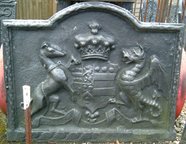
Description: Arched rectangular shape with base plinth; astragal and fillet edging (top and sides) with overlapping leaf pattern; mirrored wave pattern on plinth; shield, supporters, motto scroll and coronet of the 1st Earl of Ashburnham.
Notes: The arms are Ashburnham impaling Grey: Ashburnham: quarterly 1. Ashburnham - gules a fess between six mullets argent; 2. Holland - azure semee of fleurs-de-lys a lion rampant guardant argent; 3. Kenn - ermine three crescents gules; 4. Vaughan - sable a fess argent between three boys' heads couped at the shoulders proper having snakes enwrapped about their necks vert; and Grey - barry of six argent and azure in chief three torteaux. John, 3rd Baron Ashburnham, married Lady Jemima Grey in 1724. He was created Earl of Ashburnham in 1730 so the fireback probably dates between then and 1731 when Lady Ashburnham died. A sketch of an example of this fireback was made by J. Starkie Gardner c.1891 and is in his collection at the Victoria and Albert Museum, Archive of Art and Design (AAD/2014/8).
Copies of this fireback are known.
Inscription: LE ROY ET L'ESTAT [barely legible]
Arms: John, 1st Earl of Ashburnham
- Decoration tags:
- rectangular with round arch (shape)
- astragal & fillet (edging)
- whole carved pattern
- armorial
Manufactured: in the early-18th century probably at Ashburnham Furnace in the Weald area of England.
Current location: Mark Ripley Forge & Fireplaces, Northbridge Street, Robertsbridge, East Sussex, England.
Citation: Denny, H., 1937, 'Iron Fire-back', Sussex Notes and Queries, 6, 6, p. 189.
- Attached to series:
- Ashburnham family firebacks
- Personal armorial firebacks
-
597
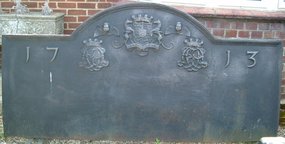
Description: Arched rectangular; ovolo edging (top and sides only); arms of the Barony of Ashburnham: (1st & 4th) gu. a fess between six mullets ar. (Ashburnham), (2nd) az. a lion rampant between eight fleurs de lys ar. (Holland), (3rd) erm. three crescents gu. (Kenn); on an escutcheon of pretence a chevron between three boys heads couped at the shoulders each entwined around the neck with a snake (Vaughan). Supporters: two greyhounds sa. their faces, breasts, and feet ar. collared and lined or; on either side of the arms is a winged cherub’s head; below each is a monogram of ‘B J’ beneath a baron’s coronet.
Notes: The arms are those of John, 1st Baron Ashburnham (1656-1710), who married Bridget Vaughan, but the fireback dates from the time of his son, John, the 3rd Baron, created Earl in 1730.
Copies of this fireback are known.
Inscription: LE ROY ET L’ESTAT / 17 13
Arms: John, 1st Baron Ashburnham
- Decoration tags:
- rectangular with round arch (shape)
- ovolo (edging)
- carved stamps
- individual numbers
- heraldic
- armorial
- text
- humans
Manufactured: in 1713 probably at Ashburnham Furnace in the Weald area of England.
Current location: Mark Ripley Forge & Fireplaces, Northbridge Street, Robertsbridge, East Sussex, England.
- Attached to series:
- Ashburnham family firebacks
- Personal armorial firebacks
-
599
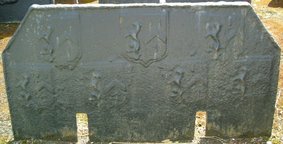
Description: Canted rectangle; ovolo moulded edging (top and sides); seven shields of Ayloffe impaling Sulyard - two rows with three on top and four on the bottom; two parallel vertical cuts for the insertion of firedogs.
Notes: Ayloffe: sable, a lion rampant Or, collared gules, between three crosses formy of the second; Sulyard: argent, a chevron gules between three pheons inverted sable. William Ayloffe (c1535-1584) of Bretons, Hornchurch, Essex, Justice of the Court of Queen’s Bench, married (c1560) Jane, dau. of Sir Eustace Sulyard, of Runwell, Essex. There is a large number of variants using the same shields.
Arms: Ayloffe impaling Sulyard (William Ayloffe of Bretons, Hornchurch)
- Decoration tags:
- rectangular with canted top corners (shape)
- rope (edging)
- carved stamps
- armorial
Manufactured: in the early-17th century in the Weald area of England.
Current location: Mark Ripley Forge & Fireplaces, Northbridge Street, Robertsbridge, East Sussex, England.
- Attached to series:
- Ayloffe series
- Personal armorial firebacks
- Andiron slot firebacks
-
604
Description: Arched rectangular with curved shoulders; cavetto-moulded edging (top and sides) with twin scrolls on inside corners, and scalloped bottom edge; armorial; shield (32 quarters), mantling, supporters (bull and crowned lion), coronet, motto, 2 helms and crests (a bear’s head erased and ducally gorged, and a bear and ragged staff).
Notes: The impaled arms appear to be those of the Earldom of Huntingdon. The crests are of Hastings and Dudley, suggesting they are of Henry, 3rd Earl (c.1535-95), and his wife, Katherine (1548-1620), daughter of John Dudley, Duke of Northumberland. Henry Hastings inherited the earldom in 1560 so the fireback probably dates from between then and 1595, when he died. This is an incomplete casting, the full version of which includes a bottom panel with a repeated guilloche design. Christie's Masters and Makers Sale, South Kensington, 30 Nov 2010, lot 516 (£4,375).
Copies of this fireback are known.
Inscription: IN VERITATE VICTORIA (illegible, but verified on other castings)
Arms: Hastings, earl of Huntingdon, impaling Dudley
- Decoration tags:
- rectangular with round arch (shape)
- cavetto (edging)
- whole carved pattern
- armorial
Manufactured: in the late-16th century in England.
Current location: not known.
- Attached to series:
- Personal armorial firebacks
-
606
Description: Canted rectangle; twisted rope edging (top and sides); seven shields of Ayloffe impaling Sulyard in two rows (3-4); Ayloffe: sable, a lion rampant Or, collared gules, between three crosses formy of the second; Sulyard: argent, a chevron gules between three pheons inverted sable.
Notes: William Ayloffe (c1535-1584) of Bretons, Hornchurch, Essex, Justice of the Court of Queen’s Bench, married (c1560) Jane, dau. of Sir Eustace Sulyard, of Runwell, Essex.
Arms: Ayloffe impaling Sulyard (William Ayloffe of Bretons, Hornchurch)
- Decoration tags:
- rectangular with canted top corners (shape)
- rope (edging)
- carved stamps
- armorial
Manufactured: in the early-17th century in the Weald area of England.
Current location: Mark Ripley Forge & Fireplaces, Northbridge Street, Robertsbridge, East Sussex, England.
- Attached to series:
- Ayloffe series
- Personal armorial firebacks
-
607
Description: Rectangular; twisted rope edging (top and sides only); eight shields of Ayloffe impaling Sulyard in three rows, 3-2-3; Ayloffe: sable, a lion rampant Or, collared gules, between three crosses formy of the second; Sulyard: argent, a chevron gules between three pheons inverted sable.
Notes: William Ayloffe (c1535-1584) of Bretons, Hornchurch, Essex, Justice of the Court of Queen’s Bench, married (c1560) Jane, dau. of Sir Eustace Sulyard, of Runwell, Essex.
Arms: Ayloffe impaling Sulyard (William Ayloffe of Bretons, Hornchurch)
- Decoration tags:
- rectangular (shape)
- rope (edging)
- carved stamps
- armorial
Manufactured: in the early-17th century in the Weald area of England.
Current location: Mark Ripley Forge & Fireplaces, Northbridge Street, Robertsbridge, East Sussex, England.
- Attached to series:
- Ayloffe series
- Personal armorial firebacks