-
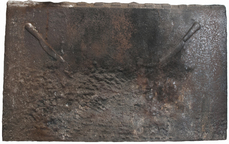
1279
Description: Plain rectangular shape with chamfered and embattled top edge; impression of a utilitarian, domestic knife inclined, blade down, at an angle of about 45 degrees from inside the top corners; the knife measures about 20.5cm in length.
Notes: An unusual, if not unique, top edge. The form of the knife suggests a late-16th or early-17th century date. The uneven surface of the lower part of the fireback may have been caused by the pouring of the molten metal and the consequent disturbance of the casting sand of the mould.
- Decoration tags:
- rectangular (shape)
- none (edging)
- simple stamps
- objects
Manufactured: in the late-16th to early-17th century in the Weald area of England.
Current location: in private hands, Wadhurst, East Sussex, England.
- Attached to series:
- Metalware stamp firebacks
- Knife & Dagger stamp firebacks
-
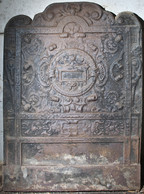
1252
Description: Quasi-arched rectangular shape; no edging; arched rectangular central panel edged with a garland within a cartouche between guilloche-moulded bands that extend vertically below to form two further panels separated by a similar but plain band; the two bottom panels each extend sideways to form simulated pedestals; below is a plain, borderless panel. Within the main panel, at each corner a cherub head facing towards the centre; within the border of the panel, a symmetrical strapwork band forms the edge of a cartouche that is scrolled at the bottom and which curves away from the edge of the panel at the sides to reveal scrolls from behind, and which forms a heart shape in front of each of the putti enclosing an indeterminate feature; in the centre of the panel, resting upon a scrolled cartouche with scallop shells to left and right, a gadrooned medallion enclosing the depiction of an empty mural monument, draped from above and with a lion's mask below. Resting upon the pedestal to the right, a consol enclosing an indeterminate circular feature with two descending bands; on the pedestal to the left a similar consol and indeterminate circular feature but with a single descending band; above each consol the head of a classical deity facing to right and left respectively, above which are rows of vertical figures, four on the left and two on the right, which may be caryatid figures possibly intended to depict the Daughters of Athens on the Parthenon; above the main panel symmetrical scrolls. In the lower panel, a central rectangular cartouche, scrolled at the top and bottom, between symmetrical vignettes.
Notes: Some of the detail is too indistinct to permit accurate description, but a fireback of untypical design features that are all characteristic of the early-17th century, and derivative of the designs of the likes of Jan Vredemen de Vries and Frans Huys.
Copies of this fireback are known.
- Decoration tags:
- rectangular with ornate arch (shape)
- none (edging)
- whole carved pattern
- architectural
- humans
- objects
Manufactured: in the early- to mid-17th century in England.
Current location: in private hands, Wartling, East Sussex, England.
- Attached to series:
- Miscellaneous pattern firebacks
-
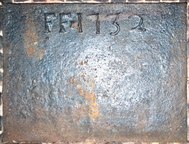
1223
Description: Rectangular; no edging; top centre, inscription, FF, and date, 1732, separated by a small saltire.
Notes: The possibility exists that the initials are those of Francis Fairburn, whose descendants are known to have occupied the house where it lies.
Inscription: FFx1732
- Decoration tags:
- rectangular (shape)
- none (edging)
- individual letters
- individual numbers
- text
Manufactured: in 1732 possibly in the Weald area of England.
Current location: in private hands, West Peckham, Kent, England.
- Attached to series:
- Date & initials firebacks
-
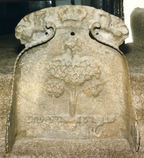
1069
Description: Quasi-arched shape with forward-facing 'wings', which splay outwards towards the base where each has been pierced with a small hole as if to insert a rod from one side to the other; the 'wings' curve to follow the shape of the main panel but curl outwards at the top; central panel with stylised tree decoration surmounted with a crown between two inward-facing animals, possibly a lion and unicorn; beneath the tree, a partially illegible inscription in relief.
Notes: Nothing is known about the sources of free-standing firebacks or what prompted their production. Their form is similar and the predominant use of horticultural or arboreal decorative themes suggests production within a limited time frame. Only a very small number of such castings are known. Depth 200mm. A similar fireback, noted at Poynings in Sussex, was illustrated in The Connoisseur, vol 41 (April 1915), p. 221; it too had a crown supported by a lion and unicorn on the top, and a tree with an illegible inscription below.
Inscription: SYLVESTR..[illegible]
- Decoration tags:
- free-standing (shape)
- none (edging)
- whole carved pattern
- text
- plants
Manufactured: in the late-17th to early-18th century in England.
Current location: in private hands, Wigmore, Herefordshire, England.
- Attached to series:
- Free-standing firebacks
-
799
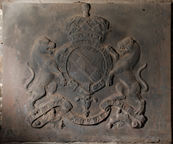
Description: Rectangular; plain plate with shield, supporters, ducal coronet, motto and garter of the Duke of Dorset: Quarterly, Or and gules, a bend vair.
Notes: Almost certainly the arms of Lionel Sackville KG (1688-1765), created first duke of Dorset in 1720; many different firebacks exist, all with precisely the same armorial stamp.
Copies of this fireback are known.
Inscription: [around shield] HONY SOIT QUI MAL Y PENSE / [on motto scroll] AUT NUNQUAM TENTES, AUT PERFICE
Arms: Lionel Sackville, 1st Duke of Dorset
- Decoration tags:
- rectangular (shape)
- none (edging)
- carved stamps
- armorial
- text
Manufactured: in the early-18th century in the Weald area of England.
Current location: in private hands, Withyham, East Sussex, England.
- Attached to series:
- Dorset arms series
- Sackville firebacks
- Personal armorial firebacks
-
800
Description: Rectangular; plain plate with shield, supporters, ducal coronet, motto and garter of the Duke of Dorset: Quarterly, Or and gules, a bend vair.
Notes: Almost certainly the arms of Lionel Sackville KG (1688-1765), created first duke of Dorset in 1720; many different firebacks exist, all with precisely the same armorial stamp.
Inscription: HONI SOIT QUI MAL Y PENSE / AUT NUNQUAM TENTES, AUT PERFICE [Either do not attempt, or complete]
Arms: Lionel Sackville, 1st Duke of Dorset
- Decoration tags:
- rectangular (shape)
- none (edging)
- carved stamps
- armorial
- text
Manufactured: in the early-18th century in the Weald area of England.
Current location: in private hands, Withyham, East Sussex, England.
- Attached to series:
- Dorset arms series
- Sackville firebacks
- Personal armorial firebacks
-
636
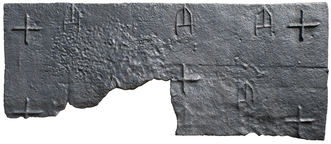
Description: Rectangular; no edging; quasi-symmetrical arrangement of crosses and buckle outlines: a cross at each corner and one to right of middle, three buckles along the top and three buckles in triad, level with, and below, the central cross; two horizontal plank lines; lower left part of back missing due to wear and corrosion. The fireback has a small accumulation of iron slag on the reverse side, probably caused by a failure, by the founder, to tap off all the slag from the furnace hearth before casting.
Notes: The buckles, which could have been stamped using a branding iron, suggest a connection with the Pelham family. This is the fireback noted in 1861 at Warbleton Priory, Sussex, which the Pelhams endowed in 1413; the priory was dissolved in 1535 suggesting that the fireback dates from before then. The excrescence, left of centre, on the surface of the fireback was probably caused by molten iron being poured from a ladle into the sand mould and displacing some of the sand.
- Decoration tags:
- rectangular (shape)
- none (edging)
- simple stamps
- carved stamps
- planklines
- heraldic
- objects
Manufactured: in the early- to mid-16th century in the Weald area of England.
Current location: Anne of Cleves House, Southover High Street, Lewes, East Sussex, England.
(part of the Sussex Archaeological Society museum group)
- Attached to series:
- Pelham family firebacks
- Metalware stamp firebacks
-
1129
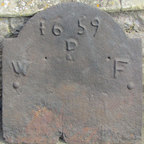
Description: Arched rectangular shape; no edging; date in arch; initials in wide triad below.
Notes: A rather crudely cast fireback; rivets indicate repair. Wotton Auctions, Wotton-under-Edge, 30 Apr-1 May 2019, lot 1138.
Inscription: 16 59 / W R [or P] F [triad]
- Decoration tags:
- rectangular with round arch (shape)
- none (edging)
- carved stamps
- individual letters
- individual numbers
- text
Manufactured: in 1659 in England.
Current location: not known.
- Attached to series:
- Date & initials firebacks