-
1018
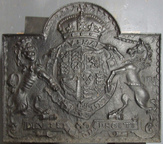
Description: Arched rectangular; cavetto-moulded edging, invected on the inner edge; English royal Stuart shield, garter, crown, supporters and motto; monogram to right of unicorn supporter.
Notes: The monogram probably identifies the pattern-maker, whose invected edging seems to be a distinctive style.
Copies of this fireback are known.
Inscription: HONI SOIT QUI MAL Y PENSE / RN / DIEV ET MON DROIT
Arms: English Stuart royal
- Decoration tags:
- rectangular with round arch (shape)
- cavetto (edging)
- whole carved pattern
- monogram
- armorial
- royal
- text
Manufactured: in the early- to mid-17th century in England.
Current location: National Maritime Museum, Greenwich, London, England.
Museum number: AAA3476 (part of the National Maritime Museum museum group)
- Attached to series:
- RN series
- Stuart royal armorial firebacks
-
81
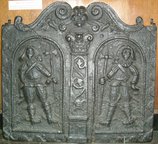
Description: Rectangular with two mirrored scrolls on top, a lion’s face between; bas-relief semi-circle edging (sides and bottom); central pilaster with vine scrolling, Corinthian capital, initials on the pedestal; on either side, an arched alcove, each with a halberdier in mid-17th century clothes, their feet pointing to the middle.
Notes: Stylistically similar to the Lenard fireback (no. 429), the initials also appear on other firebacks. All known examples of this fireback are poorly modelled and cast. A rare version (no. 400) has different edging and lacks the pattern-maker’s initials. Inferior copies of this fireback were advertised in Kings Worthy Foundry's (Winchester) catalogue in the mid-20th century.
Copies of this fireback are known.
Inscription: IM
- Decoration tags:
- rectangular with ornate arch (shape)
- fillet (edging)
- whole carved pattern
- planklines
- pictorial
- architectural
- text
- humans
Manufactured: in the early- to mid-17th century possibly at Brede Furnace in the Weald area of England.
Current location: Guildford Museum, Guildford, Surrey, England.
Museum number: S.7108 (part of the Guildford Museum museum group)
Citation: Lloyd, N., 1925, 'Domestic Ironwork I', Architectural Review, 58, pp. 58-67.
- Attached to series:
- IM series
- Brede group
-
84
Description: Arched rectangular shape; ‘egg and dart’ ovolo moulding visible on top and sides; shield, helmet, crest, mantling and supporters of the Mohun family.
Notes: Cast from a finely carved pattern, the supporters denote these are the arms of a peer. The crest is: Gules, a maunch ermine, with a hand proper holding a fleur de lys or. Egg and dart moulding is rare and examples (at Maidstone and Burwash) may be the work of the same pattern maker. From Sidney Farm, Alfold, Surrey; Reginald Mohun (pron. Moon) of Dedisham, Slinfold, Sussex, was husband of Elizabeth Blounte of Dedisham c.1636. Bottom missing due to corrosion.
Copies of this fireback are known.
Arms: Mohun family, barons of Okehampton
- Decoration tags:
- rectangular with round arch (shape)
- ovolo, egg and dart (edging)
- whole carved pattern
- heraldic
- armorial
Manufactured: in the early- to mid-17th century in England.
Current location: Guildford Museum, Guildford, Surrey, England.
Museum number: G.7106 (part of the Guildford Museum museum group)
- Attached to series:
- Personal armorial firebacks
- Mohun series
-
1006
Description: Rectangular shape with twisted rope edging (top and sides); date split between top corners.
Notes: The central button on the number 1 is consistent with a date in the first half of the seventeenth century. Hall's auction, Shrewsbury, 28 Oct 2015, lot 127 (£190).
Inscription: 16 37
- Decoration tags:
- rectangular (shape)
- rope (edging)
- individual numbers
- text
Manufactured: in 1637 possibly in the Shropshire area of England.
Current location: in private hands, Wigmore, Herefordshire, England.
- Attached to series:
- Date only firebacks
-
159
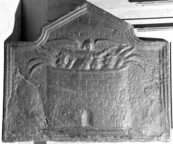
Description: Rectangular with ‘pediment’ arch linked by cavetto curves; fillet and cavetto edging; pictorial, a cylindrical furnace with inscribed stone courses, flames issuing from the top, with the heads of three people, a hand raised from two of them, and an angel with wings and arms outstretched; the furnace has a small arched opening bottom centre; above the angel, the inscription was inscribed on the pattern.
Notes: The scene represents Shadrach, Meshach, and Abednego being delivered from the burning fiery furnace by the angel of God (Daniel 3), the phrase, The Three Children, being a reference to the eponymous apocryphal verses from the Book of Daniel. Formerly at Brightling Hall, Robertsbridge, Sussex.
Inscription: THE THREE CHILDREN
- Decoration tags:
- rectangular with pediment (shape)
- cavetto (edging)
- whole carved pattern
- pictorial
- biblical
- architectural
- text
- humans
- objects
Manufactured: in the early- to mid-17th century possibly in the Weald area of England.
Current location: Hastings Museum and Art Gallery, John's Place, Bohemia Road, Hastings, East Sussex, England.
Museum number: HASMG: 1913.58 (part of the Hastings Museum museum group)
Citation: Baines, J. M., 1958, Wealden Firebacks (Hastings Museum).
Citation: Butterfield, W. R., 1916, 'Old Wealden Firebacks', The Connoisseur, 46, pp. 197-209.
Citation: Butterfield, W. R., 23 Feb 1935, 'A Scriptural Fireback', Hastings and St Leonards Observer.
- Attached to series:
- Old Testament & Apocrypha firebacks
-
1076
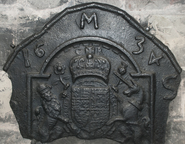
Description: Fragment; arched rectangular fireback with embattled, cavetto-moulded edging; English Stuart royal shield, Garter, crown and supporters, stemmed rose and stemmed thistle, respectively, to left and right of crown; initials CR above crown; all within a plain border, with short lengths of twisted rope edging containing, at the top, the initial M between a split date; initials (only S surviving) below date.
Notes: A Carolean composite fireback. The armorial fireback includes stylistic elements - the form of the unicorn and of the harp - identical to those on two series of firebacks dated 1618 and 1619, indicating the work of the same pattern-maker; its width is 490mm.
Inscription: M / 1634 / [?] S / C R
Arms: English Stuart royal (Charles I)
- Decoration tags:
- rounded arched (shape)
- rope (edging)
- carved pattern panels
- composite
- individual letters
- individual numbers
- heraldic
- armorial
- text
Manufactured: in 1634 possibly in the Forest of Dean area of England.
Current location: Black and White House Museum, The Old House, High Town, Hereford, Herefordshire, England.
-
915
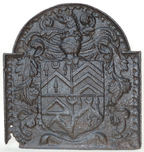
Description: Rectangular with superimposed arch; embattled, cavetto-moulded edging, with the top edge of the rectangle interrupted; quartered shield, helm, crest and mantling.
Notes: The arms appear to be those of the family of Armeston of Burbage, Leicestershire, possibly Thomas Armeston (c1606-85), 2nd son of Thomas Armeston (d.1640), sometime MP for Leicestershire: 1st and 4th (Armeston) sable a chevron between three spear heads argent with a crescent for difference, 2nd (unknown) three chevronels with a rose in a canton, 3rd (unknown) a fess between two chevronels, a crescent for difference over all. The Armeston crest is a dragon's head erased vert scaled or and charged with a crescent of the same for difference; the crescent is the mark of cadency for the second son; in this instance the arms appear to be of a second son descended from a second son in an earlier generation. The embattled edging and superimposed arch are features of a series of firebacks dated 1619. However, the style of the mantling is typical of a small group of firebacks noted in Herefordshire.
Arms: Armeston, of Burbage, Leicestershire
- Decoration tags:
- rectangular with round arch (shape)
- embattled cavetto (edging)
- whole carved pattern
- armorial
Manufactured: in the early- to mid-17th century in England.
Current location: in private hands, Honiton, Devon, England.
- Attached to series:
- Personal armorial firebacks
- Herefordshire armorial series
-
324
Description: Rectangular with two-stepped top; undefined edging; in arch, stamp formed of a talbot statant guardant upon a wreath; date below crest; vertical carved billet stamped three times, the centre one higher than the other two, between the initials, below each pair of which is a cross stamp.
Notes: The talbot crest is seen on other firebacks indicating a common source; from a drawing in report 2553 of the Domestic Buildings Research Group (Surrey). The fireback is obscured behind a stove.
Inscription: 16 30 / IM EM
- Decoration tags:
- stepped (shape)
- simple stamps
- carved stamps
- heraldic
- text
- objects
Manufactured: in 1630 in the Weald area of England.
Current location: in private hands, Horne, Surrey, England.
- Attached to series:
- Talbot crest series
- Stepped firebacks
-
329
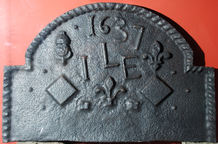
Description: Arched rectangular shape; simulated twisted rope edging (top & sides); central, symmetrical arrangement of a fleur-de-lys between two diamond stamps with two small cross-cut squares below, and a triad of dots outside; above, a haphazard arrangement of date, at top, above the initials, with a rose and crown to the left, and another fleur to the right.
Notes: Almost certainly an altered copy of a similar fireback dated 1613, some of the features of which have remained.
Inscription: 1637 / ILE
- Decoration tags:
- rectangular with round arch (shape)
- simulated rope (edging)
- carved stamps
- individual letters
- individual numbers
- heraldic
- text
Manufactured: in 1637 in the Weald area of England.
Current location: Horsham Museum, Causeway, Horsham, West Sussex, England.
(part of the Horsham Museum museum group)
- Attached to series:
- Diamond series
-
1310
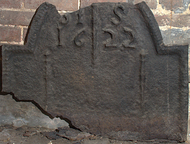
Description: Fragment; arched rectangular shape; gadrooned edging (top and sides); initials, in separate stamps, at top of arch; date probably in separate stamps, below, split by spindle; spindle used as a stamp repeated three times, one between date and initial stamps, the other two below to left and right.
Notes: Makes use of the same backing board as other firebacks in this series, and the same three spindles but with other initials; it may have originated in the Cuckfield area of Sussex, where most examples have been noted.
Inscription: SI S / 16 22
- Decoration tags:
- rectangular with round arch (shape)
- gadrooned (edging)
- simple stamps
- individual letters
- individual numbers
- text
- objects
Manufactured: in 1622 possibly at Cuckfield Furnace in the Weald area of England.
Current location: in private hands, Horsted Keynes, West Sussex, England.
- Attached to series:
- Spindle series
- Spindle/distaff firebacks

,_lot_127_28_oct_2015a.jpg)
.jpg)