-
653
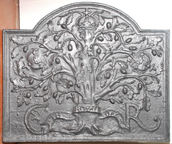
Description: Arched rectangular shape; cavetto-moulded edging; central, two handled, fluted vase with swirled, fruited vines issuing from the neck, and a bird on each side perched within the vines; out of the neck, a naïve human figure with arms outstretched, grasping vines on each side.
Notes: The figure emerging from the vase has a symbolism which has yet to be explained.
Copies of this fireback are known.
- Decoration tags:
- rectangular with round arch (shape)
- cavetto (edging)
- whole carved pattern
- pictorial
- plants
- objects
Manufactured: in the mid- to late-17th century in the Weald area of England.
Current location: Eastgate House, High Street, Rochester, Kent, England.
Museum number: A3496 (part of the Rochester Guildhall Museum museum group)
- Attached to series:
- Gadrooned vase firebacks
-
670
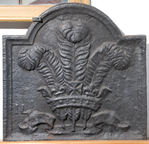
Description: Arched rectangular shape; cavetto edging; three ostrich feathers issuing from a royal coronet; a blank motto banner below; the initials bottom left, above banner.
Notes: The badge of the Prince of Wales; perhaps cast during the Commonwealth period. A copy personalised with added initials.
Copies of this fireback are known.
Inscription: IL
- Decoration tags:
- rectangular with round arch (shape)
- cavetto (edging)
- whole carved pattern
- individual letters
- heraldic
- text
Manufactured: in the mid-17th century in the Weald area of England.
Current location: Rottingdean Grange, The Green, Rottingdean, East Sussex, England.
(part of the Brighton Museum museum group)
- Attached to series:
- Prince of Wales firebacks
- Small cavetto series
-
679
Description: Arched rectangular shape; cavetto moulding all round; spreading oak tree, with leaves and acorns, filling the whole plate; three royal crowns, one at the top of the tree, the other two symmetrically on the ends of branches towards the top corners; initials CR towards the bottom corners, the remaining inscription on a scroll across the base.
Notes: The design is derived from the celebrated occasion when Charles II evaded his pursuers by hiding in an oak tree at Boscobel House, near Wolverhampton, following the final Royalist defeat at the battle of Worcester in 1651. This popular fireback has been copied frequently. Inferior copies of this fireback were advertised in Kings Worthy Foundry's (Winchester) catalogue in the mid-20th century.
Copies of this fireback are known.
Inscription: C THE ROYALL OAK R
- Decoration tags:
- rectangular with round arch (shape)
- cavetto (edging)
- whole carved pattern
- heraldic
- pictorial
- historical
- text
- plants
Manufactured: in the mid-17th century in England.
Current location: Saffron Walden Museum, Saffron Walden, Essex, England.
Museum number: 1899-2 (part of the Saffron Walden Museum museum group)
Citation: Butterfield, W. R., 19 Jan 1935, 'Charles II Fireback', Hastings and St Leonards Observer.
Citation: Butterfield, W. R., 1916, 'Old Wealden Firebacks', The Connoisseur, 46, pp. 197-209.
- Attached to series:
- Commemorative firebacks
-
350
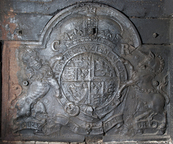
Description: Arched rectangular shape; cavetto edging; armorial; Stuart English royal arms within a circular garter; crown, motto and supporters (crowned lion and unicorn); initials separated by crown.
Notes: An early casting of a widely copied fireback. A later copy with an inserted, probably spurious, date is no. 1303. Inferior copies of this fireback were advertised in Kings Worthy Foundry's (Winchester) catalogue in the mid-20th century.
Copies of this fireback are known.
Inscription: C R / HONI SOIT QVI MAL Y PENSE / DIEU ET MON DROIT
Arms: English Stuart royal
- Decoration tags:
- rectangular with round arch (shape)
- cavetto (edging)
- whole carved pattern
- armorial
- royal
- text
Manufactured: in the mid-17th century in England.
Current location: Knole, Sevenoaks, Kent, England.
(part of the National Trust museum group)
- Attached to series:
- Carolean royal armorial firebacks
- Stuart royal armorial firebacks
-
837
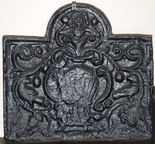
Description: Canted rectangle; cavetto-moulded edging; three horizontal strips bearing a fine repeated ribbing: one horizontal below canted corners, and two vertical strips parallel to each side, dividing the fireback into two side panels, two top corner panels, top panel and main central panel; top corner panels, a plant stamp repeated in each; top panel, date between a repeated plant stamp; side panels, fleur-de-lys stamp repeated twice on each side in a vertical arrangement, a single plant stamp below, above an initial 'I' on the left and 'B' on the right; central panel plain.
Notes: The 'daisy' stamp, fleurs-de-lys and the IB initials are found on other backs in a distinct series. Illustration from Shuffrey 1912, p.139, and formerly part of the author's personal collection.
Inscription: 1710 / I B
- Decoration tags:
- rectangular with canted top corners (shape)
- cavetto (edging)
- carved stamps
- individual letters
- individual numbers
- heraldic
- text
- plants
- objects
Manufactured: in 1710 in the Forest of Dean area of England.
Current location: not known.
Citation: Shuffrey, L. A., 1912, The English Fireplace, London, Batsford.
- Attached to series:
- IB series
- Fleur-de-lys firebacks
-
689
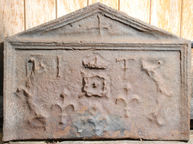
Description: Rectangular with pediment; ovolo moulded edging inside top of pediment and inside top and sides of rectangle; centre top, four-petal rose and crown with three fleurs-de-lys below; at either end, stamps made from two parts of a wreath (the middle section missing); in the pediment a cross.
Notes: The wreaths from which the stamps have been disassembled can be seen complete on three other firebacks, and the rose and crown is a common stamp on a large series of early firebacks, of which this is just one.
Inscription: I T
- Decoration tags:
- triangular arched (shape)
- cavetto (edging)
- carved stamps
- individual letters
- heraldic
- royal
- text
- objects
Manufactured: in the late-16th century in the Weald area of England.
Current location: in private hands, Slaugham, West Sussex, England.
- Attached to series:
- Royal series
- Royal (wreath) series
- Fleur-de-lys firebacks
-
1245
Description: Arched rectangular shape; cavetto-moulded edging; no decoration.
Notes: A plain base board.
- Decoration tags:
- rectangular with round arch (shape)
- cavetto (edging)
- whole carved pattern
Manufactured: in England.
Current location: not known.
- Attached to series:
- Base boards
-
1087
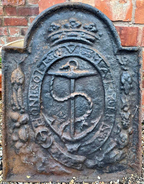
Description: Arched rectangular shape; cavetto-moulded edging; central fouled anchor within a Garter surmounted by a ducal coronet; fructal swags to each side.
Notes: The anchor may relate to the office of Lord High Admiral who, in the third quarter of the 17th century was James, Duke of York (afterwards King James II). Another example was sold at Christie's auction 12 Oct 2010 lot 109 (£500). A variant with a viscount's coronet is at Chastleton House, Oxfordshire. Copies of this fireback were advertised in the Wayte & Cheverton (Edenbridge) catalogue in the early-20th century.
Copies of this fireback are known.
Inscription: HONI SOIT QUI MAL Y PENSE
- Decoration tags:
- rectangular with round arch (shape)
- cavetto (edging)
- whole carved pattern
- heraldic
- text
- objects
Manufactured: in the mid- to late-17th century in England.
Current location: Stratford upon Avon, Warwickshire, England.
- Attached to series:
- Miscellaneous royal firebacks
-
1021
Description: Rectangular; cavetto-moulded edging; shield mounted on a strap-work cartouche, helm, crest, motto scroll and elaborate swirled mantling.
Notes: The arms of the Ironmongers' Company; blazon: Argent, on a chevron gules, between three gads of steel azure, three swivels or; crest: two talbots combatant encoupled together or. The true crest of the company has two salamanders (originally 'scaly lizards') rather than talbots, and it has been noted on other firebacks that salamanders are not always represented as amphibians; Samuel Lyne, in his Heraldry Display'd (1741), described the crest as 'two talbots', etc. The motto scroll is blank, indicating that the pattern was an armorial panel with a painted, rather than a carved, motto. A variant of the same fireback has the date 1660 and initials GI (Country Life, 8 March 1946, p. 450; 29 March 1946, p.588). Reeman Dansie auction, Colchester, 13 Apr 2016, lot 1224; Bellman's auction, Wisborough Green, 13 Oct 2021, lot 588 (£220).
Copies of this fireback are known.
Arms: Worshipful Company of Ironmongers
- Decoration tags:
- rectangular (shape)
- cavetto (edging)
- whole carved pattern
- armorial
Manufactured: in the mid-17th century in England.
Current location: not known.
- Attached to series:
- Livery company firebacks
- Armorial panel firebacks
-
909
Description: Arched rectangular shape; cavetto-moulded edging;lower centre, crowned bust of King William III above a cartouche, possibly orange branches, with leaves and fruit on each side; above, a putto blowing a trumpet; initials on each side of cartouche; date split between bottom corners.
Notes: A finely detailed image of King William III; the significance of initials is not known. It is possible that the bust of the king, the date, initials and the surrounding branches were carved on a separate pattern which was added to an otherwise simple mould comprising an arched rectangular border and the trumpet-blowing putto before casting. Christie's auction, 25 Feb 2014, lot 184 (£6,000). Inferior copies of this fireback were advertised in Bratt Colbran Ltd.'s (London) catalogue in the early-20th century.
Copies of this fireback are known.
Inscription: 16 96 / AC AL
- Decoration tags:
- rectangular with round arch (shape)
- cavetto (edging)
- whole carved pattern
- individual letters
- individual numbers
- historical
- royal
- text
- humans
- plants
Manufactured: in 1696 in England.
Current location: not known.
- Attached to series:
- Miscellaneous royal firebacks
 p139 fig 134.jpg)