-
276
Description: Arched rectangular shape; cavetto moulding all round; spreading oak tree, with leaves and acorns, filling the whole plate; three royal crowns, one at the top of the tree, the other two symmetrically on the ends of branches towards the top corners; initials GR towards the bottom corners, the remaining inscription on a scroll across the base.
Notes: The design is derived from the celebrated occasion when Charles II evaded his pursuers by hiding in an oak tree at Boscobel House, near Wolverhampton, following the final Royalist defeat at the battle of Worcester in 1651. This popular fireback has been copied frequently, and in this recast example the inscription has been re-modelled, with the traditional CR (for Carolus Rex) replaced by GR (for Georgius Rex - George V). Copies of this fireback were advertised in Bratt Colbran Ltd.'s (London) catalogue in the early-20th century.
Inscription: G THE ROYALL OAK R
- Decoration tags:
- rectangular with round arch (shape)
- cavetto (edging)
- whole carved pattern
- pictorial
- royal
- text
- plants
Manufactured: in the early-20th century in England.
Current location: Chequers, Ellesborough, Buckinghamshire, England.
- Attached to series:
- Commemorative firebacks
-
280
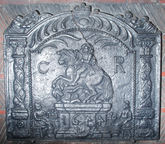
Description: Arched rectangular shaped central panel, bead edging (top and sides), pedestal bearing a supine male figure with headband being trampled by a horse, facing left, mounted by a rider with long hair, facing to the front; on each side of the plinth is a seated figure wearing a hat, with a basket of fruit; above the rider are crescent lines representative of clouds; the inscription is split either side of the horse; the date (‘7’ rotated and, with ‘4’, reversed) is on the die of the pedestal; arched rectangular shaped border, fillet edging, on each side a Solomonic column with vine decoration; in the arch, symmetrical parallel curved lines with a central oval cartouche beneath a crown; on top of each shoulder of the plate a figure in repose.
Notes: The equestrian figure is derived from the statue of Charles II erected in Stocks Market, London, in 1672. Originally to be of Jan Sobieski, later king of Poland, riding down a Tatar, it was altered to represent Charles, and the Tatar’s face was changed to that of Oliver Cromwell; the statue attracted a fair degree of derision. The statue is now at Newby Hall, near Ripon, North Yorkshire. Another version (no. 464), probably by the same pattern-maker, omits a date and has altered initials. Copies of this fireback were advertised in Bratt Colbran Ltd.'s (London) catalogue, and in the Wayte & Cheverton (Edenbridge) catalogue, in the early-20th century.
Copies of this fireback are known.
Inscription: C R / 1674
- Decoration tags:
- 'Dutch' (shape)
- cavetto (edging)
- whole carved pattern
- individual numbers
- pictorial
- historical
- architectural
- text
- animals
- humans
Manufactured: in 1674 in England.
Current location: Chequers, Ellesborough, Buckinghamshire, England.
Citation: Lloyd, N., 1925, 'Domestic Ironwork I', Architectural Review, 58, pp. 58-67.
- Attached to series:
- Carolean 'Dutch' series
- Commemorative firebacks
-
282
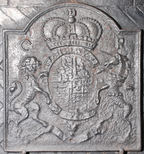
Description: Arched rectangle; cavetto moulded edging; garter enclosing Stuart royal arms, crown, crowned lion and unicorn supporters and motto; initials in top corners.
Notes: The crown is not typically English in form, suggesting that the patternmaker may have been of foreign extraction. Inferior copies of this fireback were advertised in Kings Worthy Foundry's (Winchester) catalogue in the mid-20th century.
Copies of this fireback are known.
Inscription: C R / [Garter motto - illeg.]
Arms: English Stuart royal
- Decoration tags:
- rectangular with round arch (shape)
- cavetto (edging)
- whole carved pattern
- armorial
- royal
- text
Manufactured: in the mid- to late-17th century in England.
Current location: Chequers, Ellesborough, Buckinghamshire, England.
-
278
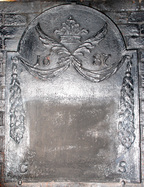
Description: Arched rectangular shape with fillet edging; mirrored drapery swags emanating from two wings, and terminating in elongated tassels hung from hooks; date split by wings; initials split at bottom corners.
Notes: A simple design with space for further personalised decoration.
Copies of this fireback are known.
Inscription: 16 87 / C S
- Decoration tags:
- rectangular with round arch (shape)
- cavetto (edging)
- whole carved pattern
- individual letters
- individual numbers
- heraldic
- text
- objects
Manufactured: in 1687 possibly in the Siegerland area of Germany.
Current location: Chequers, Ellesborough, Buckinghamshire, England.
- Attached to series:
- 'Dutch' Border only firebacks
-
576
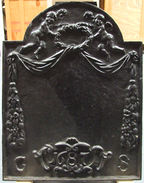
Description: Arched rectangular shape; stepped fillet edging; in the arch, two putti holding a wreath from which hang two swags of drapery which, passing through rings in each top corner of the plate, terminate in large tassels comprising fruit and flowers, which reach nearly to the bottom of the plate; at the bottom, the date in a central cartouche surmounted by a scallop shell, between the two initials.
Notes: The space in the middle of the plate is available for further decoration.
Copies of this fireback are known.
Inscription: G / 1687 / S
- Decoration tags:
- rectangular with round arch (shape)
- cavetto (edging)
- carved pattern panels
- text
- humans
- plants
Manufactured: in 1687 possibly in the Siegerland area of Germany.
Current location: National Maritime Museum, Greenwich, London, England.
Museum number: AAA3478 (part of the National Maritime Museum museum group)
- Attached to series:
- 'Dutch' Border only firebacks
-
1018
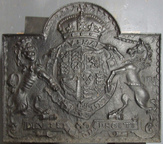
Description: Arched rectangular; cavetto-moulded edging, invected on the inner edge; English royal Stuart shield, garter, crown, supporters and motto; monogram to right of unicorn supporter.
Notes: The monogram probably identifies the pattern-maker, whose invected edging seems to be a distinctive style.
Copies of this fireback are known.
Inscription: HONI SOIT QUI MAL Y PENSE / RN / DIEV ET MON DROIT
Arms: English Stuart royal
- Decoration tags:
- rectangular with round arch (shape)
- cavetto (edging)
- whole carved pattern
- monogram
- armorial
- royal
- text
Manufactured: in the early- to mid-17th century in England.
Current location: National Maritime Museum, Greenwich, London, England.
Museum number: AAA3476 (part of the National Maritime Museum museum group)
- Attached to series:
- RN series
- Stuart royal armorial firebacks
-
76
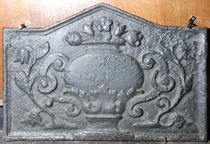
Description: Rectangular with ‘portico’ arch; cavetto edging; two-handled vase, flower stems on each side entwined round handles; flowers emerging from top of vase; base of vase overlaps the edging.
Notes: One of a varied group of small firebacks with bold, simple designs and cavetto edging; formerly in the possession of Gertrude Jekyll, Munstead Wood, near Godalming, Surrey.
- Decoration tags:
- rectangular with triangular arch (shape)
- cavetto (edging)
- whole carved pattern
- plants
- objects
Manufactured: in the mid-17th century possibly in the Weald area of England.
Current location: Guildford Museum, Guildford, Surrey, England.
Museum number: S.7129 (part of the Guildford Museum museum group)
Citation: Jekyll, G., 1903, Old West Surrey, London, Longmans.
- Attached to series:
- Small cavetto series
-
313
Description: Arched rectangular shape; cavetto moulded edging; date top centre within arch.
Notes: Plain elegant fireback from a late series, probably cast in the south east of England. The crack emanating from the top right corner of the fireback seems to be a weakness on all the recorded examples, and may have caused by thinness of the base board at that point.
Inscription: 1853
- Decoration tags:
- rectangular with round arch (shape)
- cavetto (edging)
- carved stamps
- individual numbers
- text
Manufactured: in 1853 in England.
Current location: Nymans, Staplefield Road, Handcross, Slaugham, West Sussex, England.
(part of the National Trust museum group)
- Attached to series:
- 1850s series
- Date only firebacks
-
101
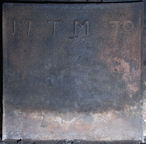
Description: Rectangular; cavetto moulded edging; date aplit by intitials placed centrally at top.
Inscription: 17 TM 70
- Decoration tags:
- rectangular (shape)
- cavetto (edging)
- individual letters
- individual numbers
- text
Manufactured: in 1770 possibly in the Weald area of England.
Current location: in private hands, Hartfield, East Sussex, England.
- Attached to series:
- Date & initials firebacks
-
119
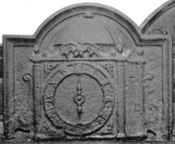
Description: Arched rectangular shape; cavetto moulded edge on all sides; perspective view of a lantern clock.
Notes: The arms of the Worshipful Company of Clockmakers were granted in 1672: Sable a Clock each of the four pillars of the case based on a Lion couchant and capped with a Globe surmounted by a Cross and on the dome of the case an Imperial Crown all Or. The hands of the clock show six o’clock, as on the livery company shield. Formerly part of the Ade Collection (from Grove Hill, Hellingly, Sussex).
Copies of this fireback are known.
- Decoration tags:
- rectangular with round arch (shape)
- cavetto (edging)
- whole carved pattern
- objects
Manufactured: in the mid-17th century in the Weald area of England.
Current location: Hastings Museum and Art Gallery, John's Place, Bohemia Road, Hastings, East Sussex, England.
Museum number: HASMG: 1952.51.48 (LA 776) (part of the Hastings Museum museum group)
- Attached to series:
- Small cavetto series
- Livery company firebacks