-
1294
Description: Rectangular shape; cavetto-moulded edging (top and sides only); top left, initials IL and top right, 1697.
Notes: The style of lettering and numerals indicate that this is a casting from a larger group produced between the late-1660s and late 1690s.
Inscription: IL 1697
- Decoration tags:
- rectangular (shape)
- cavetto (edging)
- carved stamps
- individual letters
- individual numbers
- text
Manufactured: in 1697 in the Weald area of England.
Current location: Parham House, Parham, West Sussex, England.
- Attached to series:
- 1660s-90s Wealden series
-
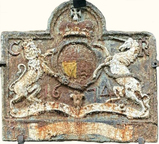
1337
Description: Arched rectangular shape; cavetto moulded edging; garter enclosing Stuart royal arms, with supporters, crown and motto; date split either side of garter buckle; rectangular extension panel at bottom.
Notes: An altered casting from a 1641 original (no. 445). With the exception of the '1' in the date, the numerals have been replaced. From the detail of the relief, probably an early casting.
Inscription: C R / HONI SOIT QVI MAL Y PENSE / 16 64 / DIEV ET MON DROIT
Arms: English Stuart royal
- Decoration tags:
- rectangular with round arch (shape)
- cavetto (edging)
- whole carved pattern
- individual numbers
- extension panels
- armorial
- royal
- text
Manufactured: in 1674 in England.
Current location: in private hands, Penistone, South Yorkshire, England.
- Attached to series:
- Royalist series
- Carolean royal armorial firebacks
- Stuart royal armorial firebacks
-
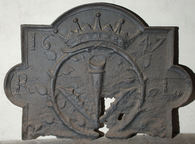
511
Description: Rectangular with semi-circular protrusions on the top and sides; cavetto edging; a pheon (a downward-pointing arrow head barbed on the inner edge), within a wreath, an earl’s coronet above; the date on either side of the coronet; the initials on left and right sides; a fleur de lys in each bottom corner.
Notes: The wreathed pheon and coronet are cast from a different pattern to the 1626 and 1630 plates.
Copies of this fireback are known.
Inscription: 16 47 / R L
- Decoration tags:
- rectangular with round arch (shape)
- cavetto (edging)
- whole carved pattern
- planklines
- heraldic
- text
Manufactured: in 1647 possibly at Robertsbridge Furnace, Salehurst in the Weald area of England.
Current location: Penshurst Place, Penshurst, Kent, England.
- Attached to series:
- Earl of Leicester series
- Personal firebacks
-
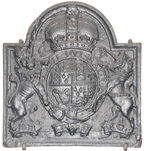
563
Description: Arched rectangular shape; cavetto edging; Stuart royal arms of England (quarterly, 1st and 4th, France and England, 2nd Scotland and 3rd Ireland) with garter, crown, motto and supporters; initials either side of crown base.
Notes: As in others of this series the design overlaps the edging. Mitford collection, Petworth House. Copies were advertised in Longden & Co.'s (Sheffield) catalogue c.1911, and inferior copies in Kings Worthy Foundry's (Winchester) catalogue in the mid-20th century.
Copies of this fireback are known.
Inscription: C R / ...SOIT QVI MAL Y ...
Arms: English Stuart royal
- Decoration tags:
- rectangular with round arch (shape)
- cavetto (edging)
- whole carved pattern
- armorial
- royal
- text
Manufactured: in the mid- to late-17th century in the Weald area of England.
Current location: Petworth House, Petworth, West Sussex, England.
Museum number: NT/PET/M/57 (part of the National Trust museum group)
-
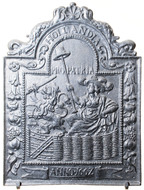
566
Description: Arched rectangular central panel; bead-on-fillet edging; wickerwork Garden of Holland (Hollandse Tuin) within which is seated a berobed female figure holding a cap of freedom on the end of a long pole; before her is the crowned heraldic lion of the States General of the Netherlands, clutching a sheaf of arrows in its left front paw; above are the words, Pro Patria; arched rectangular border with cavetto-moulded edging, with the word, Hollandia, in the arch, suspended from which are festoons of flowers and fruit and the date within a scroll on the bottom; on top, a scallop shell between two mirrored serpents.
Notes: An overtly patriotic theme with symbols of Dutch nationhood. Mitford collection, Petworth House.
Copies of this fireback are known.
Inscription: HOLLANDIA / PRO PATRIA / ANNO 1662
- Decoration tags:
- 'Dutch' (shape)
- cavetto (edging)
- whole carved pattern
- heraldic
- pictorial
- allegorical
- text
- humans
Manufactured: in 1662 in the Siegerland area of Germany.
Current location: Petworth House, Petworth, West Sussex, England.
Museum number: NT/PET/M/59 (part of the National Trust museum group)
- Attached to series:
- 'Dutch' Garden of Holland firebacks
-
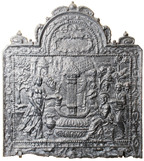
569
Description: Rectangular central panel with bead edging all round, pictorial scene of a landscape at the fore of which Jesus sits at a well with the woman of Samaria; above the panel is a bead-edged arch with a floral wreath; arched rectangular border with canted top corners and cavetto-moulded edging; repeated low-relief pattern of linked squares and diamonds; at the bottom, indistinct floral swirls; on top, a small crown with descending mirrored swirls.
Notes: The scene is from John 4. Mitford collection, Petworth House.
Manufactured: in the mid- to late-17th century possibly in the Siegerland area of Germany.
Current location: Petworth House, Petworth, West Sussex, England.
Museum number: NT/PET/M/61 (part of the National Trust museum group)
- Attached to series:
- 'Dutch' Miscellaneous Firebacks
- New Testament firebacks
-
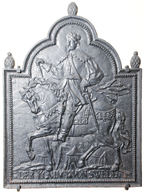
574
Description: Arched rectangular central panel with arch and bead edging within a similarly shaped cavetto-moulded border and pomegranates on to and on the ach shoulder of the plate; pictorial representation of the king of Sweden mounted on a horse.
Notes: The king would be Gustav II. There is a companion fireback bearing the image of Prince Fredrik Henrik of Oranje. Mitford collection, Petworth House.
Copies of this fireback are known.
Inscription: DIE KONINCK VON SWEDEN
- Decoration tags:
- rectangular with arch above arch (shape)
- cavetto (edging)
- whole carved pattern
- pictorial
- historical
- royal
- text
- animals
- humans
Manufactured: in the mid- to late-17th century in the Siegerland area of Germany.
Current location: Petworth House, Petworth, West Sussex, England.
Museum number: NT/PET/M/65 (part of the National Trust museum group)
- Attached to series:
- 'Dutch' Miscellaneous Firebacks
- Commemorative firebacks
-
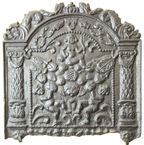
575
Description: Arched rectangular shape; cavetto-moulded edging; on each side a column of small overlapping leaves above a pedestal with a single acanthus leaf; issuing from the top of each column two ribbons, in figure-of-eight with grenade terminals, fly across the arch; within an arched rectangular central panel with bead edging three naked children disport about a swag of fruit, with a central pomegranate, suspended from the top of each column; one figure sits on the top, facing right, the other two hang symmetrically from below, with mirrored swirls behind them; along the base is a line of acanthus leaves; on top a sea serpent is curled on each end.
Notes: The design may have been inspired by the paintings of Jan Pauwel Gillemans the younger (1651-1704); he may have worked in London in 1675-8. Another version of the fireback (no. 591), probably by the same pattern-maker, has a slightly different design. Mitford collection, Petworth House.
Copies of this fireback are known.
- Decoration tags:
- 'Dutch' (shape)
- cavetto (edging)
- whole carved pattern
- planklines
- pictorial
- mythological
- humans
- plants
Manufactured: in the late-17th century in England.
Current location: Petworth House, Petworth, West Sussex, England.
Museum number: PET/M/66 (part of the National Trust museum group)
- Attached to series:
- Carolean 'Dutch' series
-
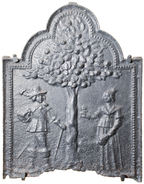
578
Description: Arched rectangular shape with arch; bead-on-fillet edging within a cavetto-moulded border; pictorial representation of a man and woman in the dress of the mid 17th century, with a fruit tree between them.
Notes: The significance of this design has not been satisfactorily explained. Carpentier suggests it may be a contemporary depiction of Adam and Eve. Mitford collection, Petworth House.
Copies of this fireback are known.
- Decoration tags:
- rectangular with arch above arch (shape)
- cavetto (edging)
- whole carved pattern
- pictorial
- humans
Manufactured: in the mid- to late-17th century in the Siegerland area of Germany.
Current location: Petworth House, Petworth, West Sussex, England.
Museum number: NT/PET/M/69 (part of the National Trust museum group)
Citation: Carpentier, H., 1912, Plaques de Cheminées (Paris, published by the author).
- Attached to series:
- 'Dutch' Miscellaneous Firebacks
-
581
Description: Arched rectangular central panel with arch and bead-on-fillet edging; pictorial representation of a popinjay, or parrot, perched on a ring suspended by a string, the bird is clutching an olive twig, two others are below; arched rectangular border with arch; cavetto-moulded edging;to left and right, a Corinthian column with twisted lower part, and an entablature above; at top, a central flower with scrolls descending on both sides of the arch; on top, n orb, repeated on each shoulder of the plate.
Notes: The inscription is a mis-spelling of the German for parrot; the parrot on the ring perch is a popular design on Dutch firebacks. Mitford collection, Petworth House.
Copies of this fireback are known.
Inscription: PAPEGEI
- Decoration tags:
- rectangular with arch above arch (shape)
- cavetto (edging)
- whole carved pattern
- pictorial
- architectural
- text
- animals
Manufactured: in the mid- to late-17th century in the Siegerland area of Germany.
Current location: Petworth House, Petworth, West Sussex, England.
Museum number: NT/PET/M/72 (part of the National Trust museum group)
- Attached to series:
- 'Dutch' Miscellaneous Firebacks
- 'Dutch' Bird on perch firebacks