-
292
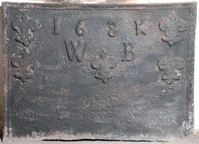
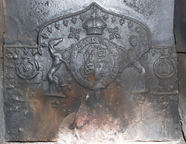
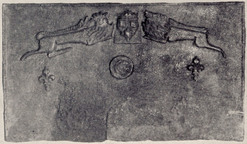
Description: Rectangular; cavetto-moulded edging; top centre, date, above initials; two low-relief fleurs de lys down each side from top corners, and central fleur below and between the initials.
Notes: The initials may relate to William Boevey who was owner of Flaxley furnace from 1683-92. Another fireback with the same date and initials, and more fleurs, is also known.
Inscription: 1685 / W B
- Decoration tags:
- rectangular (shape)
- astragal with cavetto (edging)
- carved stamps
- heraldic
- text
Manufactured: in 1685 at Flaxley Furnace in the Forest of Dean area of England.
Current location: Flaxley Abbey, Flaxley, Gloucestershire, England.
Citation: Bick, D. E. [incorrectly printed as Bick, R.], Sept 1985, 'Firebacks', Period Homes, pp. 21-4.
- Attached to series:
- Boevey series
- Fleur-de-lys firebacks
-
298
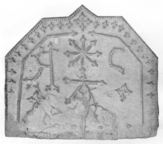
Description: Pentagonal with a small triangular arch, centre top; twisted rope edging (top and sides); in arch, cross formed of small fleurs-de-lys; row of small fleurs inside rope edging, lower half of sides plain; length of twisted rope each side, parallel to edges, with small fleur terminal at top end; upper centre, rope escarbuncle with fleur terminals between ‘R’ and ‘C’ (both of rope with fleur terminals, ‘R’ reversed); ‘A’ below escarbuncle (also rope with fleur terminals, with cross bar above); fleur cross below ‘R’.
Notes: Twisted rope with fleur terminals is seen on several firebacks with stamps otherwise associated; it is a form paralleled on firebacks from the Champagne area of France. The escarbuncle is the principal charge on the arms of the Duchy of Cleves, possibly associating this fireback with the brief marriage of Henry VIII and Anne of Cleves. Formerly at Warnham Court, Sussex; illustrated in Gardner 1898, p. 146.
Inscription: R A C [inverted triad]
- Decoration tags:
- rectangular with canted top corners and triangular arch (shape)
- rope (edging)
- simple stamps
- objects
Manufactured: in the mid- to late-16th century possibly at Pounsley Furnace, Framfield in the Weald area of England.
Current location: not known.
Citation: Gardner, J. S., 1898, 'Iron Casting in the Weald', Archaeologia, 56, 1, pp. 133-164.
-
306
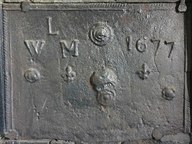
Description: Rectangular; twisted rope edging (top and sides) with a fillet inside; top centre, concentric roundel with rose-and-crown below; top left, initials in triad with small rose below 'W' and small fleur-de-lys below 'M'; upper right, date with small fleur below '6' and small rose lower, below second '7'.
Notes: The style of rose and crown is similar to that used in gun founding in the Tudor period, suggesting that the furnace that was the source of this fireback may have been previously used for that purpose.
Inscription: WLM [triad] 1677
- Decoration tags:
- rectangular (shape)
- rope (edging)
- carved stamps
- individual letters
- individual numbers
- heraldic
- text
- objects
Manufactured: in 1677 in the Weald area of England.
Current location: in private hands, Speldhurst, Kent, England.
- Attached to series:
- 1660s-90s Wealden series
- Fleur-de-lys firebacks
-
88
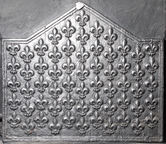
Description: Rectangular with triangular arch; stepped fillet edging; eleven columns of fleurs de lys, maximum seven in column, but varied according to space, with fleurs alternated for spacing.
Notes: Whole pattern with five vertical planklines; a field of small fleurs de lys, France Ancient in royal heraldry, might suggest a continental origin.
Copies of this fireback are known.
- Decoration tags:
- rectangular with triangular arch (shape)
- stepped fillet (edging)
- whole carved pattern
- planklines
- heraldic
- objects
Manufactured: in the late-16th to early-17th century possibly in the Weald area of England.
Current location: Hampton Court, Richmond, Greater London, England.
- Attached to series:
- Miscellaneous royal firebacks
- Fleur-de-lys firebacks
-
90
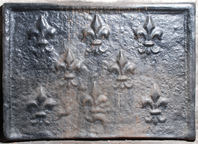
Description: Rectangular; ovolo moulded edging (top and sides); eight impressions of a fleur de lys, arranged in three horizontal rows (3-2-3), carefully spaced.
Notes: The same fleur de lys stamp has been noted on several firebacks, indicating a common source.
Copies of this fireback are known.
- Decoration tags:
- rectangular (shape)
- ovolo (edging)
- carved stamps
- heraldic
- objects
Manufactured: in the mid- to late-16th century possibly at Pounsley Furnace, Framfield in the Weald area of England.
Current location: Hampton Court, Richmond, Greater London, England.
(part of the Royal Collection museum group)
- Attached to series:
- Pounsley series
- Fleur-de-lys firebacks
-
311
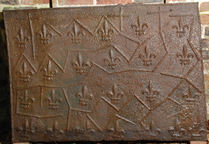
Description: Quasi-rectangular; twisted rope edging (top and sides); fleur-de-lys stamp repeated 25 times in four rows (6-6-6-7), interspersed with a length of twisted rope repeatedly stamped between each row and sometimes between fleurs; three rope crosses near top corners.
Notes: The fleurs are identical to others from the ‘Pounsley’ series.
- Decoration tags:
- rectangular (shape)
- rope (edging)
- simple stamps
- carved stamps
- heraldic
- objects
Manufactured: in the mid- to late-16th century possibly at Pounsley Furnace, Framfield in the Weald area of England.
Current location: Nymans, Staplefield Road, Handcross, Slaugham, West Sussex, England.
(part of the National Trust museum group)
- Attached to series:
- Pounsley series
- Fleur-de-lys firebacks
-
124
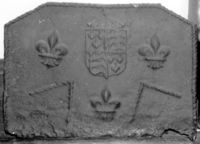
Description: Canted rectangle; twisted rope edging (top and sides); top centre, crowned Tudor royal shield; fleur de lys on each side and below; slanting, inverted 'V' of twisted rope on each side of lower fleur.
Notes: One of a large series of firebacks incorporating Tudor heraldic stamps; the 'V' shapes may have apotropaic significance.
Arms: Tudor royal arms of England
- Decoration tags:
- rectangular with canted top corners (shape)
- rope (edging)
- simple stamps
- carved stamps
- heraldic
- apotropaic
- armorial
- objects
Manufactured: in the mid-16th century in the Weald area of England.
Current location: Hastings Museum and Art Gallery, John's Place, Bohemia Road, Hastings, East Sussex, England.
Museum number: HASMG: 1904.32 (part of the Hastings Museum museum group)
- Attached to series:
- Royal series
- Fleur-de-lys firebacks
-
131
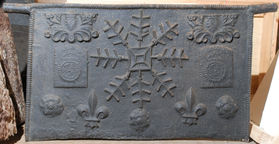
Description: Rectangular with lifting handles; twisted rope edging (top and sides); elaborate central rope design of concentric squares with eight symmetrical arms each with six branches; two crowned rose en soleil stamps left and right centre; three roses across the bottom interspersed with two fleurs de lys; in top corners, two carved furniture-derived stamps. The width of the main plate is 876mm.
Notes: The rose-en-soleil was the badge of King Edward IV and, thus, a Yorkist symbol. The individual stamps are to be seen, separately or together, on other firebacks, indicating a common source; lifting handles are infrequently encountered on firebacks. The elaborate central rope array may be an interpretation of the escarbuncle, which was the principal heraldic charge on the arms of the Duchy of Cleves (1515-57), possibly associating this fireback with the brief marriage of Henry VIII and Anne of Cleves. Formerly part of the Ade Collection (from Grove Hill, Hellingly, Sussex).
- Decoration tags:
- rectangular (shape)
- rope (edging)
- simple stamps
- carved stamps
- lifting handles
- heraldic
- architectural
- objects
Manufactured: in the mid- to late-16th century possibly at Pounsley Furnace, Framfield in the Weald area of England.
Current location: Hastings Museum and Art Gallery, John's Place, Bohemia Road, Hastings, East Sussex, England.
Museum number: HASMG: 1952.51.44 (part of the Hastings Museum museum group)
-
189
Description: Rectangular with an ogee arch; twisted rope edging (top and sides); line of small fleurs-de-lys around the top and sides, inside the edging; Tudor rose inside each top corner (overstamped on the left); below each rose an escarbuncle of twisted rope with fleur de lys terminals (understamped); top centre, a Tudor royal shield within an oval garter - HONE SOVT QUEY MAL Y PENSE - with greyhound and lion supporters, and crown above; cross of small fleurs inclined to each side of the crown; inverted 'Y' shape in twisted rope below each supporter, a fleur at the top end of each.
Notes: An oft-used achievement of arms; twisted rope with fleur de lys terminals are seen on other firebacks from the same source; it is a form paralleled on firebacks from the Champagne area of France. The escarbuncle was the principal charge on the arms of the Duchy of Cleves, the same charge on this fireback possibly associating it with the brief marriage of Henry VIII and Anne of Cleves.
Inscription: HONE SOVT QUEY MAL Y PENSE
Arms: Tudor royal (prob. Elizabeth I)
- Decoration tags:
- rectangular with ogee-arch (shape)
- rope (edging)
- carved stamps
- heraldic
- armorial
- royal
- text
- objects
Manufactured: in the mid- to late-16th century possibly at Pounsley Furnace, Framfield in the Weald area of England.
Current location: in private hands, Hatfield, Hertfordshire, England.
-
1174
Description: Rectangular; twisted rope edging (top and sides); top centre, crowned shield bearing initials, KH, above a fleur-de-lys, between a leopard passant guardant sinister (on the left) and a leopard passant (on the right); below the rear legs of each leopard, a fleur-de-lys, each inclined slightly outwards at the top; beneath, and slightly to the left of the shield a circular stamp bearing the letter C.
Notes: One of the legs of the leopard on the right is missing, suggesting that the stamps, which appear complete on many firebacks, were well used and had been damaged; this suggests a relatively late use of these stamps. The style of fleur-de-lys is one of two seen on this series of firebacks. The fireback was formerly at Marden Hill House, Tewin, Hertfordshire.
Inscription: C
- Decoration tags:
- rectangular (shape)
- rope (edging)
- carved stamps
- heraldic
- royal
- text
- animals
- objects
Manufactured: in the mid- to late-16th century in the Weald area of England.
Current location: Hertford Museum, 18 Bull Plain, Hertford, Hertfordshire, England.
Museum number: HETFM2893.2 (part of the Hertford Museum museum group)
- Attached to series:
- Royal series
- Fleur-de-lys firebacks