-
832
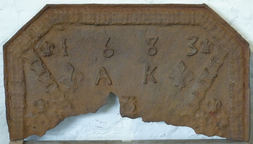
Description: Canted rectangular; astragal edging (top and sides), inside of which are repeated panels carved with overlapping fleurs-de-lys; upper centre, date evenly spaced in individual numerals; below date, initials evenly spaced in individual letters; at each end of date, single small fleur-de-lys stamp; at each end of initials, large hollow fleur-de-lys; diagonally from each lower corner of canting, line of six squared cross stamps; in bottom corners, triad of small fleur-de-lys stamps each enclosing a large fleur below; bottom centre, woodblock stamp.
Notes: The repeated fleur panels are likely to have derived from furniture. Varied use of the same stamps are on other firebacks, including one dated 1667 at Upper End Farm, Hope Mansell, Herefordshire.
Inscription: 1683 / AK
- Decoration tags:
- rectangular with canted top corners (shape)
- astragal (edging)
- carved stamps
- individual letters
- individual numbers
- heraldic
- text
- objects
Manufactured: in 1683 in the Forest of Dean area of England.
Current location: not known.
-
338
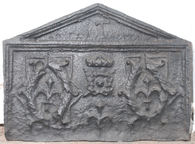
Description: Rectangular with pediment; ovolo moulded edging inside top of pediment and inside top and sides of rectangle; centre top, four-petal rose and crown with fleur de lys below; at either end, stamps made from two parts of a wreath (the middle section missing) enclosing a fleur de lys.
Notes: The wreaths from which the stamps have been disassembled can be seen complete on three other firebacks, and the rose and crown is a common stamp on a large series of early firebacks.
Inscription: ?I T
- Decoration tags:
- triangular arched (shape)
- ovolo (edging)
- carved stamps
- individual letters
- heraldic
- text
- objects
Manufactured: in the late-16th century in the Weald area of England.
Current location: in private hands Burford, Oxfordshire, England.
- Attached to series:
- Royal series
- Royal (wreath) series
- Fleur-de-lys firebacks
-
942
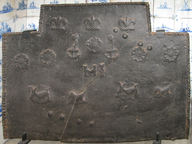
Description: Rectangular with a central rectangular extension; twisted rope edging; fleur-de-lys stamp with twisted band repeated three times at top; ?rose stamp repeated five times in line below fleurs, some over pressed, central rose above others; cabled anchor stamp repeated twice, either side of central rose; initials below central rose; ?cow and dog stamps each repeated twice alternately in line below initials; eight rivets from later repair.
Notes: None of the stamps is known from any other fireback; cabled anchor may suggest a connection with a seaport.
Inscription: HI
- Decoration tags:
- rectangular with square arch (shape)
- rope (edging)
- simple stamps
- carved stamps
- individual letters
- heraldic
- text
- animals
- plants
- objects
Manufactured: in the early-17th century in England.
Current location: Wilberforce House, High Street, Kingston upon Hull, Yorkshire, England.
(part of the Hull Museums museum group)
- Attached to series:
- Miscellaneous stamp firebacks
- Fleur-de-lys firebacks
-
841
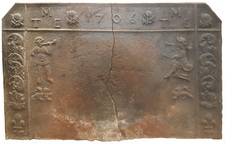
Description: Canted rectangle; cavetto-moulded edging (top and sides); single horizontal fillet below canted corners and vertical fillet parallel to each side, dividing the fireback into two side panels, two top corner panels, top panel and main central panel; corner panels, ‘daisy’ plant stamp; top panel, date between ‘daisy’ stamps, between initials in triad at each end; side panels, swirling foliage stamp repeated each side above a fleur-de-lys; centre panel, stamp of ‘Indian’ smoking a pipe at top left, stamp of seated ‘gentleman’ smoking a pipe and holding another, at top right; below each, a lion passant stamp, facing right on the left and facing left on the right; initials IB in bottom corners of centre panel.
Notes: The 'daisy' stamp is identical to those on similar firebacks dated between 1703 and 1721, and probably indicating the same founder whose initials IB are at the bottom; the use of stamps relating to tobacco smoking may suggest an origin near Bristol, the main entry port for the tobacco trade at that time. Previously noted at Little Faringdon House, near Lechlade. Bishop & Miller auction, Stowmarket, Suffolk, 25 May 2022, lot 293 (ns).
Inscription: TME [triad] 1706 TME [triad] / I B
- Decoration tags:
- rectangular with canted top corners (shape)
- cavetto (edging)
- carved stamps
- individual letters
- individual numbers
- heraldic
- text
- animals
- humans
- plants
- objects
Manufactured: in 1706 in the Forest of Dean area of England.
Current location: not known.
- Attached to series:
- IB series
- Fleur-de-lys firebacks
-
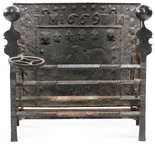
1097
Description: Rectangular; cavetto-moulded edging; [?]fillet frame parallel with edging; on top, central date between two groups of initials in triad, with six 'daisy heads' above; on each side, vertical line of at least four squared cross stamps; inside frame, four fleurs-de-lys between two oval 'buttons' on a rectangular base at least five 'daisy heads' in a vertical line on each side.
Notes: A significant fireback, it comprises decorative stamps from at least three series of firebacks produced in the Forest of Dean area, linking their production to the same ironworks. The same fireback (or copies thereof), with and without the attached grate, was illustrated in catalogues issued c1910-21 by Arthur Todhunter, architectural antiques dealer, of New York (catalogue #919, $50). Leland Little auction, Hillsborough, North Carolina, 3 Mar 2018, lot 260, $400.
Inscription: THM [triad] 1669 THM [triad]
- Decoration tags:
- rectangular (shape)
- cavetto (edging)
- carved stamps
- individual letters
- individual numbers
- heraldic
- text
- objects
Manufactured: in 1669 possibly at Elmbridge Furnace, Newent in the Forest of Dean area of England.
Current location: not known.
-
371
Description: Rectangular; twisted rope edging (top and sides); top row, two square-within-a-square arrangements of twisted rope between three stamps formed of Gothic tracery cresting; 2nd row, two more tracery cresting stamps (the one on the right over stamping a fleur-de-lys) between two crowned, star-embossed butter mould stamps with a crowned rose-en-soleil stamp in the middle; 3rd row, three star-embossed butter mould stamps with two pairs of fleurs-de-lys between them; bottom row, seven fleurs-de-lys; plus interspersed short rope lengths, and a vertical, double zig-zag arrangement of rope lengths on each side.
Notes: The rose-en-soleil was the badge of King Edward IV and, thus, a Yorkist symbol. Many of the stamps employed on this fireback are seen, with other stamps, on a wide variety of firebacks, suggesting a common source; similar gothic tracery stamps can be seen as pierced cresting on a rare late-Medieval, wooden Easter sepulchre at the redundant church of St Michael at Cowthorpe, North Yorkshire. Another fireback with an almost identical arrangement of the same stamps has also been noted (no. 713).
- Decoration tags:
- rectangular (shape)
- rope (edging)
- simple stamps
- carved stamps
- heraldic
- objects
Manufactured: in the mid- to late-16th century possibly at Pounsley Furnace, Framfield in the Weald area of England.
Current location: Anne of Cleves House, Southover High Street, Lewes, East Sussex, England.
Museum number: LH000.940 (part of the Sussex Archaeological Society museum group)
-
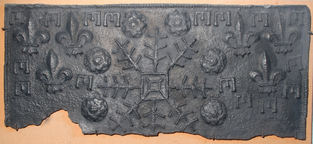
375
Description: Rectangular; twisted rope edging (top and sides); central rope carbuncle with eight arms, with a rose between each of the top six pairs of arms; a fleur-de-lys repeated six times in two triads (2-1) in each top corner; a letter ‘E’ rotated clockwise repeated 8 times along the top between the fleurs and roses, and twice down each side; four additional ‘E’s, one to the left of the carbuncle and three to the right.
Notes: All the stamps can be seen on other firebacks associating them with the same source; The ‘E’s are identical to those seen on the John Harvo armorial fireback. The elaborate central rope array may be an interpretation of the escarbuncle, which was the principal heraldic charge on the arms of the Duchy of Cleves, possibly associating this fireback with the brief marriage of Henry VIII and Anne of Cleves. Formerly part of the J. H. Every collection.
- Decoration tags:
- rectangular (shape)
- rope (edging)
- simple stamps
- carved stamps
- heraldic
- text
- objects
Manufactured: in the mid- to late-16th century possibly at Pounsley Furnace, Framfield in the Weald area of England.
Current location: Anne of Cleves House, Southover High Street, Lewes, East Sussex, England.
Museum number: 1944.24.076 (part of the Sussex Archaeological Society museum group)
Citation: Hughes, G. B., 1960, Collecting Antiques (London, Country Life), pp. 85-93.
Citation: Hughes, G. B., May 1940, 'Old English Firebacks', Apollo, 31, 185, pp. 117-120.
- Attached to series:
- Pounsley series
- Fleur-de-lys firebacks
-
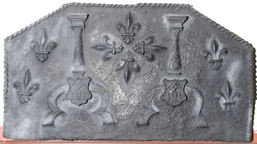
393
Description: Rectangular with canted top corners; twisted rope edging all round except base: plain plate with two stamps of an iron firedog with twisted neck and shield bearing letters HN and crossed staples; firedogs have columnar capitals; fleur de lys stamp repeated six times, singly at each end, in star pattern in middle; stamps have twisted wreaths.
Notes: The initials HN probably refer to Henry Nevill, the crossed staples being a badge of the Nevill family. Henry Nevill occupied Mayfield furnace from about 1585 until 1599. One of two variants (see no. 742) with the same firedogs and fleurs-de-lys; other firedogs in a very similar style are known. Formerly at Holmbush Farm, Hellingly, Sussex.
Inscription: HN HN
- Decoration tags:
- rectangular with canted top corners (shape)
- rope (edging)
- simple stamps
- carved stamps
- heraldic
- text
- objects
Manufactured: in the late-16th century possibly at Mayfield Furnace in the Weald area of England.
Current location: Anne of Cleves House, Southover High Street, Lewes, East Sussex, England.
Museum number: LH000.902 (part of the Sussex Archaeological Society museum group)
Citation: Anon., 30 Dec 1911, 'Sussex Backs and their Story', The Ironmonger.
Citation: Dawson, C., 1903, 'Sussex Iron Work and Pottery', Sussex Archaeological Collections, 46, pp. 1-54.
Citation: Gardner, J. S., 1898, 'Iron Casting in the Weald', Archaeologia, 56, 1, pp. 133-164.
-
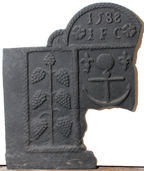
439
Description: Fragment; left part only; this fireback comprises at least four separate elements: the rectangular central panel has an anchor with coiled rope between two fleurs de lys, below which are two roses; the rectangular side panels each comprise a vertical stem with six ‘grape bunches’ surmounted by a circular grape cluster; above, a semicircular arch contains the initials between two roses as in the central panel, with the date above; where the arch meets the central panel there is an arc across each corner. The side and top panels are edged with simulated twisted rope; to the left and botoom, a plain extension has been added before casting.
Notes: One of an unusual series formed from separate panels. The left panel is likely to have been repeated in the missing section. The extensions to the side and bottom will be unique to this casting which, because of the sharpness of the relief detail, is probably an early example. Because of its date and the use of the anchor motif, this much-copied plate is often referred to as the Armada fireback. No other connection with the sea battle is known. Other firebacks have been cast using some of the separate elements described.
Inscription: 1588 / IFC
- Decoration tags:
- rectangular with round arch (shape)
- none (edging)
- carved pattern panels
- heraldic
- text
- plants
- objects
Manufactured: in 1588 in the Weald area of England.
Current location: Anne of Cleves House, Southover High Street, Lewes, East Sussex, England.
Museum number: 1944.24.060 (part of the Sussex Archaeological Society museum group)
- Attached to series:
- Armada series
- Fleur-de-lys firebacks
-
964
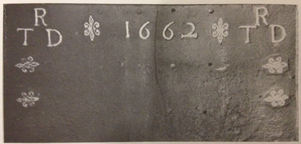
Description: Rectangular; Twisted rope edging (top and sides); top centre, date; initials in triad in top corners; a double fleurs-de-lys between date and each set of initials, and two rotated down each side of the plate.
Notes: Formerly at a cottage in Bradford's Lane, Newent, Gloucestershire. Illustration from Bick 1987.
Inscription: TRD / 1662 / TRD
- Decoration tags:
- rectangular (shape)
- rope (edging)
- carved stamps
- individual letters
- individual numbers
- heraldic
- text
Manufactured: in 1662 in the Forest of Dean area of England.
Current location: The Glasshouse Inn, May Hill, Longhope, Gloucestershire, England.
Citation: Bick, D. E., 1987, The Mines of Newent and Ross, (Newent, The Pound House), p. 35.
- Attached to series:
- Miscellaneous stamp firebacks
- Fleur-de-lys firebacks