-
865
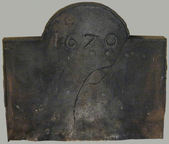
Description: Arched rectangle; twisted rope edging (top and sides); central date at bottom of arch.
Inscription: 1670
- Decoration tags:
- rectangular with round arch (shape)
- rope (edging)
- individual numbers
- text
Manufactured: in 1670 in England.
Current location: not known.
- Attached to series:
- Date only firebacks
-
872
Description: Arched rectangular shape; rebated fillet edging (top and sides); word 'BERSHAM' (AM ligature) in arch; initials triad 'C LL S' (LL ligature) in left shoulder; date on two lines in right shoulder.
Notes: The initials are likely to be those of Charles Lloyd of Dolobran, Montgomeryshire, and Sarah (née Crowley) his wife. Lloyd ran Bersham Furnace, near Wrexham, from 1710 until 1728. Smelting iron with coke began at Bersham in 1721, so it is likely that this fireback was made of coke-smelted iron.
Inscription: BERSHAM / LL 17 / C S 22
- Decoration tags:
- rectangular with round arch (shape)
- rebated fillet (edging)
- carved stamps
- individual letters
- individual numbers
- text
Manufactured: in 1722 at Bersham Furnace in the North Wales area of Wales.
Current location: Wrexham Museum, Wrexham, Clwyd, Wales.
(part of the Wrexham County Borough Museums museum group)
- Attached to series:
- Date & initials firebacks
-
877
Description: Low arched rectangle; astragal and stepped fillet edging; slanted shield, helm and mantling; crest missing; at bottom, date split either side of shield.
Notes: The arms are of the Pollen family of Redenham, Hampshire; blazon: azure, on a bend cotised or between six lozenges argent each charged with an escallop sable, five escallops vert.
Inscription: 19 27
Arms: Pollen of Andover, Hampshire
- Decoration tags:
- rectangular with round arch (shape)
- astragal and stepped fillet (edging)
- whole carved pattern
- armorial
Manufactured: in 1927 in England.
Current location: not known.
- Attached to series:
- Personal armorial firebacks
-
253
Description: Arched rectangular shape; cavetto moulded edging; garter enclosing Stuart royal arms, with supporters, crown and motto; date split either side of garter buckle; rectangular extension panel at bottom.
Notes: An altered casting from a 1641 original (no. 445), the last part of the date having disproportionate numerals; often copied. From the detail of the relief, probably an early casting. Inferior copies of this fireback were advertised in Kings Worthy Foundry's (Winchester) catalogue in the mid-20th century.
Copies of this fireback are known.
Inscription: C R / HONI SOIT QVI MAL Y PENSE / 16 64 / DIEV ET MON DROIT
Arms: English Stuart royal
- Decoration tags:
- rectangular with round arch (shape)
- cavetto (edging)
- whole carved pattern
- individual numbers
- extension panels
- armorial
- royal
- text
Manufactured: in 1664 possibly in the Weald area of England.
Current location: not known.
- Attached to series:
- Carolean royal armorial firebacks
- Stuart royal armorial firebacks
- Royalist series
-
1054
Description: Arched rectangular shape; chamfered edging; 'renaissance' style shield with floriate decoration; incised heraldic design.
Notes: The arms are of Sir John Herbert Vernon Bt. impaling those of his wife, Elizabeth Bagnall; Blazon: (Vernon) Or, on a fess azure between two crosses moline gules three garbs of the field, a canton of a baronet; (Bagnall) Ermine, two bars or, over all a lion rampant azure. The fireback dates from between 1919, when Sir John inherited the baronetcy and his death in 1933.
Arms: Vernon impaling Bagnall
- Decoration tags:
- rectangular with round arch (shape)
- chamfered (edging)
- whole carved pattern
- heraldic
- armorial
Manufactured: in the early-20th century in England.
Current location: not known.
- Attached to series:
- Personal armorial firebacks
-
965
Description: Upon a moulded base plinth, wide scrolled side double fillets with foliage about the scrolls and suspended bell flowers in chain above; central foliate cartouche behind an oval shield surmounted by a viscomte's coronet; on top, an arch rising from horizontal moulding on each side.
Notes: Blazon: Azure, a chevron Argent between three estoiles Or, all surmounted by a bar of the second; characteristic of designs illustrated by architects such as Daniel Marot; the texturing on the shield indicates the azure tincture. See Carpentier p. 234, fig. 644.
Arms: Besset de la Chapelle
- Decoration tags:
- rectangular with round arch (shape)
- complex individual (edging)
- whole carved pattern
- armorial
Manufactured: in the late-17th to early-18th century in France.
Current location: not known.
Citation: Carpentier, H., 1912, Plaques de Cheminées (Paris, published by the author).
- Attached to series:
- Foreign armorial firebacks
-
982
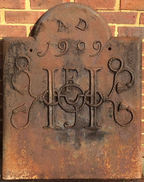
Description: Arched rectangular shape with demi-bullnose edging (top and sides); 'AD' curved in arch, with straight date below; central letter 'H' in the form of a horse's bit, with initials 'F' and 'J' respectively above and below; two lengths of rope with tasselled ends looped and tied symmetrically around the 'H' and on each side.
Notes: A finely moulded personal fireback with an equestrian connection.
Inscription: AD / 1909 / HFJ
- Decoration tags:
- rectangular with round arch (shape)
- demi-bullnose (edging)
- whole carved pattern
- monogram
- text
- objects
Manufactured: in 1909 in England.
Current location: not known.
- Attached to series:
- Personal firebacks
- Miscellaneous stamp firebacks
-
990
Description: Complex quasi-arched rectangular shape with fillet edging; bell flowers descending from the top of the arch; double fillet scrolls at the side with cockerel terminals; under the arch, a royal crown surmounting a counter-posed double 'L' monogram enclosing a human mask with a sunburst; below, a table draped with a cloth bearing a circular royal shield of France within palm leaves.
Notes: A very elaborate and symbolic design alluding to the Sun King, Louis XIV.
- Decoration tags:
- rectangular with round arch (shape)
- fillet (edging)
- whole carved pattern
- architectural
- monogram
- humans
- plants
Manufactured: in the late-17th to early-18th century in France.
Current location: not known.
- Attached to series:
- Foreign armorial firebacks
-
989
Description: Arched rectangular shape with fillet edging; within an arched rectangular border alternating repeated acanthus leaves, and a floral cartouche, a heart-shaped shield of the royal arms of France, surmounted by a royal crown and within splayed olive branches.
Arms: France Royal
- Decoration tags:
- rectangular with round arch (shape)
- fillet (edging)
- whole carved pattern
Manufactured: in the late-17th century in France.
Current location: not known.
- Attached to series:
- Foreign armorial firebacks
-
736
Description: Other examples indicate that this fireback comprises at least four separate elements: the rectangular central panel has an anchor with coiled rope between two fleurs de lys, below which are two roses; this arrangement is repeated alongside; the two rectangular side panels each comprise a vertical stem with six ‘raspberries’ surmounted by a circular berry cluster; above, a semicircular arch contains the initials between two roses as in the central panel, with the date above; where the arch meets the central panel there is an arc across each corner; on the rectangular base panel, on a stippled ground, is a central six-pointed star and a four-strand root system beneath each of the stems in the side panels. The top and sides panels are edged with simulated twisted rope.
Notes: One of an unusual series formed from separate panels arranged, in this instance, with each vertical panel repeated. Because of its date and the use of the anchor motif, this much-copied plate is often referred to as the Armada fireback. No other connection with the sea battle is known. Other firebacks have been cast using some of the separate elements described above. The bottom panel which, unlike the other panels is separately edged with twisted rope, is likely to have been an addition to a copy of an earlier casting (no. 822) and not original.
Copies of this fireback are known.
Inscription: 1588 / IFC
- Decoration tags:
- rectangular with round arch (shape)
- simulated rope (edging)
- carved pattern panels
- text
- plants
- objects
Manufactured: in the late-16th century in the Weald area of England.
Current location: Victoria & Albert Museum, Cromwell Road, Kensington & Chelsea, Greater London, England.
Museum number: M.77-1957 (part of the Victoria & Albert Museum museum group)
Citation: Lloyd, N., 1925, 'Domestic Ironwork I', Architectural Review, 58, pp. 58-67.
- Attached to series:
- Armada series