-
367
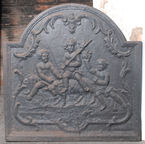
Description: Arched rectangular shape; fillet and cavetto moulded edging; pictorial scene of three children, the centre one holding a stick strung with a bunch of grapes over his shoulder, and sitting on a goat.
Notes: A mythological scene of the young Bacchus.
- Decoration tags:
- rectangular with round arch (shape)
- fillet and cavetto (edging)
- whole carved pattern
- pictorial
- mythological
- humans
Manufactured: in the 18th century in France.
Current location: Newarke Houses, Leicester, Leicestershire, England.
Museum number: H.358.1953.0.0 (part of the Leicester City Museums museum group)
Citation: Carpentier, H., 1912, Plaques de Cheminées (Paris, published by the author).
- Attached to series:
- Miscellaneous pattern firebacks
-
1083
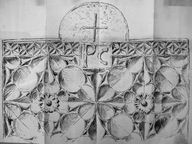
Description: Arched rectangular shape; fillet edging (top and sides); twisted rope cross in centre of arch; fillet-edged square below arch containing initials of uneven size; along the top, a line of five quatrefoils on each side of the initials; below, two symmetrically carved roundels and associated spandrels, each with a central flower.
Notes: The quatrefoils and roundels are likely to have been part of a redundant, probably medieval, furniture panel, perhaps from a chest. The life-size rubbing, reinforced with ink, is by W. R. Lethaby. The fireback was formerly property of the artist John Callcott Horsley RA (1817-1903) at Wilsley Green, Cranbrook, Kent.
Inscription: PC
- Decoration tags:
- rectangular with round arch (shape)
- fillet (edging)
- carved pattern panels
- apotropaic
- text
- objects
Manufactured: in the mid- to late-16th century possibly in the Weald area of England.
Current location: Victoria & Albert Museum, Cromwell Road, Kensington & Chelsea, London, England.
Museum number: 3267-1932 (part of the Victoria & Albert Museum museum group)
Citation: Lethaby, W. R., 1 Oct 1926, 'English Cast Iron - I', The Builder, 131, no. 4365, pp. 537-8.
- Attached to series:
- Miscellaneous pattern firebacks
-
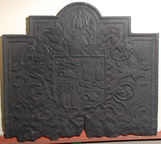
828
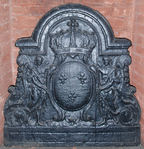
Description: Upon a rectangular base plinth with an inscribed rectangle, to each side, a wide foliate scroll; central cartouche behind an oval shield bearing three fleurs-de-lys over a horizontally textured ground, supported on each side by a draped male figure, the whole surmounted by a French royal crown; on top, an arch rising from horizontal moulding on each side.
Notes: Characteristic of designs illustrated by architects such as Daniel Marot; the texturing on the shield indicates the azure tincture.
Arms: French royal
- Decoration tags:
- rectangular with round arch (shape)
- complex individual (edging)
- whole carved pattern
- planklines
- armorial
- royal
Manufactured: in the late-17th to early-18th century in France.
Current location: in private hands, Lewes, East Sussex, England.
- Attached to series:
- Foreign armorial firebacks
-
376
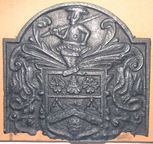
Description: Arched rectangular shape; fillet edge on top and sides. Shield, helm, crest and mantling of the Worshipful Company of Joiners and Ceilers.
Notes: Blazon: Gules a Chevron Argent between in chief two pairs of Compasses extended at the points and in base a sphere Or. On a chief of the second a pale Azure between two Roses of the field barbed and seeded proper, the pale charged with an Escallop of the second; Crest: a demi Savage proper wreathed about the head and waist with Leaves Vert holding in the dexter hand over the shoulder a Tilting Spear Or headed Argent; arms granted 1571.
Copies of this fireback are known.
Arms: Worshipful Company of Joiners and Ceilers
- Decoration tags:
- rectangular with round arch (shape)
- fillet (edging)
- whole carved pattern
- armorial
Manufactured: in the mid-17th century possibly in the Weald area of England.
Current location: Anne of Cleves House, Southover High Street, Lewes, East Sussex, England.
Museum number: LH000.938 (part of the Sussex Archaeological Society museum group)
- Attached to series:
- Livery company firebacks
-
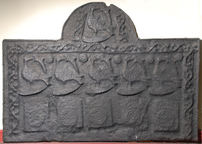
383
Description: Arched rectangular shape; thin twisted rope edging on top and sides; trailing vine strips frame a row of repeated bird (probably swan) stamps (5) above repeated rose en soleil stamps (5); single bird stamp with two short, slanting vine strips in top arch.
Notes: The rose-en-soleil was the badge of King Edward IV and, thus, a Yorkist symbol, while the swan had been adopted by Henry IV and was, therefore, a Lancastrian symbol.
- Decoration tags:
- rectangular with round arch (shape)
- rope (edging)
- simple stamps
- carved stamps
- heraldic
- objects
Manufactured: in the mid- to late-16th century possibly at Pounsley Furnace, Framfield in the Weald area of England.
Current location: Anne of Cleves House, Southover High Street, Lewes, East Sussex, England.
Museum number: LH000.941 (part of the Sussex Archaeological Society museum group)
Citation: Butterfield, W. R., 1916, 'Old Wealden Firebacks', The Connoisseur, 46, pp. 197-209.
-
387
Description: Arched rectangular shape; astragal edging. Shield, helm, crest and mantling of the Worshipful Company of Blacksmiths.
Notes: Blazon: Sable, a chevron Or between three hammers Argent handled and crowned with open crowns of the second; Crest: a phoenix in flames rising proper; arms granted in 1611. Formerly part of the J. H. Every collection.
Copies of this fireback are known.
Arms: Worshipful Company of Blacksmiths
- Decoration tags:
- rectangular with round arch (shape)
- astragal (edging)
- whole carved pattern
- planklines
- armorial
Manufactured: in the mid-17th century in the Weald area of England.
Current location: Anne of Cleves House, Southover High Street, Lewes, East Sussex, England.
Museum number: 1944.24.052 (part of the Sussex Archaeological Society museum group)
- Attached to series:
- Livery company firebacks
-
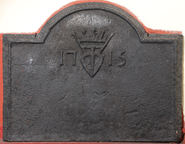
389
Description: Arched rectangular shape; plain edge with inset astragal on all sides; stylised buckle surmounted by an earl’s coronet between the two halves of the date.
Notes: The buckle is the badge of the Pelham family and the earl’s coronet may refer to the Earldom of Clare to which Thomas Pelham-Holles, 2nd Baron Pelham of Laughton was raised in 1714. The following year he was created Marquess of Clare and Duke of Newcastle-upon-Tyne. Formerly part of the J. H. Every collection.
Inscription: 17 15
- Decoration tags:
- rectangular with round arch (shape)
- flanged (edging)
- carved stamps
- individual numbers
- heraldic
- text
Manufactured: in 1715 in the Weald area of England.
Current location: Anne of Cleves House, Southover High Street, Lewes, East Sussex, England.
Museum number: 1944.24.084 (part of the Sussex Archaeological Society museum group)
- Attached to series:
- Pelham family firebacks
-
392
Description: Arched rectangular shape; cavetto moulding on all sides, with short gaps at each end of the base (possibly to accommodate firedogs); date in top corners; shield, supporters, coronet and motto of the Barony of Bergavenny: Gules, on a saltire argent, a rose of the field, barbed and seeded proper. The motto, ‘Ne vile velis’ (Wish nothing base) is a pun on the family name.
Notes: The arms are those of William Nevill, 16th Baron Bergavenny, of Kidbrooke Park, Forest Row, Sussex. The date of the fireback coincides with the completion of the mansion. Formerly part of the J. H. Every collection.
Copies of this fireback are known.
Inscription: 1736 / NE VILE VELIS
Arms: William Nevill, 16th Baron Bergavenny
- Decoration tags:
- rectangular with round arch (shape)
- cavetto (edging)
- whole carved pattern
- individual numbers
- armorial
- text
Manufactured: in 1736 in the Weald area of England.
Current location: Anne of Cleves House, Southover High Street, Lewes, East Sussex, England.
Museum number: 1944.24.086 (part of the Sussex Archaeological Society museum group)
Citation: Hughes, G. B., 21 Apr 1955, 'Old English Firebacks', Country Life, 117, pp. 1056-60.
- Attached to series:
- Bergavenny firebacks
- Personal armorial firebacks
-
394
Description: Rectangular, with arched rectangular extension on top; double astragal edging (top & sides); shield, helmet, crest and mantling of the Pelham family: quarterly, 1st and 4th, Azure, three pelicans vulning themselves proper; 2nd and 3rd, Gules, two broken belts palewise the buckles upwards argent; the crest: a peacock in pride argent.
Notes: The arms may be those of Sir Nicholas Pelham (1517-59) or of one of his two sons, Sir John (d. 1580) or Sir Thomas (c1540-1624); the latter was created a Baronet in 1611. As there is no evidence of the augmentation of a baronet on the arms, the fireback probably predates the creation of the baronetcy. Formerly part of the J. H. Every collection.
Copies of this fireback are known.
Arms: Sir Nicholas, Sir John or Sir Thomas Pelham
- Decoration tags:
- rectangular with round arch (shape)
- double astragal (edging)
- whole carved pattern
- armorial
Manufactured: in the early-17th century possibly at Waldron Furnace in the Weald area of England.
Current location: Anne of Cleves House, Southover High Street, Lewes, East Sussex, England.
Museum number: 1944.24.054 (part of the Sussex Archaeological Society museum group)
- Attached to series:
- Pelham family firebacks
- Personal armorial firebacks
- Low relief armorial series
-
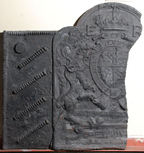
403
Description: Fragment; arched rectangular shape with rounded corners; ovolo within fillet moulding all round; oval Tudor royal shield with garter surrounding, topped with a royal crown; dragon and (missing)greyhound supporters; initials split by crown; inscription on a fillet between legs of supporters, behind garter finial; motto on an Ionic plinth at bottom; rectangular side panels with twisted rope edging top and side; a short length of turned dowel stamped four times, diagonally, on each panel; a circular disc with concentric grooves in top left corner.
Notes: Similar to a fireback in the Victoria & Albert Museum, but differentiated by the twisted rope edging of the side panel and the addition of the grooved disc. The disparity between the worn surface of the armorial panel and the greater clarity of the extensions indicates that the extended casting was made using an already well-used armorial fireback and therefore at a substantially later date.
Inscription: E R / HONY SOIT QUE ... / Made in Sussex by J... / DV ET MOV...
Arms: Tudor royal - Edward VI
- Decoration tags:
- rectangular with round arch (shape)
- rope (edging)
- simple stamps
- carved stamps
- whole carved pattern
- extension panels
- armorial
- royal
- text
- objects
Manufactured: in the late-16th century in the Weald area of England.
Current location: Anne of Cleves House, Southover High Street, Lewes, East Sussex, England.
Museum number: LH000.916 (part of the Sussex Archaeological Society museum group)
- Attached to series:
- Pounsley series
- John Harvo series
- Tudor royal armorial firebacks