-
750
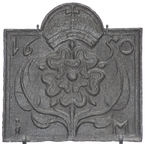
Description: Arched rectangular shape; cavetto edging; crowned rose with symmetrical leaves; date split across top; initials split across bottom.
Notes: The hooked ‘1’ and ‘IM’ suggests a common pattern-maker with other firebacks bearing those features. Copies were advertised in Longden & Co.'s (Sheffield) catalogue c.1911, and in the Carron Company's catalogue.
Copies of this fireback are known.
Inscription: 16 50 / I M
- Decoration tags:
- rectangular with round arch (shape)
- cavetto (edging)
- whole carved pattern
- planklines
- heraldic
- royal
- text
Manufactured: in 1650 possibly at Brede Furnace in the Weald area of England.
Current location: Victoria & Albert Museum, Cromwell Road, Kensington & Chelsea, Greater London, England.
Museum number: M.113-1953 (part of the Victoria & Albert Museum museum group)
- Attached to series:
- IM series
- Small cavetto series
- Hooked '1' series
- Brede group
-
753
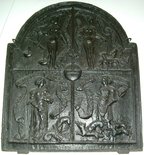
Description: Arched rectangular shape; parallel astragal and fillet edging; four panels divied by fillets, an orb with a cross at the intersection; top left, naked female figure holding scales in her right hand, a scroll bearing an inscription above her and to her left and right; top right, a naked female figure holding a hawk in her right hand and leading two dogs with her left hand, a scroll bearing an inscription above her and to her left and right; bottom left, a clothed female figure, at her feet a fox attacking a serpent, a scroll bearing an inscription above her and to her left and right; bottom right, a clothed female figure, at her feet hounds chasing and attacking another animal, a scroll bearing an inscription above her and to her left and right.
Notes: The figures (clockwise from top left) probably represent Justice and Vigilance (both naked), Indifference and Perfidy (both clothed).
Copies of this fireback are known.
Inscription: ..T IS V EN SCHADE DAT TROV IS LICHTER DAN PLVME / ICH JAG OM DIE VINDE OFT ICH TROV KOND FINDEN / TROV IS DOET ONTROVE VERDT VERFAVLEN / ONTOVE LOEPT OVER ..AL
- Decoration tags:
- rectangular with round arch (shape)
- astragal & fillet (edging)
- whole carved pattern
- planklines
- pictorial
- allegorical
- text
- humans
Manufactured: in the late-16th century possibly in the Wallonia area of Belgium.
Current location: Victoria & Albert Museum, Cromwell Road, Kensington & Chelsea, Greater London, England.
Museum number: 142.1898 (part of the Victoria & Albert Museum museum group)
- Attached to series:
- Virtues and Faults firebacks
-
758
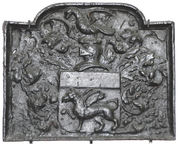
Description: Flattened arched rectangular shape; cavetto moulded edge all round; armorial; arms of Browne family of Brenchley, Kent: Gules, a griffin passant or, a chief of the second; Crest: a vulture proper, wings endorsed, displuming a mallard’s wings.
Notes: John Browne, gunfounder, was granted arms in 1626. His principal furnace was in Brenchley parish, Kent. The royal gunfounder 1615-51, he petitioned the Crown for a monopoly of casting firebacks in 1633.
Copies of this fireback are known.
Arms: Browne of Brenchley (John Browne)
- Decoration tags:
- rectangular with round arch (shape)
- cavetto (edging)
- whole carved pattern
- armorial
Manufactured: in the early- to mid-17th century possibly at Brenchley and Horsmonden Furnace in the Weald area of England.
Current location: Victoria & Albert Museum, Cromwell Road, Kensington & Chelsea, Greater London, England.
Museum number: 493.1901 (part of the Victoria & Albert Museum museum group)
- Attached to series:
- Personal armorial firebacks
-
761
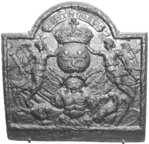
Description: Arched rectangular; astragal edging with simiulated ribbon pattern; inscription on a banner in arch; crowned roundel bearing the arms of France between two angel supporters carrying trumpets; below, a triumph of arms; on the bottom, a plain extension panel.
Notes: The motto, translated, reads 'Alone against all'; other firebacks bear the motto, 'Victorieux contre tous' (Victorious against all).
Inscription: SEVL CONTRE TOVS
Arms: France modern
- Decoration tags:
- rectangular with round arch (shape)
- astragal (edging)
- whole carved pattern
- extension panels
- armorial
- text
- humans
- objects
Manufactured: in the late-17th century in France.
Current location: Victoria & Albert Museum, Cromwell Road, Kensington & Chelsea, Greater London, England.
Museum number: M.3-1918 (part of the Victoria & Albert Museum museum group)
Citation: Carpentier, H., 1912, Plaques de Cheminées (Paris, published by the author).
- Attached to series:
- Foreign armorial firebacks
-
763
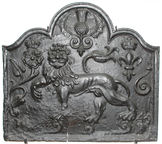
Description: Quasi-Arched rectangular shape with cyma reversa shoulders; ovolo edging; stylised lion passant guardant; crowned rose with leaf and stem on left, crowned fleur de lys on right, thistle with leaves above centre; three right-facing scrolls at base; down-facing scroll, with staple, on right side; date split between bottom corners; initials below date, bottom right.
Notes: Blatantly Royalist in its symbolism, a variant (no. 901) is dated (perhaps more convincingly) 1641. Numeral style, initials, leaf depiction and the stapled scroll are typical features of firebacks made from patterns by the same maker. A later version of the same subject, but with a different shaped plate and without the fleur-de-lys, is also known (see 'Royalist series'). M. A. Lower writes of firebacks of this design of being cast at Waldron Furnace in Sussex (Lower, 1849, p.219). Copies were advertised in F. Parkin & Sons (Exeter) catalogue in 1972.
Copies of this fireback are known.
Inscription: 16 49 / IM
- Decoration tags:
- rectangular with round arch (shape)
- ovolo (edging)
- whole carved pattern
- heraldic
- royal
- text
- animals
Manufactured: in 1649 possibly at Brede Furnace in the Weald area of England.
Current location: Victoria & Albert Museum, Cromwell Road, Kensington & Chelsea, Greater London, England.
Museum number: 492.1901 (part of the Victoria & Albert Museum museum group)
Citation: Lloyd, N., 1925, 'Domestic Ironwork I', Architectural Review, 58, pp. 58-67.
- Attached to series:
- IM series
- Hooked '1' series
- Stapled scroll series
- Brede group
-
765
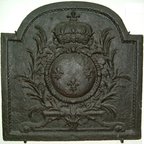
Description: Arched rectangular; fillet edging with darts on the inside; circular arms of France within the chains of the Ordre d'Esprit and the Ordre de St Michel, with crown above, all resting on a framework compartment, with olive leaf sprays on each side ofn the shield.
Notes: Typical form of the arms of France of the period of Louis XIV.
Arms: France modern
- Decoration tags:
- rectangular with round arch (shape)
- fillet (edging)
- whole carved pattern
- armorial
- royal
Manufactured: in the late-17th to early-18th century in France.
Current location: Victoria & Albert Museum, Cromwell Road, Kensington & Chelsea, Greater London, England.
Museum number: M.1132-1926 (part of the Victoria & Albert Museum museum group)
Citation: Carpentier, H., 1912, Plaques de Cheminées (Paris, published by the author).
- Attached to series:
- Foreign armorial firebacks
-
768
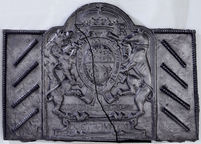
Description: Arched rectangular shape with rounded corners; ovolo within fillet moulding all round; oval Tudor royal shield with garter surrounding, topped with a royal crown; dragon and greyhound supporters; initials split by crown; inscription on a fillet between legs of supporters, behind garter finial; motto on an Ionic plinth at bottom; two rectangular side panels with twisted rope edging top and side; a short length of turned dowel stamped four times, diagonally, on each panel.
Notes: The supporters are those of Henry VII or Henry VIII, but the initials suggest the fireback dates from the reign of Edward VI (1547-53). John Harvo (d. c1565) was a gunfounder who has been identified as occupying Pounsley furnace, Framfield, Sussex, possibly from as early as 1547; the fireback may have been cast originally during the reign of Henry VIII (1509-47), with the initials added to an early casting using the original pattern. The disparity between the worn surface of the armorial panel and the greater clarity of the extensions indicates that the extended casting was made using an already well-used armorial fireback and therefore at a substantially later date.
Copies of this fireback are known.
Inscription: E R / HONY SOIT QVE MAL Y PAYNCE / Made in Sussex by John Harvo / DV ET MOVN DROI
Arms: Tudor royal - Probably Henry VIII
- Decoration tags:
- rectangular with round arch (shape)
- rope (edging)
- carved stamps
- whole carved pattern
- individual letters
- extension panels
- armorial
- royal
- text
- objects
Manufactured: in the late-16th century in England.
Current location: Victoria & Albert Museum, Cromwell Road, Kensington & Chelsea, Greater London, England.
Museum number: 685.1899 (part of the Victoria & Albert Museum museum group)
- Attached to series:
- Pounsley series
- John Harvo series
-
775
Description: Arched rectangle; ovol-moulded edging; pictorial scene of a begowned figure waving to figures standing beneath a portico with a sun behind, other figures opening a door to his left, above which is the shape of the man in the moon; blottom left, a computer; bottom right, a painter's palette.
Notes: A farewell gift to William Vaughan, Reader in Art History at University College, London (later professor of the History of Art at Birkbeck College).
Inscription: WILLIAM VAUGHAN / 1972 UNIVERSITY 1986 / COLLEGE
- Decoration tags:
- rectangular with round arch (shape)
- ovolo (edging)
- whole carved pattern
- pictorial
- architectural
- text
- humans
Manufactured: in 1987 in England.
Current location: Victoria & Albert Museum, Cromwell Road, Kensington & Chelsea, Greater London, England.
Museum number: M.15-1994 (part of the Victoria & Albert Museum museum group)
- Attached to series:
- Personal firebacks
-
1063
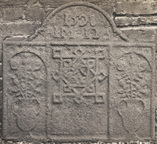
Description: Composite of three elements; central panel has a complex ‘knot’ pattern with a fillet edge; side panel, repeated on either side of the central panel, contains a vase of flowers, possibly stylised thistles, within an arched frame and fillet edge; arched panel above, also with fillet edge, contains the date and inscription; the spandrels of the side panels, and the arched top panel, contain a series of circular motifs comprising concentric rings deepening towards the centre.
Notes: ‘Knot’ patterns were popular in gardens of the period. The garden theme is continued with the side panels. An example of the same design, noted at Linchmere, West Sussex, is a different casting, the top panel with the date and initials being slightly askew. From a photograph in the Victoria and Albert Museum, London; photographed at Mapesbury House, Willesden in 1904.
Copies of this fireback are known.
Inscription: 1598 / IM IB
- Decoration tags:
- rectangular with round arch (shape)
- astragal (edging)
- carved pattern panels
- text
- plants
- objects
Manufactured: in 1598 in the Weald area of England.
Current location: not known.
Museum number: E.4376-2000 (part of the Victoria & Albert Museum museum group)
- Attached to series:
- Armada series
- Garden design types
-
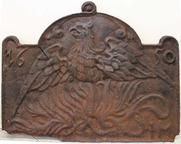
895
Description: Quasi-arched rectangular shape, semi-circular protrusions on top corners; cavetto-moulded edging looped at top; two mirrored scrolls inside arch; a phoenix in flames, its wings displayed and inverted; date, in two parts, in top corners; initials in bottom right corner.
Notes: On a copy (no. 590) the loop at the top is missing and the date and the initials have been erased. Copies of this fireback were advertised in Bratt Colbran Ltd.'s (London) catalogue in the early-20th century.
Copies of this fireback are known.
Inscription: 16 50 / IM
- Decoration tags:
- rectangular with round arch (shape)
- cavetto (edging)
- whole carved pattern
- pictorial
- mythological
- text
- animals
Manufactured: in 1650 possibly at Brede Furnace in the Weald area of England.
Current location: not known.
- Attached to series:
- Hooked '1' series
- IM series
- Loop edged firebacks
- Brede group
- Phoenix firebacks