-
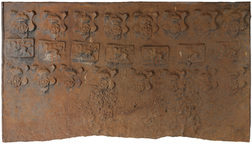
1260
Description: Rectangular shape; twisted rope edging (top and sides); from top: rose and crown within a shield stamped eight times horizontally; rectangular stamp with a griffin passant repeated seven times horizontally; rose and crown within a shield stamped eight times horizontally.
Notes: Five other firebacks bearing these stamps are known: two are in Hastings, and one, dated 1569, is at Hadlow Down, Sussex. The locations of the other two, formerly in Ipswich and Guildford, are not known. Two excrescences on the lower part of the fireback show where the iron was poured, displacing the sand in the mould. Woolley & Wallis auction, Salisbury, 4 Apr 2023, lot 46 (£1,400).
- Decoration tags:
- rectangular (shape)
- rope (edging)
- carved stamps
- heraldic
Manufactured: in the mid- to late-16th century in the Weald area of England.
Current location: not known.
- Attached to series:
- Griffin series
-
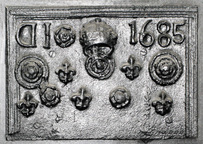
1105
Description: Rectangular shape; cyma recta moulded edging (top and sides); top centre, rose and crown; top right, date; top left, initials, DI (with D reversed); small rose stamp between initials and rose/crown; concentric, rope-patterned roundel below date and below initials, with fleur-de-lys separating each from the rose/crown; below, uneven alternating line of three fleurs and two small rose stamps.
Notes: One of a series of firebacks cast between the 1670s and 1690s bearing small, simple stamps, initials and dates; the style of rose and crown is similar to that used in gun founding in the Tudor period, suggesting that the furnace that was the source of this fireback may have been previously used for that purpose.
Inscription: D [reversed] I 1685
- Decoration tags:
- rectangular (shape)
- complex, furniture-derived (edging)
- carved stamps
- individual letters
- individual numbers
- heraldic
- royal
- text
- objects
Manufactured: in 1685 in the Weald area of England.
Current location: Rowfant House, Worth, West Sussex, England.
- Attached to series:
- 1660s-90s Wealden series
- Fleur-de-lys firebacks
-
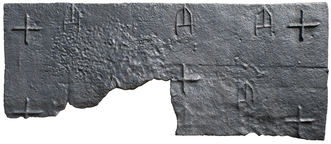
636
Description: Rectangular; no edging; quasi-symmetrical arrangement of crosses and buckle outlines: a cross at each corner and one to right of middle, three buckles along the top and three buckles in triad, level with, and below, the central cross; two horizontal plank lines; lower left part of back missing due to wear and corrosion. The fireback has a small accumulation of iron slag on the reverse side, probably caused by a failure, by the founder, to tap off all the slag from the furnace hearth before casting.
Notes: The buckles, which could have been stamped using a branding iron, suggest a connection with the Pelham family. This is the fireback noted in 1861 at Warbleton Priory, Sussex, which the Pelhams endowed in 1413; the priory was dissolved in 1535 suggesting that the fireback dates from before then. The excrescence, left of centre, on the surface of the fireback was probably caused by molten iron being poured from a ladle into the sand mould and displacing some of the sand.
- Decoration tags:
- rectangular (shape)
- none (edging)
- simple stamps
- carved stamps
- planklines
- heraldic
- objects
Manufactured: in the early- to mid-16th century in the Weald area of England.
Current location: Anne of Cleves House, Southover High Street, Lewes, East Sussex, England.
(part of the Sussex Archaeological Society museum group)
- Attached to series:
- Pelham family firebacks
- Metalware stamp firebacks
-
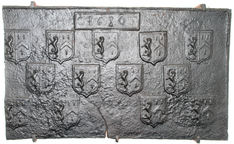
1008
Description: Rectangular; twisted rope edging on top and (probably both) sides; cavetto-moulded-edged rectangle top centre, enclosing date between initials; 13 shields of Ayloffe impaling Sulyard in three rows (5-4-4), the bottom row having a gap between the middle pair of shields; Ayloffe: sable, a lion rampant Or, collared gules, between three crosses formy of the second; Sulyard: argent, a chevron gules between three pheons inverted sable.
Notes: William Ayloffe (c1535-1584) of Bretons, Hornchurch, Essex, Justice of the Court of Queen’s Bench, married (c1560) Jane, dau. of Sir Eustace Sulyard, of Runwell, Essex. About 110mm of the left side has broken off suggesting an original width of 1340mm. The initials 'CT' are likely to be those of Charles Tyler, a founder whose working life and that of his family have strong parallels with the occurrence of these firebacks.
Inscription: C 1610 T
Arms: Ayloffe impaling Sulyard (William Ayloffe of Bretons, Hornchurch)
- Decoration tags:
- rectangular (shape)
- rope (edging)
- carved stamps
- individual letters
- individual numbers
- armorial
- text
Manufactured: in 1610 possibly at Bedgebury Furnace, Goudhurst in the Weald area of England.
Current location: Wye College, High Street, Wye, Kent, England.
- Attached to series:
- Ayloffe series
- Personal armorial firebacks
-
1010
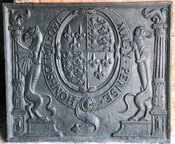
Description: Rectangular with ovolo-moulded edging; central oval shield of England (quarterly France modern and England) surrounded by the Garter with the additional word 'IL', and supported by a dragon on the dexter side and a greyhound on the sinister side, each standing on a plinth; to each side of the armorial group is a column with the upper part of the shaft fluted and the lower part foliate; each has an Ionic capital and a moulded pedestal; fire issues from the top of the capital.
Notes: The style of carving is not typical of English design but is similar to other firebacks bearing Tudor armorials that were probably cast in Wallonia.
Inscription: HONI SOIT IL QVI MAL Y PENSE
Arms: English royal Tudor (prob. Henry VIII)
- Decoration tags:
- rectangular (shape)
- ovolo (edging)
- whole carved pattern
- armorial
- royal
Manufactured: in the 17th century possibly in the Wallonia area of Belgium.
Current location: Westpreussenring 1, Saarbrucken, Saarland, Germany.
Citation: Carpentier, H., 1912, Plaques de Cheminées (Paris, published by the author).
- Attached to series:
- Tudor royal armorial firebacks
- Continental Tudor royal armorial firebacks