-
1100
Description: Quasi-rectangular shape with inward curving sides; twisted rope edging (top and sides); arrangement of fleurs-de-lys: top centre, four in a star formation with two horizontally below; two vertically to left and right; vertical dagger, pommel to base, stamped twice inside outer fleurs.
Notes: A uniquely shaped fireback with fleurs and daggers (each about 35cm long) seen on two other firebacks (no. 595 and no. 660).
- Decoration tags:
- rectangular (shape)
- rope (edging)
- simple stamps
- carved stamps
- heraldic
- objects
Manufactured: in the mid-16th century in the Weald area of England.
Current location: Sackville College, Church Lane, East Grinstead, West Sussex, England.
- Attached to series:
- Royal series
- Knife & Dagger stamp firebacks
- Fleur-de-lys firebacks
-
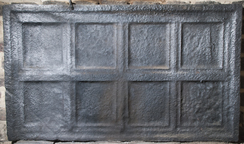
1101
Description: Rectangular arrangement with fillet edging of eight square panels (four over four) between moulded stiles.
Notes: The pattern for this fireback suggests that it was made from a section of panelling, perhaps fitted into a frame for rigidity.
- Decoration tags:
- rectangular (shape)
- fillet (edging)
- carved pattern panels
- architectural
Manufactured: in the late-16th to early-17th century possibly in the Weald area of England.
Current location: Sackville College, Church Lane, East Grinstead, West Sussex, England.
- Attached to series:
- Miscellaneous pattern firebacks
-
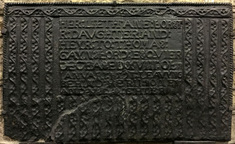
57
Description: Rectangular; rope edging on top and sides; central inscription panel; repeated trailing vine decoration from impressed wooden strips — one horizontal line at top, four vertical strips each side of panel, eleven vertical strips below.
Notes: This fireback came to East Grinstead church from Hurst-an-Clays, a former farmhouse on the edge of the town, in 1933. The inscription is from the same carved pattern used on the graveslab of Anne Forster in Crowhurst church, Surrey; several firebacks have been cast using this panel, each different in other details from the rest. All of the firebacks using this inscription date from after 1591.
Inscription: HER : LIETH : ANE : FORST/ R : DAVGHTER : AND : / HEYR : TO : THOMAS : / GAYNSFORD : ESQVIER / DECEASED : XVIII : OF: / IANVARI : 1591 : LEAVYNG / BEHIND : HER II : SONES : / AND : V : DAVGHTERS
- Decoration tags:
- rectangular (shape)
- rope (edging)
- simple stamps
- carved pattern panels
- text
- objects
Manufactured: in the late-16th century possibly at Pounsley Furnace, Framfield in the Weald area of England.
Current location: St Swithun's Church, High Street, East Grinstead, West Sussex, England.
-
60
Description: Fragment; rectangular; flanged top edge; probable symmetrical arrangement of crowned Tudor royal shield stamps (4 above 3); vertical line on either side of each shield; left hand print in bottom left corner, probably mirrored on right.
Notes: The right side of the fireback is missing. Very crude modelling of stamp suggests an early date; the same crowned shield and use of hand print can be seen on a fireback at Rolvenden (no. 661), indicating a common source..
- Decoration tags:
- rectangular (shape)
- flanged (edging)
- simple stamps
- carved stamps
- heraldic
- humans
Manufactured: in the early- to mid-16th century in the Weald area of England.
Current location: in private hands, Etchingham, East Sussex, England.
- Attached to series:
- Hand print firebacks
- Early Tudor series
- Tudor royal armorial firebacks
-
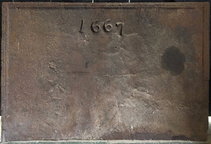
1085
Description: Rectangular; rebated ovolo-moulded edging (top, left and half-right sides); top centre, date with unevenly positioned numerals.
Notes: The asymmetry of the side moulding is unusual.
Inscription: 1667
- Decoration tags:
- rectangular (shape)
- rebated ovolo moulding (edging)
- carved stamps
- individual numbers
- text
Manufactured: in 1667 possibly in the Weald area of England.
Current location: Faversham, Kent, England.
- Attached to series:
- Date only firebacks
- 1660s-90s Wealden series
-
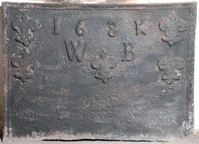
292
Description: Rectangular; cavetto-moulded edging; top centre, date, above initials; two low-relief fleurs de lys down each side from top corners, and central fleur below and between the initials.
Notes: The initials may relate to William Boevey who was owner of Flaxley furnace from 1683-92. Another fireback with the same date and initials, and more fleurs, is also known.
Inscription: 1685 / W B
- Decoration tags:
- rectangular (shape)
- astragal with cavetto (edging)
- carved stamps
- heraldic
- text
Manufactured: in 1685 at Flaxley Furnace in the Forest of Dean area of England.
Current location: Flaxley Abbey, Flaxley, Gloucestershire, England.
Citation: Bick, D. E. [incorrectly printed as Bick, R.], Sept 1985, 'Firebacks', Period Homes, pp. 21-4.
- Attached to series:
- Boevey series
- Fleur-de-lys firebacks
-
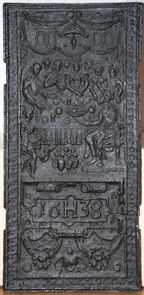
565
Description: Rectangular; flanged edging; small guilloche pattern down each side and along the bottom; upper panel, pictorial scene of the Marriage at Cana; lower panel, inscription panel within a strapwork cartouche with flowers below.
Notes: An end stove plate with a popular scene from the New Testament - John 2.
Copies of this fireback are known.
Inscription: 16 H 38
- Decoration tags:
- rectangular (shape)
- flanged (edging)
- whole carved pattern
- pictorial
- biblical
- text
- humans
Manufactured: in 1638 possibly in the Siegerland area of Germany.
Current location: Folkestone Library and Heritage Centre, Grace Street, Folkestone, Kent, England.
(part of the Folkestone Library and Heritage Centre museum group)
- Attached to series:
- Stoveplates
- Marriage at Cana stoveplates
-
1199
Description: Rectangular, plain plate; top centre, cross probably formed of a repeated length of dowel helically wrapped with a leather strap; top right, a buckle impressed four times, the top two with their prongs inclined towards each other, and the bottom two with prongs vertical and parallel; left of the cross, a shield, indented at the top, charged with a bird upon a branch, to the left of which is a 'renaissance' style shield stamp with a 'PL' monogram above two [?]bougets.
Notes: The four buckles suggest a connection with the Pelham family whose badge it is. The protrusion low on the right edge of the fireback is probably the stub of a runner through which the cast iron was run into the mould from a temporary basin formed in the casting sand. The given width dimension assumes the crack across the fireback is closed.
- Decoration tags:
- rectangular (shape)
- none (edging)
- simple stamps
- carved stamps
- heraldic
- apotropaic
- objects
Manufactured: in the early- to mid-16th century in the Weald area of England.
Current location: in private hands, Framfield, East Sussex, England.
- Attached to series:
- Bird shield series
- Pelham family firebacks
- Metalware stamp firebacks
-
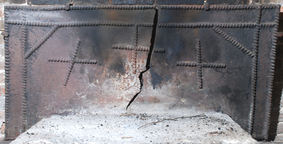
69
Description: Rectangular; twisted rope edging (top and sides); twisted rope lengths parallel to top and both sides and crossing at corners, with shorter rope lengths across inside angles; shorter rope lengths arranged in three crosses across middle of plate, the middle one higher than the other two.
Notes: A particularly large and elaborate arrangement of rope lengths. The crosses suggest Christian significance.
- Decoration tags:
- rectangular (shape)
- rope (edging)
- simple stamps
- apotropaic
- objects
Manufactured: in the 16th century in the Weald area of England.
Current location: in private hands, Freshfield, East Sussex, England.
- Attached to series:
- Rope design firebacks
-
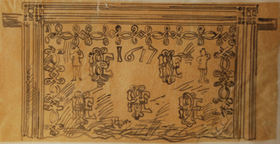
949
Description: Rectangular; low-relief moulded edging along top, then down sides; double-looped 'lens' pattern stamp repeated six times across the top, inside the edging and, rotated, three times down each side; becapped human figure stamp, with his left arm raised to his head and his right arm akimbo, repeated in each top corner; between these, 'IE' monogram with continuous loop between the letters repeated five times, two in line above and three below, the centre one slightly raised; the date between the top two; a lifting handle on each side.
Notes: Said to have been at Horsham, Sussex; on another fireback, at the Old Manor, Upper Beeding in Sussex, cast with the same stamps, and also dated 1617, the monogram stamp is clearly carved on a 'renaissance' shield, indicating that in this instance the stamps were not impressed as deeply. Drawing by J. Lewis André in the J. Starkie Gardner Collection, Victoria & Albert Museum, Archive of Art and Design (AAD/2014/8). Possibly the fireback referred to by Lewis André in 1882 as belonging to a Miss Alman, of East Street, Horsham (Sussex Archaeological Collections, XXXII (1882), p.76).
Inscription: IE 1617 IE / IE IE IE
- Decoration tags:
- rectangular (shape)
- complex individual (edging)
- carved stamps
- individual numbers
- lifting handles
- monogram
- text
- humans
Manufactured: in 1617 in the Weald area of England.
Current location: not known.
Citation: Gardner, J. S., 1898, 'Iron Casting in the Weald', Archaeologia, 56, 1, pp. 133-164.
Citation: Gardner, J. S., 30 Apr 1904, 'An old fire-back' (letter), Country Life, p. 647.
.jpg)