-
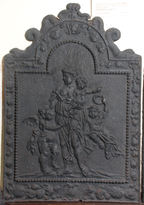
423
Description: Arched rectangular central panel with bead edging; standing female figure, classically dressed, holding a child in her arms, another child holding a wreath, seated to her left, and a putto standing to her right; arched rectangular border with fillet edging; mask top centre with descending floral bunches on ribbons, with a cartouche centre bottom; on top, two symmetrical descending serpents.
Notes: The figure represents Charity, one of a several iconic figures portrayed on firebacks of this period.
Copies of this fireback are known.
- Decoration tags:
- 'Dutch' (shape)
- fillet (edging)
- whole carved pattern
- pictorial
- allegorical
- humans
Manufactured: in the mid- to late-17th century in the Siegerland area of Germany.
Current location: Anne of Cleves House, Southover High Street, Lewes, East Sussex, England.
Museum number: LH000.947 (part of the Sussex Archaeological Society museum group)
- Attached to series:
- 'Dutch' Miscellaneous Firebacks
- Charity firebacks
-
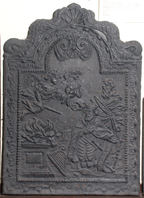
424
Description: Arched rectangular central panel with bead edging terminating at the top in two loops, gather drapery and a scallop shell; two figures to the right, both bearded, the one kneeling wears cavalry armour, a cloak and a crown, the other stands behind; to the left is a sacrificial pyre on which an ox carcass burns, and above an angel carrying a sword in his right hand and a skull in his left; around this is an arched rectangular border with fillet edging and a repeated leaf pattern; on top is a scallop shell between two dolphins.
Notes: The scene illustrates the visitation of the pestilence on Israel described in 2 Samuel 24, and the sacrifice of an oxen by King David; the skull borne by the angel represents the death of those struck down by the plague. A slightly different version has the face of David looking down (no. 527). Formerly part of the J. H. Every collection.
Copies of this fireback are known.
Manufactured: in the mid- to late-17th century in the Siegerland area of Germany.
Current location: Anne of Cleves House, Southover High Street, Lewes, East Sussex, England.
Museum number: 1944.24.070 (part of the Sussex Archaeological Society museum group)
Citation: Hughes, G. B., 1960, Collecting Antiques (London, Country Life), pp. 85-93.
-
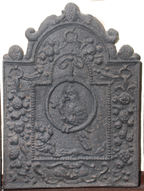
426
Description: Arched rectangular central panel with bead edging; suspended from the top, by a ribbon, a ring with a popinjay, or parrot, perched thereon, biting a twig in its right claw; below left is a seated child; around this panel is an arched rectangular border with fillet edging containing floral swags hung on ribbons suspended from rings; on top, two serpents.
Notes: A common design among firebacks produced in Germany for the Dutch market. Formerly part of the J. H. Every collection.
Copies of this fireback are known.
Manufactured: in the mid- to late-17th century in the Siegerland area of Germany.
Current location: Anne of Cleves House, Southover High Street, Lewes, East Sussex, England.
Museum number: 1944.24.072 (part of the Sussex Archaeological Society museum group)
- Attached to series:
- 'Dutch' Miscellaneous Firebacks
- 'Dutch' Bird on perch firebacks
-
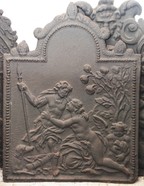
446
Description: Arched rectangular; bead edging; pictorial scene of Venus, naked and kneeling, and Adonis, standing, holding a spear in his left hand, with Cupid to the left, and a hound to the right; pomegranates on top and on each shoulder of the plate, with two symmetrical, descending serpents.
Notes: Probably based on one of two paintings of Venus and Adonis by Peter Paul Rubens.
Copies of this fireback are known.
- Decoration tags:
- 'Dutch' (shape)
- bead (edging)
- whole carved pattern
- pictorial
- mythological
- humans
Manufactured: in the mid- to late-17th century in the Siegerland area of Germany.
Current location: Anne of Cleves House, Southover High Street, Lewes, East Sussex, England.
Museum number: LH000.971 (part of the Sussex Archaeological Society museum group)
- Attached to series:
- 'Dutch' Borderless series
- 'Dutch' Venus and Adonis firebacks
-
476
Description: Arched rectangular central panel with bead edging; pictorial scene of a stork dipping its beak into a tall pot, a fox close by, a tree to the right; arched rectangular border with fillet edging; at top, a double clasp with descending ribbon on each side from which are suspended, via rings, a shield, trumpets and an armoured torso; at the bottom, an oval cartouche between two blocks; on the top, a central pomegranate between two descending sea serpents, and a pomegranate on each shoulder of the plate.
Notes: The scene illustrates one of Aesop's Fables.
- Decoration tags:
- 'Dutch' (shape)
- fillet (edging)
- whole carved pattern
- pictorial
- mythological
- animals
- objects
Manufactured: in the mid- to late-17th century in the Siegerland area of Germany.
Current location: Maidstone Museum, St Faith's Street, Maidstone, Kent, England.
(part of the Maidstone Museum museum group)
- Attached to series:
- 'Dutch' Miscellaneous Firebacks
-
477
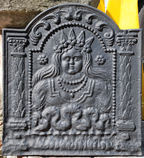
Description: Arched rectangular shaped central panel, bead edging, bust of female figure with long hair and eastern crown decorated with flowers; arched rectangular shaped border with fillet edging; leafed, Corinthian column on each side with symmetrical swirls of foliage above and a row of acanthus leaves below.
Notes: The figure is that of the Virgin, part of the arms and crest of the Mercers’ Company: Issuant from a Bank of clouds a Figure of the Virgin couped at the shoulders proper, vested in a crimson robe adorned with gold, the neck encircled by a jewelled necklace, crined Or and wreathed about the temples with a chaplet of Roses alternately Argent and of the first, and crowned with a Celestial Crown. The arms were first recorded in 1568. One of a small series of firebacks with similar proportions and detail.
Copies of this fireback are known.
- Decoration tags:
- rectangular with round arch (shape)
- cavetto (edging)
- whole carved pattern
- pictorial
- allegorical
- humans
Manufactured: in the mid- to late-17th century in England.
Current location: Maidstone Museum, St Faith's Street, Maidstone, Kent, England.
(part of the Maidstone Museum museum group)
- Attached to series:
- Carolean 'Dutch' series
- Livery company firebacks
-
481
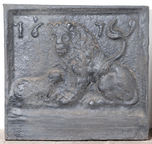
Description: Rectangular; cavetto edging all round; seated lion on right, its tail rising above its back and its head turned to face the viewer; a seated sheep on the left; at the bottom, a plain rectangular extension panel; date split across top.
Notes: Intended to represent the saying, ‘The lion shall lie down with the lamb’, a popular misquotation of Isaiah 11: 6.
- Decoration tags:
- rectangular (shape)
- cavetto (edging)
- whole carved pattern
- individual numbers
- extension panels
- pictorial
- biblical
- text
- animals
Manufactured: in 1679 in the Weald area of England.
Current location: in private hands, Maresfield, East Sussex, England.
- Attached to series:
- Small cavetto series
- Old Testament & Apocrypha firebacks
-
489
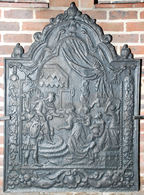
Description: Arched rectangular central panel with additional arch above; bead and fillet edging; pictorial scene of Solomon, rising from a scallop-backed, canopied throne, greeting the Queen of Sheba, with other figures in attendance; identical shaped border with cavetto-moulded edging; a vase on top with descending swags of drapery; at the sides, overlapping bunches of foliage suspended from ribbon bows; at the bottom, a central cartouche between fruit bunches; on top, a pomegranate with a descending serpent on each side, and a pomegranate on each shoulder of the plate.
Notes: Several contemporary paintings are of similar scenes; this design may have been derived from one of two by Erasmus Quellinus. Close observation shows that the scene depicted, and some other decorative elements, are different to those on a similar fireback, no. 1289.
Copies of this fireback are known.
Manufactured: in the mid- to late-17th century in the Siegerland area of Germany.
Current location: Michelham Priory, Arlington, East Sussex, England.
(part of the Sussex Archaeological Society museum group)
-
866
Description: Rectangular with a sinuous arch and three simulated loops, one top centre, the other two to each side; two-handled flower vase with gadrooned upper surface and acanthus bas-relief below, trailing fruited vines issuing from top descending through handles to base; lion’s mask at top; date split either side of vase base; ball on each shoulder of the plate; broadened side edges.
Notes: The simulated loops are seen on a small number of other firebacks, suggesting a common pattern-maker; a variation on a design typical of this period.
Inscription: 16 77
- Decoration tags:
- rectangular with ornate arch (shape)
- fillet (edging)
- whole carved pattern
- individual numbers
- extension panels
- pictorial
- text
- plants
- objects
Manufactured: in 1677 possibly in the Weald area of England.
Current location: Metropolitan Museum of Art, 1000, Fifth Avenue, New York, New York, United States of America.
Museum number: 08.81.1 (part of the Metropolitan Museum of Art, New York museum group)
- Attached to series:
- Gadrooned vase firebacks
- Loop edged firebacks
-
1314
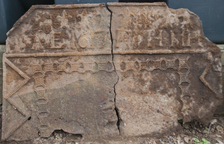
Description: Canted rectangle; hatched fillet edging (top and sides); initials in triad to the left; fleur-de-lys stamp repeated seven times across top; date and initial pairs below; full width, horizontal hatched fillet below inscription; zig-zag formed of short, hatched fillets down each side below horizontal fillet; space within bordered by squared cross stamp repeated 12 times horizontally and six times on each side.
Notes: The distinctive squared cross and fleur stamps are seen on other firebacks; the initials in triad may relate to a husband and wife, the pairs of initials to their children; an almost identical fireback seen at Coombes in West Sussex (no. 1023) differs only in the alignment of the left-hand column of squared crosses. Unearthed close to the site of Elmbridge Furnace, at Newent, Gloucestershire.
Inscription: AHE [triad] 1671 WH MH
- Decoration tags:
- rectangular with canted top corners (shape)
- hatched fillet (edging)
- simple stamps
- carved stamps
- individual letters
- individual numbers
- heraldic
- text
- objects
Manufactured: in 1671 possibly at Elmbridge Furnace, Newent in the Forest of Dean area of England.
Current location: Smith's Funeral Services, Furnace Lane, Newent, Gloucestershire, England.
- Attached to series:
- Square cross Dean series 1
- Newent area group
- Fleur-de-lys firebacks