-
678
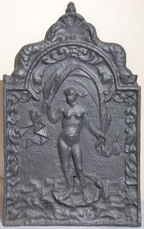
Description: Arched rectangular main panel; fillet edging; nude female figure standing on shield and holding a wind-blown sheet, upon a ground; suspended floral garlands with swirled foliage above; on top, a scallop shell between two symmetrical sea serpents
Notes: The figure is of Fortune. The theft in 1699 from a Thames-side warehouse of several firebacks, including '5 iron Chimney-Backs cast in the figure of Fortune standing naked on a Conchus in the Sea' may refer to this type (Post Boy 11-14 Nov. 1699).
- Decoration tags:
- 'Dutch' (shape)
- fillet (edging)
- whole carved pattern
- pictorial
- allegorical
- humans
Manufactured: in the mid- to late-17th century possibly in the Siegerland area of Germany.
Current location: Saffron Walden Museum, Saffron Walden, Essex, England.
Museum number: 1901-39 (part of the Saffron Walden Museum museum group)
- Attached to series:
- 'Dutch' Miscellaneous Firebacks
-
903
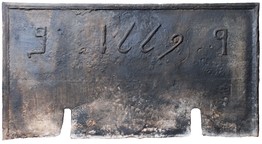
Description: Rectangular; ovolo-moulded edging (top and sides); date between split initials across upper half of plate; two notches cut away for insertion of firedogs.
Notes: The ‘6s’ appear to have been moulded from a type of jemmy.
Inscription: g 1669 P [reversed]
- Decoration tags:
- rectangular (shape)
- ovolo (edging)
- simple stamps
- carved stamps
- individual letters
- individual numbers
- text
- objects
Manufactured: in 1669 possibly in the Weald area of England.
Current location: George & Dragon Inn, Speldhurst Hill, Speldhurst, Kent, England.
- Attached to series:
- Andiron slot firebacks
- Metalware stamp firebacks
- Miscellaneous stamp firebacks
-
1079
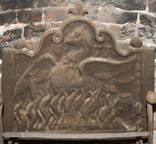
Description: Quasi-arched rectangular shape; fillet edging, indented on the inner edge; pictorial representation of a phoenix rising from flames, date split either side of its neck; the lateral edges are wide in relation to the top, from which the arch rises from two loop and is surmounted by a fleur-de-lys; above each shoulder of the plate, a roundel.
Notes: The looped fillet edging is rarely seen and does not seem to be diagnostic of a particular pattern-maker.
Inscription: 16 77
- Decoration tags:
- rectangular with ornate arch (shape)
- fillet (edging)
- whole carved pattern
- pictorial
- mythological
- text
- animals
Manufactured: in 1677 possibly in the Staffordshire area of England.
Current location: Ford Green Hall, Ford Green Road, Smallthorne, Stoke-on-Trent, Staffordshire, England.
(part of the Stoke-on-Trent Museums museum group)
- Attached to series:
- Miscellaneous pattern firebacks
- Phoenix firebacks
- Loop edged firebacks
-
1078
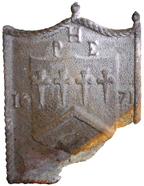
Description: Fragment; quasi-arched rectangular shape; twisted rope or leather edging; flame on centre arch and on top corners (left missing); initials in triad above central shield with date split either side of centre; the bottom right corner is missing.
Notes: The initials are of Philip Hollins (d. 1724) of Mosslee Hall, Cheddleton, Staffordshire, and his wife Elizabeth Bage whom he married in 1671. Blazon: Argent, a chevron azure, in chief four crosses formee fitchee of the second.
Inscription: PHE [triad] / 16 71
Arms: Hollins, of Mosslee Hall
- Decoration tags:
- rectangular (shape)
- rope (edging)
- whole carved pattern
- heraldic
- armorial
- text
Manufactured: in 1671 possibly in the Staffordshire area of England.
Current location: The Potteries Museum and Art Gallery, Bethesda Street, Stoke-on-Trent, Staffordshire, England.
Museum number: LH.SH.1955.21 (part of the Stoke-on-Trent Museums museum group)
- Attached to series:
- Personal armorial firebacks
-
1087
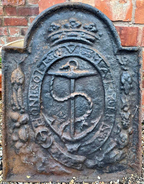
Description: Arched rectangular shape; cavetto-moulded edging; central fouled anchor within a Garter surmounted by a ducal coronet; fructal swags to each side.
Notes: The anchor may relate to the office of Lord High Admiral who, in the third quarter of the 17th century was James, Duke of York (afterwards King James II). Another example was sold at Christie's auction 12 Oct 2010 lot 109 (£500). A variant with a viscount's coronet is at Chastleton House, Oxfordshire. Copies of this fireback were advertised in the Wayte & Cheverton (Edenbridge) catalogue in the early-20th century.
Copies of this fireback are known.
Inscription: HONI SOIT QUI MAL Y PENSE
- Decoration tags:
- rectangular with round arch (shape)
- cavetto (edging)
- whole carved pattern
- heraldic
- text
- objects
Manufactured: in the mid- to late-17th century in England.
Current location: Stratford upon Avon, Warwickshire, England.
- Attached to series:
- Miscellaneous royal firebacks
-
704
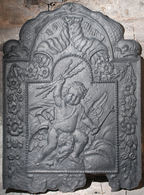
Description: Arched rectangular central panel with bead edging; pictorial figure of a winged child holding a thunderbolt in his right hand and a sceptre in his left hand, on a ground of clouds; arched rectangular border with astragal and cavetto moulded edging; two cornucopiae, flowers and leaves tumbling from them and hanging suspended down the sides; on top, two sea serpents.
Notes: The figure is of Zeus/Jupiter as a child.
Copies of this fireback are known.
Inscription: 16 [...]
- Decoration tags:
- 'Dutch' (shape)
- cavetto (edging)
- whole carved pattern
- pictorial
- mythological
- text
- humans
Manufactured: in the mid- to late-17th century in the Siegerland area of Germany.
Current location: Tiverton Castle, Tiverton, Devon, England.
- Attached to series:
- 'Dutch' Miscellaneous Firebacks
-
684
Description: Arched rectangular central panel with bead edging; an inverted, cabled anchor surmounted by a crown, flanked by one initial each side; arched rectangular border with cavetto-moulded edging; top centre, face of a putto with flowing leaf arrangement descending each side.
Notes: An English pastiche of the ‘Dutch’ style of fireback, which became popular in the second half of the seventeenth century. One of a small series of firebacks with similar proportions and detail. Copies of this fireback were advertised in the Wayte & Cheverton (Edenbridge) catalogue in the early-20th century.
Copies of this fireback are known.
Inscription: C R
- Decoration tags:
- rectangular with round arch (shape)
- cavetto (edging)
- whole carved pattern
- planklines
- heraldic
- text
- objects
Manufactured: in the mid- to late-17th century in England.
Current location: in private hands.
- Attached to series:
- Carolean 'Dutch' series
- Miscellaneous royal firebacks
-
464
Description: Arched rectangular shaped central panel, bead edging (top and sides), pedestal bearing a supine male figure with headband being trampled by a horse, facing left, mounted by a rider with long hair, facing to the front; on each side of the plinth is a seated figure with a basket of fruit; the inscription is split either side of the horse; arched rectangular shaped border, fillet edging, on each side a Solomonic column with vine decoration; in the arch, symmetrical parallel curved lines intertwined beneath a crown; on top of each shoulder of the plate a female figure in repose.
Notes: The equestrian figure is derived from the statue of Charles II erected in Stocks Market, London, in 1672. Originally to be of Jan Sobieski, later king of Poland, riding down a Tatar, it was altered to represent Charles, and the Tatar’s face was changed to that of Oliver Cromwell; the statue attracted a fair degree of derision. The 'CC' monogram is likely to be for Charles and Catherine (of Braganza). The statue is now at Newby Hall, near Ripon, North Yorkshire. Another version (no. 280), probably by the same pattern-maker, is dated 1674 and has altered initials.
Copies of this fireback are known.
Inscription: CC [interlocked, and the first reversed] R
- Decoration tags:
- 'Dutch' (shape)
- ovolo (edging)
- whole carved pattern
- individual letters
- pictorial
- historical
- text
Manufactured: in the mid- to late-17th century in the Weald area of England.
Current location: not known.
- Attached to series:
- Carolean 'Dutch' series
- Commemorative firebacks
-
720
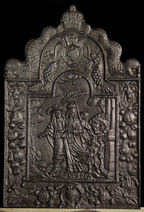
Description: Arched rectangular central panel with bead-on-fillet edging, pictorial representation of a man and woman walking, behind the woman a child holds her train and a young person carries a parasol; from behind a column on the right, a horse's head is visible, a tree stands to the left, at the foot of the scene is the word 'EVROPA'; tall-arched rectangular border with fillet edging; at top of arch, a lion's head above a ring, with descending grape vines on each side; at each side, a festoon of fruit suspended on a ribbon from a lion's head; at the bottom, an oval cartouche between flowers; on top, a Holy Roman Imperial crown between two descending dolphins.
Notes: The pictorial scene is based on an engraving c.1642 of Friedrich Wilhelm, Elector of Brandenburg, and his wife, Luise Henriette of Oranje-Nassau, by Mathias Czwiczek; one of series of firebacks depicting allegories of the four continents.
Copies of this fireback are known.
Inscription: EVROPA
- Decoration tags:
- 'Dutch' (shape)
- fillet (edging)
- whole carved pattern
- pictorial
- architectural
- text
- humans
- plants
Manufactured: in the mid- to late-17th century in the Siegerland area of Germany.
Current location: not known.
- Attached to series:
- 'Dutch' Miscellaneous Firebacks
- 'Dutch' Continents firebacks
-
865
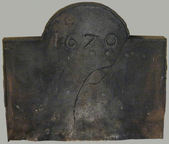
Description: Arched rectangle; twisted rope edging (top and sides); central date at bottom of arch.
Inscription: 1670
- Decoration tags:
- rectangular with round arch (shape)
- rope (edging)
- individual numbers
- text
Manufactured: in 1670 in England.
Current location: not known.
- Attached to series:
- Date only firebacks