-
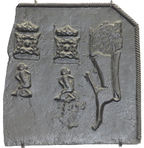
748
Description: Fragment; right part only; canted rectangle; twisted rope edging; lion passant positioned vertically along right side; rose and crown stamp repeated twice (both over-pressed), each above an ‘imp’ figure with both arms lowered.
Notes: A particularly clear casting; the right rear leg of the lion (missing on some variants of this series) has been replaced by a short length of twisted rope.
- Decoration tags:
- rectangular with canted top corners (shape)
- rope (edging)
- carved stamps
- heraldic
- animals
Manufactured: in the mid-16th century in the Weald area of England.
Current location: Victoria & Albert Museum, Cromwell Road, Kensington & Chelsea, Greater London, England.
Museum number: 897.1901 (part of the Victoria & Albert Museum museum group)
- Attached to series:
- Royal series
-
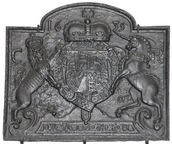
749
Description: Flattened arched rectangular shape; cavetto moulded edge all round; Stuart royal arms with lion and unicorn supporters, crown, garter and motto; CR initials placed separately outside supporters; date split either side of crown.
Notes: A commonly copied variant has the intials, IT, at the top; one vertical plank-line on right side. Inferior copies of this fireback were advertised in Kings Worthy Foundry's (Winchester) catalogue in the mid-20th century.
Copies of this fireback are known.
Inscription: 1635 / C R / HONI SOIT QVI MAL Y PENSE / DIEV ET MON DROIT
Arms: English Stuart royal - Charles I
- Decoration tags:
- rectangular with round arch (shape)
- cavetto (edging)
- whole carved pattern
- planklines
- armorial
- royal
- text
Manufactured: in 1635 possibly in the Weald area of England.
Current location: Victoria & Albert Museum, Cromwell Road, Kensington & Chelsea, Greater London, England.
Museum number: 795.1896 (part of the Victoria & Albert Museum museum group)
Citation: Anon., 2 Dec 1905, 'Old Kent and Sussex Fire-backs', Country Life, pp. 767-768.
- Attached to series:
- Stuart royal armorial firebacks
- Carolean royal armorial firebacks
-
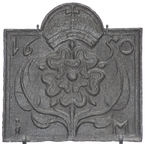
750
Description: Arched rectangular shape; cavetto edging; crowned rose with symmetrical leaves; date split across top; initials split across bottom.
Notes: The hooked ‘1’ and ‘IM’ suggests a common pattern-maker with other firebacks bearing those features. Copies were advertised in Longden & Co.'s (Sheffield) catalogue c.1911, and in the Carron Company's catalogue.
Copies of this fireback are known.
Inscription: 16 50 / I M
- Decoration tags:
- rectangular with round arch (shape)
- cavetto (edging)
- whole carved pattern
- planklines
- heraldic
- royal
- text
Manufactured: in 1650 possibly at Brede Furnace in the Weald area of England.
Current location: Victoria & Albert Museum, Cromwell Road, Kensington & Chelsea, Greater London, England.
Museum number: M.113-1953 (part of the Victoria & Albert Museum museum group)
- Attached to series:
- IM series
- Small cavetto series
- Hooked '1' series
- Brede group
-
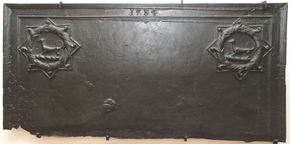
752
Description: Rectangular; cavetto moulded edging on top and sides, with astragal and fillet inside; talbot crest within wreath and eight-pointed star, repeated at top corners; date top centre between mouldings.
Notes: The crest is probably that of the Parker family, of Ratton, near Eastbourne, Sussex. The base board appears to have been repositioned prior to the wreath stamps being impressed in the mould. Acquired from Marle Green Farm, Hathfield, Sussex, in 1896.
Inscription: 1584
- Decoration tags:
- rectangular (shape)
- carved stamps
- individual numbers
- heraldic
- text
- animals
- objects
Manufactured: in 1584 in the Weald area of England.
Current location: Victoria & Albert Museum, Cromwell Road, Kensington & Chelsea, Greater London, England.
Museum number: 780.1896 (part of the Victoria & Albert Museum museum group)
- Attached to series:
- Royal series
- Royal (wreath) series
-
757
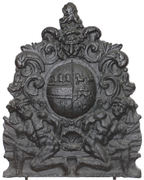
Description: Within a surround of symmetrical swirled foliage, an oval armorial shield carried by two naked, kneeling male figures seated on a broad pedestal, between them a scallop shell; above the shield a lion’s face surmounted by a crest of a lion’s head erased. The arms are of Worge impaling Collier.
Notes: George Worge (1705-65), of Starr’s Green, Battle, steward of the Battle Abbey estate, married Elizabeth (1707-66), daughter of John Collier, town clerk of Hastings, in 1727. The arms of Worge have been variously blazoned, but the memorial to George Worge in Battle church indicates these tinctures: gules, a fess cotised or, in chief three lion’s heads erased of the last; Collier - argent, on a chevron azure, between three unicorns courant couped gules, as many oak sprigs fructed proper. This deeply detailed fireback might have been cast in a closed mould; it had a circular aperture in the centre into which, in this instance, an armorial was placed; the same armorial is on a fireback, dated 1762, at Great Dixter, Northiam, Sussex, as is the lion crest (no. 1317).
Arms: Worge impaling Collier (George and Elizabeth Worge)
- Decoration tags:
- baroque (shape)
- complex individual (edging)
- whole carved pattern
- pictorial
- armorial
- humans
Manufactured: in the early- to mid-18th century probably at Robertsbridge Furnace, Salehurst in the Weald area of England.
Current location: Victoria & Albert Museum, Cromwell Road, Kensington & Chelsea, Greater London, England.
Museum number: 686.1899 (part of the Victoria & Albert Museum museum group)
- Attached to series:
- Baroque series
- Personal armorial firebacks
- Worge/Collier series
-
758
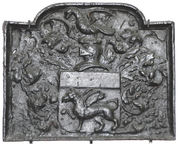
Description: Flattened arched rectangular shape; cavetto moulded edge all round; armorial; arms of Browne family of Brenchley, Kent: Gules, a griffin passant or, a chief of the second; Crest: a vulture proper, wings endorsed, displuming a mallard’s wings.
Notes: John Browne, gunfounder, was granted arms in 1626. His principal furnace was in Brenchley parish, Kent. The royal gunfounder 1615-51, he petitioned the Crown for a monopoly of casting firebacks in 1633.
Copies of this fireback are known.
Arms: Browne of Brenchley (John Browne)
- Decoration tags:
- rectangular with round arch (shape)
- cavetto (edging)
- whole carved pattern
- armorial
Manufactured: in the early- to mid-17th century possibly at Brenchley and Horsmonden Furnace in the Weald area of England.
Current location: Victoria & Albert Museum, Cromwell Road, Kensington & Chelsea, Greater London, England.
Museum number: 493.1901 (part of the Victoria & Albert Museum museum group)
- Attached to series:
- Personal armorial firebacks
-
763
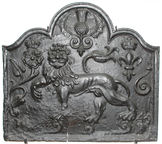
Description: Quasi-Arched rectangular shape with cyma reversa shoulders; ovolo edging; stylised lion passant guardant; crowned rose with leaf and stem on left, crowned fleur de lys on right, thistle with leaves above centre; three right-facing scrolls at base; down-facing scroll, with staple, on right side; date split between bottom corners; initials below date, bottom right.
Notes: Blatantly Royalist in its symbolism, a variant (no. 901) is dated (perhaps more convincingly) 1641. Numeral style, initials, leaf depiction and the stapled scroll are typical features of firebacks made from patterns by the same maker. A later version of the same subject, but with a different shaped plate and without the fleur-de-lys, is also known (see 'Royalist series'). M. A. Lower writes of firebacks of this design of being cast at Waldron Furnace in Sussex (Lower, 1849, p.219). Copies were advertised in F. Parkin & Sons (Exeter) catalogue in 1972.
Copies of this fireback are known.
Inscription: 16 49 / IM
- Decoration tags:
- rectangular with round arch (shape)
- ovolo (edging)
- whole carved pattern
- heraldic
- royal
- text
- animals
Manufactured: in 1649 possibly at Brede Furnace in the Weald area of England.
Current location: Victoria & Albert Museum, Cromwell Road, Kensington & Chelsea, Greater London, England.
Museum number: 492.1901 (part of the Victoria & Albert Museum museum group)
Citation: Lloyd, N., 1925, 'Domestic Ironwork I', Architectural Review, 58, pp. 58-67.
- Attached to series:
- IM series
- Hooked '1' series
- Stapled scroll series
- Brede group
-
769
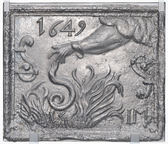
Description: Rectangular; cavetto-moulded edge; a snake rises from a fire and bites the middle finger of the hand of a sleeved left arm that descends from a top right corner cloud; left and right, ‘S’ scrolls appear strapped to the edge of the fireback; the date, top left of centre; initials, bottom right corner.
Notes: An illustration of the New Testament episode (Acts 28: 3) when St Paul, shipwrecked in the island of Malta, was putting sticks on a fire and a viper bit him. The distinctive shape of the ‘1’ in the date and the initials, ‘IM’, together with the ‘S’ scrolls, parallel such features in other firebacks. The design is an adaptation of an illustration in 'Devises Heroiques' by Claudius Paradin (1557) which was translated into English by Geoffrey Whitney as 'The Book of Emblemes' (1586).
Copies of this fireback are known.
Inscription: 1649 / IM
- Decoration tags:
- rectangular (shape)
- cavetto (edging)
- whole carved pattern
- biblical
- text
- animals
- humans
Manufactured: in 1649 possibly at Brede Furnace in the Weald area of England.
Current location: Victoria & Albert Museum, Cromwell Road, Kensington & Chelsea, Greater London, England.
Museum number: M.119-1984 (part of the Victoria & Albert Museum museum group)
Citation: Hamling, T., 2010, Decorating the 'Godly' Household (New Haven, Yale), pp. 251-2.
- Attached to series:
- IM series
- Hooked '1' series
- New Testament firebacks
- Brede group
-
771
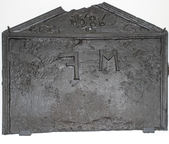
Description: Rectangular with triangular pediment; stepped fillet and ogee moulded edge; initials in rectangular panel (F reversed); date in pediment.
Notes: The triangular top is a separate element, in this instance impressed before the lower panel. A variant at Hastings Museum (no. 118) has the letters positioned slightly differently.
Inscription: 1586 / FM
- Decoration tags:
- triangular arched (shape)
- stepped fillet and ogee (edging)
- individual letters
- date stamp
- text
Manufactured: in 1586 in the Weald area of England.
Current location: Victoria & Albert Museum, Cromwell Road, Kensington & Chelsea, Greater London, England.
Museum number: M.129-1913 (part of the Victoria & Albert Museum museum group)
- Attached to series:
- 1586 series
-
1067
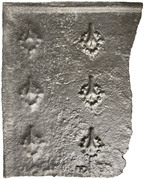
Description: Fragment; rectangular shape; ovolo-moulded edging (top and sides); six stamps, in two columns of three, taking the form of a long-pointed arrow head within a circlet of small curls.
Notes: The stamps are of an unfamiliar type with some similarity to the heraldic symbol for ermine. Because only the left part of the fireback has survived it is not known how many original columns of this stamp there were.
- Decoration tags:
- rectangular (shape)
- ovolo (edging)
- carved stamps
- heraldic
Manufactured: in the 16th century possibly in the Weald area of England.
Current location: Victoria and Albert Museum, Cromwell Road, Kensington and Chelsea, London, England.
Museum number: M.148-1915 (part of the Victoria & Albert Museum museum group)
- Attached to series:
- Miscellaneous stamp firebacks