-
815
 ? x ? mmImage subject to copyright
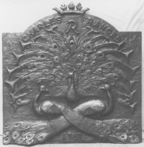
Description: Arched rectangular shape with crown, top centre; central peacock, its tail feathers displayed, with two other peacocks below, their tail feathers down; name across top of arch, split by initial, R; date ato bottom below tail feathers.
Notes: Manufactured by Seager's of Dartford, Kent
Inscription: CHARLES FRANCIS / R / 1967
- Decoration tags:
- rectangular with round arch (shape)
- none (edging)
- whole carved pattern
- pictorial
- text
- animals
Manufactured: in 1967 in England.
Current location: not known.
- Attached to series:
- Personal firebacks
-
1084
 ? x ? mmImage subject to copyright
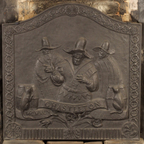
Description: Ogee-arched rectangular shaped central panel with fillet edging; pictorial scene with three figures dressed in clothing of the early 17th century, with wide-brimmed hats, the central figure to the fore and wearing doublet and belt, the two others in coats; across the bottom a trpartite scroll bearing the inscription CHASTLETON on the upper part, and the date MCMXCV and C of A (Charteris of Amisfield) & [illegible] R split between the lower parts, with three tulips beneath; resting on each outer part of the scroll, a barrel with a cat; an ogee-arched rectangular border with fillet edging with floral guilloche decoration and daisy flowers at the top and in the top corners; in the bottom left corner the circular badge of the National Heritage Memorial Fund, and in the bottom right corner the circular badge of the National Trust.
Notes: This fireback was cast for Martin, Lord Charteris of Amisfield (1913-99), Trustee of the National Heritage Memorial Fund, from a pattern he designed and made, to commemorate the 390th anniversary of the Gunpowder Plot; cast with figures associated with Robert Catesby, owner of a previous house on the site and one of the chief conspirators, and the cats belonging to the then owner, Mrs Barbara Clutton-Brock.
Inscription: CHASTLETON / MCMXCV / C of A & [?]R
- Decoration tags:
- rectangular with round arch (shape)
- fillet (edging)
- whole carved pattern
- pictorial
- text
- animals
- humans
- plants
- objects
Manufactured: in 1995 in England.
Current location: Chastleton House, Chastleton, Oxfordshire, England.
Museum number: 1430298 (part of the National Trust museum group)
- Attached to series:
- Martin Charteris firebacks
- Commemorative firebacks
-
35
 ? x ? mm
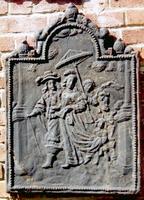
Description: 'Dutch' style; arched rectangular shaped with bead edging; figures of a man and woman walking, in dress of the mid-17th century, a page holding the woman's train. followed by a man holding a parasol, and by a horse; they pass between the bases of two columns; above is foliage and clouds. On top are two serpents and three pomegranates arranged symmetrically.
Notes: The pictorial scene is based on an engraving c.1642 of Friedrich Wilhelm, Elector of Brandenburg, and his wife, Luise Henriette of Oranje-Nassau, by Mathias Czwiczek; one of series of firebacks depicting allegories of the four continents.
Copies of this fireback are known.
Manufactured: in the mid-17th century .
Current location: in private hands, Chichester, West Sussex, England.
- Attached to series:
- 'Dutch' Continents firebacks
- 'Dutch' Borderless series
-
1201
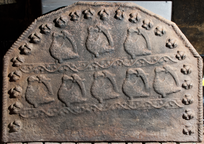
Description: Rectangular with five-facetted arched shape; twisted rope edging (top and sides); small flower-bud stamp repeated 23 times inside the edging; across the middle of the fireback, two approximately parallel lines of lengths of vine strip moulding inclined up to the right; between them, five bird stamps, probably swans (a Lancastrian badge), the front of their left wings 'displayed and inverted', and three more swans above the top line of vine strip moulding.
Notes: The stamps are all seen on other firebacks in the same series. The five-facetted arch is seemingly unique. A very similar fireback with minor differences was lot 2630 at Toovey's auction, Washington, West Sussex, 19 Jun 2015.
Copies of this fireback are known.
- Decoration tags:
- multi-facet arched (shape)
- rope (edging)
- carved stamps
- animals
- objects
Manufactured: in the late-16th century possibly at Pounsley Furnace, Framfield in the Weald area of England.
Current location: in private hands, Chiddingstone, Kent, England.
- Attached to series:
- Pounsley series
- Swan series
- Vine strip series
-
257
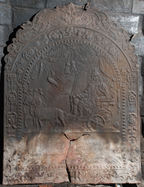
Description: Arched rectangular central panel with ‘nutshell’ edging on a broad fillet; crowned figure, holding a sceptre in his right hand, sitting in a chariot drawn to the left by two horses with ostrich feather head-dresses; the whole upon a causeway with pilasters and masonry, and waves beneath; a heron flying to the left; above, swagged drapery with two tassels hanging from the centre; arched rectangular shaped border with fillet edging, symmetrical, flower bunches, descending from a ribbon loop; monogram centre bottom, between plant tendrils; on top, symmetrical scrolled plant tendrils.
Notes: The design is derived from a personification of Europe, one of a set of playing cards entitled 'Jeu de la Géographie', designed by Stefano della Bella (1677); a similarity with Queen Anne may not be coincidental; the flying heron has been copied from a print by Wenceslaus Hollar c.1658.
Copies of this fireback are known.
Inscription: SHR
Manufactured: in the late-17th to early-18th century in England.
Current location: Chiddingstone Castle, Chiddingstone, Kent, England.
- Attached to series:
- SHR series
- British 'Dutch' style firebacks
-
824
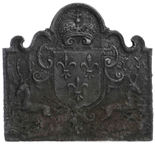
Description: Rectangular with complex quasi-arched rectangular top; ovolo moulded edging; shield with Royal arms of France in a swirled cartouche; above, an English crown; below to right and left, a prancing stag.
Notes: The combination of the English crown and French arms is common and may relate to the marriage of Charles I and Princess Henrietta Maria of France in 1625; although the framing of the pattern is very similar to others of the same basic design, the style suggests a different pattern maker. Christie's auction 21 Jun 2011 lot 208 (£2,750).
Copies of this fireback are known.
Arms: France modern
- Decoration tags:
- rectangular with round arch (shape)
- ovolo (edging)
- whole carved pattern
- armorial
- animals
Manufactured: in the early- to mid-17th century possibly in the Weald area of England.
Current location: not known.
- Attached to series:
- Ornate border series
- Miscellaneous royal firebacks
- Anglo-French armorial firebacks
-
262
Description: Rectangular; twisted rope edging (top and sides); top centre, crowned Tudor royal shield (over-pressed) between a leopard passant guardant sinister (on the left) and a leopard passant (on the right); below, crowned shield bearing initials, KH, above a fleur-de-lys, between two crowned roses; below each leopard, a pair of 'imp' figures, the left of each with both arms lowered, the right its right arm raised; right top corner, a crowned rose; left top corner, and uncrowned rose.
Notes: One of the 'Royal' series. Christie's Interiors - Oak Edition, South Kensington (Sale 5369), 4 November 2008, lot 257 (£3,250).
Inscription: KH
Arms: Tudor Royal (prob. Henry VIII)
- Decoration tags:
- rectangular (shape)
- rope (edging)
- carved stamps
- heraldic
- armorial
- royal
- text
- animals
- objects
Manufactured: in the mid-16th century in the Weald area of England.
Current location: not known.
- Attached to series:
- Royal series
-
1196
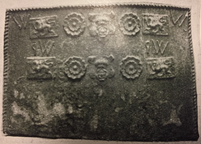
Description: Quasi-rectangular shape; twisted rope edging (top and sides); 'W' in top corners, between which are a line of five stamps: a 'renaissance' style shield bearing a rose and crown, between two rose stamps, and a rectangular stamp bearing a griffin at each end; below each dragon stamp, a 'W' preceded by a reversed 'P'; below this, the line of five stamps repeated.
Notes: The shield and griffin stamps have been seen on other firebacks, associating them with a common producer; the 'W' may be apotropaic and symbolic of the Virgin Mary. Illustration from Christy 1908 who noted the fireback at Guildford, Surrey.
Inscription: W W / qW qW
- Decoration tags:
- rectangular (shape)
- rope (edging)
- simple stamps
- carved stamps
- individual letters
- heraldic
- apotropaic
- animals
Manufactured: in the mid- to late-16th century in the Weald area of England.
Current location: not known.
- Attached to series:
- Griffin series
-
1194
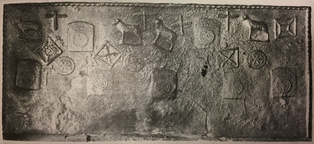
Description: Rectangular shape; twisted rope or strap edging (top and sides); semi-random arrangement of three stamps interspersed with rope crosses and rope 'squares' with saltires or linked smaller squares within; low centre, a crowned rose-en-soleil stamp repeated, more or less regularly, five times across the width of the fireback; above, four circular butter mould stamps with a hexagonal design, between which are two rope squares with saltires and, to the left, a rope square containing a smaller square with its corners linked to the corners of the outer square; above, a horned sheep standing on a base repeated four times, between which are two crowned rose-en-soleil stamps and four rope crosses, with a square-within-a-square at the right end.
Notes: The rose-en-soleil was the badge of King Edward IV and, thus, a Yorkist symbol. It, together with the butter mould and rope squares, are seen on other firebacks associating them with the same producer/foundry. A ram is the crest of the Gage family of West Firle, for many centuries major landholders in Sussex; it is also the crest of the Clothworkers' Company of London. Formerly at Heringdales/Heronsdale Manor, Waldron, East Sussex, which, however, was not a Gage property. Illustration from Christy 1908.
- Decoration tags:
- rectangular (shape)
- rope (edging)
- simple stamps
- carved stamps
- heraldic
- apotropaic
- animals
- objects
Manufactured: in the mid- to late-16th century possibly at Pounsley Furnace, Framfield in the Weald area of England.
Current location: Wickham Manor, Winchelsea, East Sussex, England.
Museum number: NT/WMF/M/007 (part of the National Trust museum group)
Citation: Gardner, J. S., 1898, 'Iron Casting in the Weald', Archaeologia, 56, 1, pp. 133-164.
- Attached to series:
- Pounsley series
- Food mould stamp firebacks
- Rose-en-soleil series
-
1035
 ? x ? mm
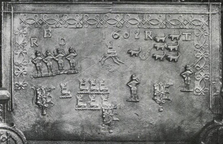
Description: Rectangular with furniture-derived mounding (top and sides); double-loop 'lens' pattern stamp repeated inside the moulded edging nine times along the top and three times down each side; top left, initials RBD in triad; right of top centre, date 1602; top right, initials RT split between two repeated dog stamps; four other dog stamps in pairs below, and one below date; becapped human figure stamp, with his left arm raised to his head and his right arm akimbo, repeated four times below initial triad and two singly, one below lone dog stamp and one centre right; top centre, stamp of a crest formed of a stag 'lodged' (i.e. sitting) upon a wreath, in this instance only with pseudo legs drawn below, also repeated six times in two rows of three left of lower centre, with one to the left of the six; 'renaissance' shield bearing initials 'IE' linked with twisted cord, repeated lower left and right with a third bottom centre impressed partially over the centremost stag crest.
Notes: A fireback remarkable for the haphazard arrangement of groups of seemingly unrelated stamps. Acquired in 1900 by Sir Spencer Maryon-Wilson for Charlton House (Country Life, 23 April 1904, from whence has come the illustration); several of the stamps have been noted on two other firebacks, both dated 1617, and suggesting by their location an origin in the Horsham area of the Weald.
Inscription: R B D [triad] 1602 R T / IE IE / IE
- Decoration tags:
- rectangular (shape)
- furniture moulding (edging)
- carved stamps
- heraldic
- monogram
- text
- animals
- humans
Manufactured: in 1602 in the Weald area of England.
Current location: not known.
Citation: Gardner, J. S., 30 Apr 1904, 'An old fire-back' (letter), Country Life, p. 647.
Citation: S. M. W. [Spencer Maryon-Wilson], 23 Apr 1904, 'An old fireback' [letter], Country Life, p. 611.
Citation: Shuffrey, L. A., 1912, The English Fireplace, London, Batsford.