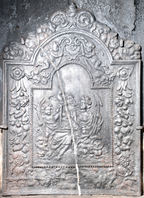
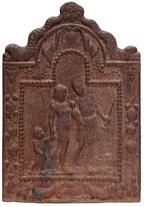
-
22
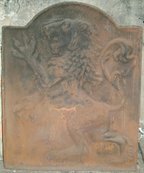
Description: Arched rectangular shaped; fillet edging; a lion rampant
Notes: Whole pattern. A modern design of fireback
Copies of this fireback are known.
- Decoration tags:
- rectangular with round arch (shape)
- fillet (edging)
- whole carved pattern
- heraldic
- animals
Manufactured: in the late-19th to early-20th century in England.
Current location: St Mary's House, Bramber, West Sussex, England.
- Attached to series:
- Miscellaneous pattern firebacks
-
651
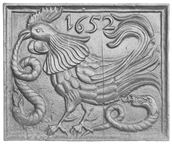
Description: Rectangular; cavetto edging; a left-facing cockerel grasps a snake in its beak, another snake writhes on the ground behind it; date to left of the cockerel’s tail; four vertical planklines.
Notes: The design may have religious significance, the snake symbolising sin and the cockerel denoting St Peter’s denial of Christ. The ‘1’ of the date is hooked, suggesting a common source with firebacks designed by the pattern-maker, IM. A copy of this fireback is set into the brickwork of 16 Old Church Street, Chelsea, London.
Copies of this fireback are known.
Inscription: 1652
- Decoration tags:
- rectangular (shape)
- cavetto (edging)
- whole carved pattern
- planklines
- pictorial
- biblical
- text
- animals
Manufactured: in 1652 possibly at Brede Furnace in the Weald area of England.
Current location: not known.
- Attached to series:
- Small cavetto series
- Hooked '1' series
- New Testament firebacks
- Brede group
-
851
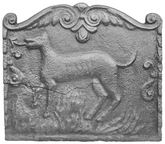
Description: Rectangular with mirrored floriate scrolled top; simulated overlapping tile edging at sides, with fillet bottom edge; a mythical salamander in the form of a dog with an arrow-shaped tongue, standing among flames; a stapled scroll inside the left and right edges.
Notes: This fireback was used to create a composite fireback design on a plate at Rivers Farmhouse, Ardingly (no. 13).
- Decoration tags:
- rectangular (shape)
- simulated overlapping tile (edging)
- whole carved pattern
- mythological
- animals
- objects
Manufactured: in the mid-17th century in the Weald area of England.
Current location: not known.
Citation: Lloyd, N., 1925, 'Domestic Ironwork I', Architectural Review, 58, pp. 58-67.
- Attached to series:
- Stapled scroll series
- Brede group
-
852
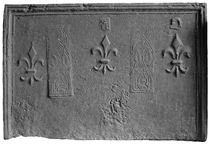
Description: Rectangular; cyma recta (ogee) moulded edging (top and sides); fleur-de-lys stamp repeated three times across the upper part of the plate; a long pastry mould stamped between each pair of fleurs; above the central fleur, a small stamp, over-pressed, bearing FL below a coronet; above the right fleur, a small stamp, over-pressed, bearing a fish embowed.
Notes: The food moulds are variations of others used in the same series.
Inscription: FL
- Decoration tags:
- rectangular (shape)
- cyma reversa/ogee (edging)
- simple stamps
- carved stamps
- heraldic
- text
- animals
- objects
Manufactured: in the mid- to late-16th century possibly at Pounsley Furnace, Framfield in the Weald area of England.
Current location: not known.
- Attached to series:
- Food mould stamp firebacks
- Pounsley series
-
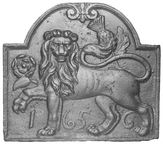
399
Description: Arched rectangular shape; ovolo-moulded edging with inverted fleur-de-lys at top; lion passant guardant, with rose to the left and thistle above tail; date split between legs; single horizontal plank-line.
Notes: The boldness of the figuration suggests association with firebacks possibly cast at Brede Furnace in the same period.
Copies of this fireback are known.
Inscription: 1 6 5 6
- Decoration tags:
- rectangular with round arch (shape)
- cyma reversa/ogee (edging)
- whole carved pattern
- planklines
- heraldic
- text
- animals
- plants
Manufactured: in 1656 in the Weald area of England.
Current location: not known.
- Attached to series:
- Royalist series
-
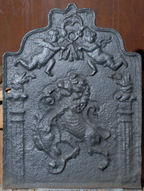
210
Description: Quasi-arched rectangular shape; ovolo-moulded edging; fluid curving, double ovolo arch with a pair of putti holding looped ribbons; a lion rampant holding a cartouche, between two pilasters, each surmounted by a dragon’s head.
Notes: A simple decorative device has replaced the customary allegorical or classical scene.
Copies of this fireback are known.
- Decoration tags:
- rectangular with ornate arch (shape)
- ovolo (edging)
- whole carved pattern
- pictorial
- animals
Manufactured: in the late-17th century in England.
Current location: Brighton Museum and Art Gallery, Brighton, East Sussex, England.
Museum number: HA105020 (part of the Brighton Museum museum group)
- Attached to series:
- Late pictorial series (all)
- Late pictorial series 5
-
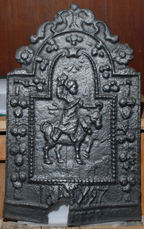
212
Description: Arched rectangular central panel, bead edging, female figure, her right arm raised, sitting on a bull; arched rectangular border, fillet edging, swags of fruit bunches suspended from ribbon, inscription below central panel; on top, symmetrical floral swirls and flowers; plain panel at bottom.
Notes: The image is of Europa being carried away to Crete by Zeus disguised as a bull.
Copies of this fireback are known.
Inscription: 16 NDW 97
- Decoration tags:
- 'Dutch' (shape)
- fillet (edging)
- whole carved pattern
- pictorial
- mythological
- monogram
- text
- animals
- humans
Manufactured: in 1697 in the Siegerland area of Germany.
Current location: Brighton Museum and Art Gallery, Brighton, East Sussex, England.
Museum number: HA105015 (part of the Brighton Museum museum group)
- Attached to series:
- 'Dutch' NDW series
-
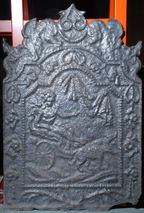
215
Description: Arched rectangular central panel with canted, cavetto-canted shoulders and bead edging on a broad fillet; seated female figure in a chariot drawn by dogs, symmetrical hanging drapery above right; same-shaped border with fillet edging at top, and suspended ribbons with floral bunches; at base, symmetrical palm leaves tied with ribbon; symmetrical serpents on top their tails intertwined.
Notes: The design is derived from a personification of America, one of a set of playing cards entitled Jeu de la Géographie, designed by Stefano della Bella (1677). The pattern for this fireback, from which the protuberances above the serpents’ heads is missing, is in Rottingdean Grange (no. 930). The pattern, however, has a base panel of a chain-link design, which is missing from this casting.
Copies of this fireback are known.
- Decoration tags:
- 'Dutch' (shape)
- fillet (edging)
- whole carved pattern
- planklines
- pictorial
- allegorical
- animals
- humans
- objects
Manufactured: in the late-17th to early-18th century possibly in the Weald area of England.
Current location: Brighton Museum and Art Gallery, Brighton, East Sussex, England.
Museum number: HATMP002214 (part of the Brighton Museum museum group)
- Attached to series:
- Mayfield 'Dutch' series
- British 'Dutch' style firebacks
-
1002
Description: Arched rectangular shaped central panel with bead edging; pictorial scene of a seated female figure resting against a hurdle, holding an anchor, a child on each side of her, the one on the left standing clutching corn stalks, the one on the right sitting also holding the anchor and a circular object; a bird sits on a post; arched rectangular border with bead edging; fructal and floral festoons suspended on ribbons with two putti at the top and two on each side; in the left and right bottom corners, the initials 'HH' and 'S' respectively; at the bottom, a central cartouche with date, between floral swags; on top, twin spirals between descending floral festoons.
Notes: The figure is an allegory of Hope. The theft in 1699 from a Thames-side warehouse of several firebacks, including '3 of Hope with an Anchor' may refer to this type (Post Boy 11-14 Nov. 1699). A recasting.
Copies of this fireback are known.
Inscription: [?H]H ...
- Decoration tags:
- 'Dutch' (shape)
- ovolo (edging)
- whole carved pattern
- pictorial
- allegorical
- text
- animals
- humans
- objects
Manufactured: in the mid-17th century in the Siegerland area of Germany.
Current location: Ashmolean Museum Broadway, 65 High Street, Broadway, Worcestershire, England.
(part of the Ashmolean Museum museum group)
- Attached to series:
- 'Dutch' HHS series
- Hope firebacks
-
1198
Description: Arched rectangular central panel with beaded edging, containing an image of a semi-naked adult male with feathered headdress and 'grass' skirt and holding a club in his left hand; beside hima an adult female also wearing a 'grass' skirt and with a bird perched on her left hand, while holding with her right hand a standing child; within an arched rectangular border with fillet edging, descending from draped foliage on each side, swags or what appear to be coconuts or gourds, and at the bottom a cartouche between swirled foliage; on top, the mask of a putto with dolphins descending on each side.
Notes: One of a series portraying allegories of the four known continents - Europe, Asia, Africa and America; each comprises a pair of adults and a child dressed stereotypically, in this case representative of America. The images were derived from other media, such as paintings or engravings. A copy.
Copies of this fireback are known.
- Decoration tags:
- 'Dutch' (shape)
- fillet (edging)
- whole carved pattern
- pictorial
- allegorical
- animals
Manufactured: in the mid- to late-17th century in the Siegerland area of Germany.
Current location: not known.
Citation: Elling, W. & Winkler-Borck, S., 1992, Ofen- und Kaminplatten (Vreden, Hamaland-Museum).
- Attached to series:
- 'Dutch' Continents firebacks