-
154
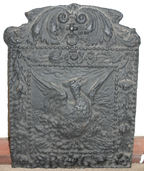
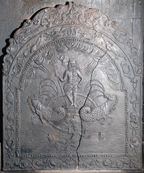
Description: Rectangular central panel with bead edging; a phoenix, with wings displayed, rising from the flames; rectangular border with bead edging, flowers and leaves festooned from a central flower; initials split either side of a flower at the base; on top, symmetrical swirled leaves.
Notes: Although similar to 'Dutch' types made in north Germany, this is probably an English design. A fireback bearing a phoenix was one of three designs ordered by Trubshaw's, ironmongers of London and Birmingham, from George Sitwell's furnace at Foxbrooke, Derbyshire, in the 1660s. Formerly part of the Ade Collection (from Grove Hill, Hellingly, Sussex).
Copies of this fireback are known.
Inscription: R (or B) G
- Decoration tags:
- 'Dutch' (shape)
- bead (edging)
- whole carved pattern
- individual letters
- mythological
- text
- animals
Manufactured: in the mid- to late-17th century in England.
Current location: Hastings Museum and Art Gallery, John's Place, Bohemia Road, Hastings, East Sussex, England.
Museum number: HASMG: 1952.51.16 (part of the Hastings Museum museum group)
Citation: Lloyd, N., 1925, 'Domestic Ironwork I', Architectural Review, 58, pp. 58-67.
Citation: Riden, P., 1985, George Sitwell's Letterbook, 1662-66 (Derbyshire Record Society vol. 10).
- Attached to series:
- British 'Dutch' style firebacks
- Phoenix firebacks
-
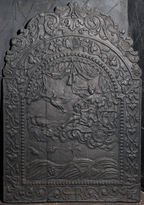
163
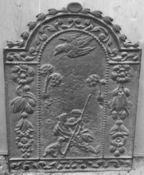
Description: Arched rectangular shape with fillet edging; tall, arched central panel with bead edging (top and sides); flying bird in arch, with two small trees below, and two figures, one with a staff in his right hand, and a dog, at the bottom; two side panels with similar cascades of flowers; narrow base panel with fillet edging and symmetrical floral arrangement; on top, a scallop shell between two symmetrical lines of trailing flowers.
Notes: The figures may be Venus and Adonis, the bird aboive being a dove; probably an English design based on the 'Dutch' style. Formerly part of the Ade Collection (from Grove Hill, Hellingly, Sussex).
Manufactured: in the late-17th to early-18th century in England.
Current location: Hastings Museum and Art Gallery, John's Place, Bohemia Road, Hastings, East Sussex, England.
Museum number: HASMG: 1952.51.31 (part of the Hastings Museum museum group)
- Attached to series:
- British 'Dutch' style firebacks
-
174
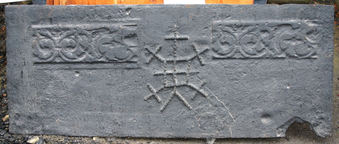
Description: Rectangular; plain plate with central crossed-square rope pattern with crosses at the corner and top; on each side a rectangular stamp with swirled tendril, serpent and demi-cup decoration.
Notes: The crossed square was an alchemistic symbol for iron vitriol (i.e. ferrous sulphate or copperas), but the crosses at the extremities may indicate other symbolism or none; similar patterns are found on other firebacks of a group that may have been associated with Pounsley furnace, Sussex. The repeated panel at the top appears to have been formed using a mould for a section of a plasterwork frieze, resulting in an intaglio impression (approx 395 x 142mm or 15½ x 5½ in.) as opposed to the normal bas-relief; this is very unusual on a fireback. The style of the mould dates from the Elizabethan or Jacobean period. The stubs on the bottom edge are likely to have been the remains of runners where the molten iron entered the mould. Recovered from a property in Burwash, Sussex, in 1910.
- Decoration tags:
- rectangular (shape)
- none (edging)
- simple stamps
- apotropaic
- animals
- objects
Manufactured: in the late-16th to early-17th century possibly at Pounsley Furnace, Framfield in the Weald area of England.
Current location: Hastings Museum and Art Gallery, John's Place, Bohemia Road, Hastings, East Sussex, England.
Museum number: HASMG: 1910.26.1 (part of the Hastings Museum museum group)
Citation: Baines, J. M., 1958, Wealden Firebacks (Hastings Museum).
- Attached to series:
- Pounsley series
- Miscellaneous stamp firebacks
-
180
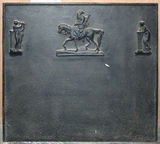
Description: Rectangular: fillet edging; top left, standing classically dressed female figure playing a lyre, with short column behind; top right, classically dressed female figure leaning on a short column; top centre, hatted figure of a bearded man with bagpipes on his back, riding a horse.
Notes: An unusual group of stamps, possibly derived from brass chimney ornaments; the middle figure seems to have little in common with the other two, and the horse’s tail may include part of another figure. Formerly part of the Ade Collection (from Grove Hill, Hellingly, Sussex).
- Decoration tags:
- rectangular (shape)
- fillet (edging)
- carved stamps
- animals
- humans
Manufactured: in the late-19th to early-20th century in England.
Current location: Hastings Museum and Art Gallery, John's Place, Bohemia Road, Hastings, East Sussex, England.
Museum number: HASMG: 1952.51.66 (part of the Hastings Museum museum group)
- Attached to series:
- Ornament stamp firebacks
- Metalware stamp firebacks
-
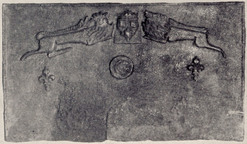
1174
Description: Rectangular; twisted rope edging (top and sides); top centre, crowned shield bearing initials, KH, above a fleur-de-lys, between a leopard passant guardant sinister (on the left) and a leopard passant (on the right); below the rear legs of each leopard, a fleur-de-lys, each inclined slightly outwards at the top; beneath, and slightly to the left of the shield a circular stamp bearing the letter C.
Notes: One of the legs of the leopard on the right is missing, suggesting that the stamps, which appear complete on many firebacks, were well used and had been damaged; this suggests a relatively late use of these stamps. The style of fleur-de-lys is one of two seen on this series of firebacks. The fireback was formerly at Marden Hill House, Tewin, Hertfordshire.
Inscription: C
- Decoration tags:
- rectangular (shape)
- rope (edging)
- carved stamps
- heraldic
- royal
- text
- animals
- objects
Manufactured: in the mid- to late-16th century in the Weald area of England.
Current location: Hertford Museum, 18 Bull Plain, Hertford, Hertfordshire, England.
Museum number: HETFM2893.2 (part of the Hertford Museum museum group)
- Attached to series:
- Royal series
-
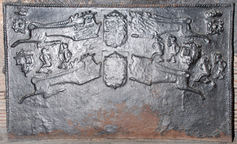
322
Description: Rectangular; rope edging (top and sides); two central crowned Tudor shields, one above the other, each with lion passant guardant sinister to the left, and lion passant to right; crowned, barbed, four-petalled rose in right and left corners; two crowned shields with KH in Lombardic characters above a fleur de lys, each irregularly placed between lions on left and right sides; three 'imps' with right arm raised, two on right and one on left between lions; two ‘imps’ with both arms lowered, one on each side in similar positions.
Notes: One of the legs of the leopards on the right is missing, suggesting that the stamp, which appears complete on many firebacks, was well used and had been damaged; this suggests a relatively late use of these stamps. The same heraldic charges can be seen on other firebacks, with other charges, forming the decoration on many other firebacks, suggesting they were the stock of one particular furnace.
Arms: Tudor royal arms of England
- Decoration tags:
- rectangular (shape)
- rope (edging)
- carved stamps
- heraldic
- armorial
- royal
- animals
Manufactured: in the mid- to late-16th century in the Weald area of England.
Current location: Hever Castle, Hever, Kent, England.
- Attached to series:
- Royal series
-
327
Description: Arched rectangular shaped central panel with open-bud edging; pictorial: Venus in her chariot drawn by doves, with her child, Cupid; a heron flies away to the left; above are swagged curtains and a pair of tassels, below is a landscape; arched rectangular shaped border with fillet edging, a scallop shell top centre with symmetrical arrangement of vine and acanthus leaves and tendrils; the monogram, SHR, bottom centre; above is a symmetrical design of scrolled floral tendrils.
Notes: The design is derived from a personification of the planet Venus in 'Planetarum effectus et eorum in signis zodiaci', by Marten de Vos (1585). Two editions of engravings of de Vos's drawings are known, by Jan Sadeler, dated 1585, and by Gregor Fentzel in about 1650. The flying heron has been copied from a print by Wenceslaus Hollar c.1658. The theft, in 1699, from a Thames-side warehouse of several firebacks, included '6 of Venus in a Chariot with Doves', which is likely to refer to this type (Post Boy 11-14 Nov. 1699).
Copies of this fireback are known.
Inscription: SHR
- Decoration tags:
- 'Dutch' (shape)
- fillet (edging)
- whole carved pattern
- planklines
- pictorial
- mythological
- allegorical
- text
- animals
- humans
Manufactured: in the late-17th century in England.
Current location: Horsham Museum, Causeway, Horsham, West Sussex, England.
(part of the Horsham Museum museum group)
- Attached to series:
- SHR series
- British 'Dutch' style firebacks
- De Vos Planets series
-
330
Description: Rectangular; plain edge; top centre, ring between repeated lion's head between repeated narrow human figure with folded arms standing on a bracket; below each figure, a small bracket.
Notes: The figures are indistinct and are disproportionately small for the size of the firebacks; from Isfield Place 1921.
- Decoration tags:
- rectangular (shape)
- none (edging)
- simple stamps
- carved stamps
- animals
- humans
- objects
Manufactured: in the late-19th to early-20th century in England.
Current location: Horsham Museum, Causeway, Horsham, West Sussex, England.
(part of the Horsham Museum museum group)
- Attached to series:
- Miscellaneous stamp firebacks
-
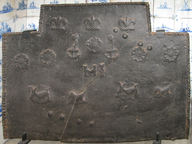
942
Description: Rectangular with a central rectangular extension; twisted rope edging; fleur-de-lys stamp with twisted band repeated three times at top; ?rose stamp repeated five times in line below fleurs, some over pressed, central rose above others; cabled anchor stamp repeated twice, either side of central rose; initials below central rose; ?cow and dog stamps each repeated twice alternately in line below initials; eight rivets from later repair.
Notes: None of the stamps is known from any other fireback; cabled anchor may suggest a connection with a seaport.
Inscription: HI
- Decoration tags:
- rectangular with square arch (shape)
- rope (edging)
- simple stamps
- carved stamps
- individual letters
- heraldic
- text
- animals
- plants
- objects
Manufactured: in the early-17th century in England.
Current location: Wilberforce House, High Street, Kingston upon Hull, Yorkshire, England.
(part of the Hull Museums museum group)
- Attached to series:
- Miscellaneous stamp firebacks
-
341
Description: Arched rectangular shaped central panel with ’nutshell,’ paternost edging on a broad fillet; figure of Neptune/Poseidon holding a trident in his right hand, standing on a pedestal in the centre of a circular fountain, with two hippocampi, water issuing from their mouths; in front, a mermaid swims in waves, her arms raised; behind, blasts of wind issue from clouds; arched rectangular border with fillet edging; symmetrical design of seashells suspended from chains of pearls; bottom centre, the monogram between swirled plant tendrils; on top, symmetrical floral swirls.
Notes: Although very similar in size and design to a fireback in the 1724 series, this is not based on a design by Daniel Marot; instead it may have been inspired by the design for a fountain by Jean Lepautre (1618-82) published in a set of 12 etchings by Jean Le Blond in 1650. Almost certainly the 'iron chimney back' purchased by Henry Campion, of Danny, from John Legas for two guineas in 1731; another example, presumably from the same source, is at The Vine, near Basingstoke, Hampshire.
Copies of this fireback are known.
Inscription: SHR
- Decoration tags:
- 'Dutch' (shape)
- fillet (edging)
- whole carved pattern
- pictorial
- architectural
- text
- animals
- humans
- objects
Manufactured: in the early-18th century possibly at Gloucester Furnace, Lamberhurst in the Weald area of England.
Current location: Danny House, Hurstpierpoint, West Sussex, England.
Citation: Brent, C. & J., 2013, Danny House (Chichester, Phillimore), pp. 58-9.
- Attached to series:
- SHR series
- British 'Dutch' style firebacks