-
492
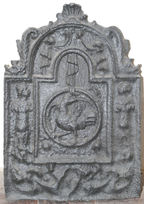
Description: Arched rectangular central panel; fillet and ovolo edging; a ring suspended with drapery, supporting a bird, its wings displayed and inverted, looking to the right, with a small roundel below it in each corner; arched rectangular border with fillet edging, and symmetrical drapery in the arch; and indistinct figure on each side, and indistinct foliage below; on top, a scllop shell between two descending serpents.
Notes: A bird, usually a parrot, perching on a suspended ring can be seen on other firebacks produced in the Siegerland for the Dutch market in the latter part of the 17th century.
Copies of this fireback are known.
Manufactured: in the late-17th century in the Siegerland area of Germany.
Current location: Michelham Priory, Arlington, East Sussex, England.
(part of the Sussex Archaeological Society museum group)
- Attached to series:
- 'Dutch' Miscellaneous Firebacks
- 'Dutch' Bird on perch firebacks
-
1131
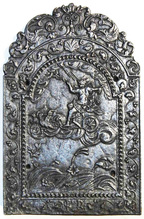
Description: Arched rectangular shaped central panel with 'nutshell' edging; pictorial: Mercury in his chariot drawn by two birds (possibly ravens) across the clouds, his caduceus held aloft; above are clouds, below is a landscape with plants; arched rectangular shaped border with fillet edging, a scallop shell top centre with descending symmetrical arrangement of vine and acanthus leaves and tendrils; the monogram, SHR, bottom centre; on top is a symmetrical design of scrolled floral tendrils. One vertical plankline right of centre.
Notes: The design is based on a personification of the planet Mercury in 'Planetarum effectus et eorum in signis zodiaci', by Marten de Vos (1585). Two editions of engravings of de Vos's drawings are known, by Jan Sadeler, dated 1585, and by Gregor Fentzel in about 1650. The holes were for fixing to a grate.
Inscription: SHR
- Decoration tags:
- 'Dutch' (shape)
- fillet (edging)
- whole carved pattern
- planklines
- pictorial
- allegorical
- monogram
- animals
- humans
- plants
Manufactured: in the late-17th to early-18th century in England.
Current location: not known.
- Attached to series:
- SHR series
- British 'Dutch' style firebacks
- De Vos Planets series
-
1290
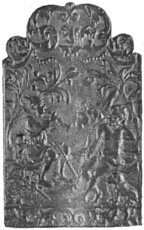
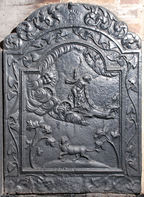
Description: Rectangular, with arch at the top. Above and below acanthus vines. In the middle a landscape with trees and two seated figures; on the left Mercury, playing a flute, a staff over his right shoulder, and at his feet a caduceus; to the right a seated male figure with his left hand supporting his head, in his right hand a stick with which he is supporting himself, behind him a cow, at his feet a dog.
Notes: A scene from classical mythology.
- Decoration tags:
- rectangular with ornate arch (shape)
- fillet (edging)
- whole carved pattern
- pictorial
- mythological
- animals
- humans
- plants
- objects
Manufactured: in the early-18th century in England.
Current location: Rotterdam, Netherlands.
Museum number: 15229 (part of the Museum Rotterdam museum group)
- Attached to series:
- Late pictorial series 2
- Late pictorial series (all)
-
1211
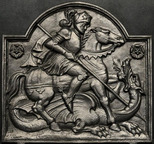
Description: Arched rectangular shape: ovolo-moulded edging; pictorial scene of St George in armour, mounted on a horse, spearing a dragon which lies beneath the horse; in each top corner, a rose.
Notes: A portrayal of St George and the Dragon in bold relief that owes something to the famous modelling by Benedetto Pistrucci of 1817; however, the figure of St George is disproportionately large in relation to the horse.
- Decoration tags:
- rectangular with round arch (shape)
- ovolo (edging)
- whole carved pattern
- pictorial
- mythological
- animals
- humans
- plants
Manufactured: in the 20th century in England.
Current location: Thornhill Galleries, 43-45 Wellington Crescent, New Malden, London, England.
- Attached to series:
- Miscellaneous pattern firebacks
-
867
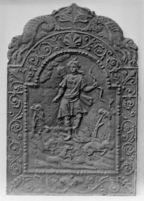
Description: Arched rectangular central panel; bead-and-pellet edging; pictorial scene of a male figure, standing on a ground with trees and animals, with a quiver of arrows and holding a bow in his left hand; clouds above; arched rectangular border with fillet edging; repeated, linked scroll-work on all sides; on top symmetrical leaves between two mirrored serpents.
Notes: The figure is probably that of Apollo.
- Decoration tags:
- 'Dutch' (shape)
- fillet (edging)
- whole carved pattern
- mythological
- animals
- humans
- plants
Manufactured: in the early-18th century in England.
Current location: Metropolitan Museum of Art, 1000, Fifth Avenue, New York, New York, United States of America.
Museum number: 08.81.2 (part of the Metropolitan Museum of Art, New York museum group)
- Attached to series:
- British 'Dutch' style firebacks
-
868
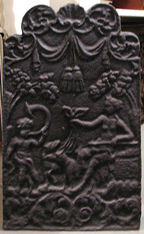
Description: Rectangular with arched, mirrored scrolls on top and central scallop shell, below which are swagged drapes with a central tassel; fillet edging; in a grove, to the left a putto blowing a horn, to the right a semi-naked female figure seated, holding the tail of a fish, with two ?dogs at her feet; at the bottom, narrow panel with symmetrical scrolled foliate decoration.
Notes: Like others in the series, the scene is not immediately identifiable with a scene in classical mythology.
Copies of this fireback are known.
- Decoration tags:
- rectangular with ornate arch (shape)
- fillet (edging)
- whole carved pattern
- pictorial
- mythological
- animals
- humans
- plants
Manufactured: in the early-18th century in England.
Current location: Metropolitan Museum of Art, 1000, Fifth Avenue, New York, New York, United States of America.
Museum number: 08.81.6 (part of the Metropolitan Museum of Art, New York museum group)
- Attached to series:
- Late pictorial series (all)
- Late pictorial series 2
-
710
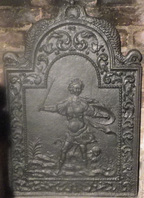
Description: Arched rectangular central panel with bead edging; figure of a man with a shield, brandishing a sword in his right hand, a lion behind him; arched rectangular border with astragal and fillet edging; mirrored swirled foliate design; on top, a scallop shell between two descending sea serpents.
Notes: The figure is probably Hercules who was charged by Eurystheus to slay the Nemean lion, one of his 12 labours.
Copies of this fireback are known.
- Decoration tags:
- 'Dutch' (shape)
- astragal & fillet (edging)
- whole carved pattern
- pictorial
- mythological
- animals
- humans
Manufactured: in the mid- to late-17th century in the Siegerland area of Germany.
Current location: Great Dixter, Northiam, East Sussex, England.
- Attached to series:
- 'Dutch' Miscellaneous Firebacks
-
509
Description: Arched rectangular central panel with astragal and fillet edging; Phaëton riding Apollo’s chariot across the skies, the sun to the left behind clouds, a lion on ground below, between two trees; arched rectangular border with fillet edging; trailing convolvulus leaves surround the central panel; on top, earl’s coronet above an illegible character, between mirrored, swirled foliage.
Notes: The illustration upon which the design has been based has not been identified, save that it figures in book II of Ovid's Metamorphoses. The convolvulus border is a common feature of this series of firebacks and can be compared with other. The wooden pattern from which this casting was made survives in the collection of the Sussex Archaeological Society (no. 928).
- Decoration tags:
- 'Dutch' (shape)
- fillet (edging)
- whole carved pattern
- planklines
- pictorial
- mythological
- animals
- humans
- objects
Manufactured: in the early-18th century at Ashburnham Furnace in the Weald area of England.
Current location: Penhurst Manor, Penhurst, East Sussex, England.
- Attached to series:
- TAN series
- British 'Dutch' style firebacks
-
551
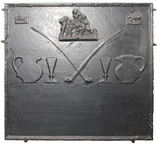
Description: Rectangular; ovolo-moulded edging; top centre, stamp formed of a carved domestic scene of a family around a table, between two small mirrored rectangular stamps each of a cow; lower centre, symmetrical arrangement of two jugs, two goblets and two crossed churchwarden pipes, all in low relief.
Notes: The domestic group has been formed from a decorative iron mantelpiece ornament portraying the tale of the goose that laid golden eggs. Having killed the goose, the family are lamenting the loss of their bounty (see Ames, 1980, p.94). The style of the fireback suggests a pastiche using designs suggesting the past. The same mantelpiece group can be seen as decoration on the kitchen spit assemblage at Petworth House, West Sussex, which was cast at Robert Chorley's foundry at Cocking, south of Midhurst. Evidently this and another fireback bearing the same ornament stamp were among items from the Cowdray estate sold in 1898. Mitford collection, Petworth House.
- Decoration tags:
- rectangular (shape)
- ovolo (edging)
- carved stamps
- animals
- humans
- objects
Manufactured: in the early-19th century probably at Cocking Foundry in the Weald area of England.
Current location: Petworth House, Petworth, West Sussex, England.
Museum number: NT/PET/M/43 (part of the National Trust museum group)
Citation: Ames, A., 1980, Collecting Cast Iron (Ashbourne, Moorland Publishing).
- Attached to series:
- Cocking foundry firebacks
- Ornament stamp firebacks
- Metalware stamp firebacks
-
558
Description: Arched rectangular shape; fillet edging; top centre, stamp formed of a carved domestic scene of a family around a table; in top corners, repeated small stamp of St George and the Dragon; below, repeated stamp of a pineapple in a pot; centre; small stamp of the royal arms of the United Kingdom 1801-37.
Notes: The domestic group has been formed from a decorative iron mantelpiece ornament portraying the tale of the goose that laid golden eggs. Having killed the goose, the family are lamenting the loss of their bounty (see Ames, 1980, p.94). The same mantelpiece group and pineapple stamp can be seen as decoration on the kitchen spit assemblage at Petworth House, West Sussex, which was cast at Robert Chorley's foundry at Cocking, south of Midhurst. Evidently this and another fireback bearing the same ornament stamp were among items from the Cowdray estate sold in 1898. Mitford collection, Petworth House.
Arms: Royal arms of the United Kingdom 1801-37
- Decoration tags:
- rectangular with round arch (shape)
- fillet (edging)
- carved stamps
- armorial
- royal
- animals
- humans
- plants
Manufactured: in the early-19th century probably at Cocking Foundry in the Weald area of England.
Current location: Petworth House, Petworth, West Sussex, England.
Museum number: NT/PET/M/50 (part of the National Trust museum group)
Citation: Ames, A., 1980, Collecting Cast Iron (Ashbourne, Moorland Publishing).
- Attached to series:
- Cocking foundry firebacks
- Ornament stamp firebacks
- Metalware stamp firebacks