-
37
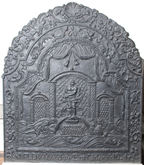
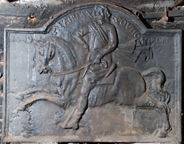
Description: Arched rectangular shaped; cavetto moulded edging; male figure in dress of the period, right hand on hip, left hand holding reins, astride a prancing horse; date and inscription (letter 'N' reversed) follow inside top edge.
Notes: Thomas Fairfax, 3rd Lord Fairfax of Cameron (1612-1671), commander of the New Model Army, which probably prompted the epithet, conqueror. 1649 was the year of Charles I's execution, to which Fairfax was opposed.
Copies of this fireback are known.
Inscription: 1649 LD FAIRFAX COVNQVIROR
- Decoration tags:
- rectangular with round arch (shape)
- cavetto (edging)
- whole carved pattern
- pictorial
- historical
- text
- animals
- humans
Manufactured: in 1649 in England.
Current location: in private hands, Cowbeech, East Sussex, England.
- Attached to series:
- Commemorative firebacks
-
1011
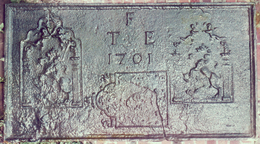
Description: Rectangular shape with cavetto-moulded edging; top centre, initials in triad with date below; on each side, stamp formed of a small, wavy-arched rectangular fireback bearing a lion rampant between pilasters surmounted by burning cauldrons, beneath two mirrored putti holding branches; beneath the date, a stamp formed of a small arched-rectangular fireback laid on its left side with a burning cauldron on each shoulder and the faint figure of a bird in the centre.
Notes: The two identical fireback stamps on either side of the inscription have been noted elsewhere (see no. 210 Late Pictorial series 5); the centre and right fireback stamps have been impressed insufficiently; illustration from Country Life advertisement by T. Crowther & Son Ltd, 18 Oct 1984.
Inscription: TFE [triad] / 1701
- Decoration tags:
- rectangular (shape)
- cavetto (edging)
- composite
- individual letters
- individual numbers
- pictorial
- architectural
- text
- animals
Manufactured: in 1701 in England.
Current location: not known.
-
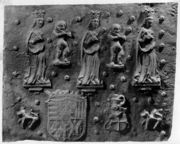
1025
Description: Quasi-rectangular shape; top, crowned robed statuary figure holding a book, repeated three times, interspersed with a naked child statuary figure playing a flute; bottom, shield and coronet to left, small shield, helm and crest to right, all between a crude dog figure repeated on each side; the whole plate dotted randomly with a repeated small gadrooned bead stamp.
Notes: The figures are from wall-mounted statuary. The shield and coronet are those of the Duchy of Lorraine prior to 1538; blazon: Quarterly, 1. barry of eight gules and argent (Hungary) impaling azure semy-de-lis Or a label gules (Naples); 2. argent a cross potent and four crosslets Or (Jerusalem) impaling Or four pallets gules (Aragon); 3. azure semy-de-lis Or a bordure gules (Valois-Anjou); 4. azure crusilly fitchy, two barbels addorsed Or (Bar); overall an inescutcheon Or a bend gules three alerions argent (Lorraine). The figure holding the book is that of St Catherine of Siena (see von den Driesch, pp. 220, 222).
Arms: Duchy of Lorraine
- Decoration tags:
- rectangular (shape)
- none (edging)
- carved stamps
- heraldic
- historical
- armorial
- animals
- humans
- objects
Manufactured: in the early-16th century in the Lorraine area of Germany.
Current location: not known.
- Attached to series:
- Foreign armorial firebacks
-
1026
 ? x ? mm
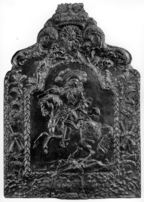
Description: Arched rectangular central panel with overlapping leaf bud edging; prancing equestrian figure of a man in late-seventeenth century dress, with a plumed tricorn hat, his head turned to his left, his left hand holding the reins and his right hand pointing a baton beside the horse's head; quasi-arched rectangular border with overlapping leaf bud edging enclosing martial emblems (cannon, helmets etc.) to left and right, and surmounted by two reclining female figures, that to the left blowing a hunting horn, and that to the right supporting a cornucopia; between them, a sun in splendour, above which is a royal crown; at the bottom corrosion through use and damage has rendered the decoration indistinct.
Notes: The sun in splendour suggests that the figure is that of Louis XIV, of France, but the 'Dutch' style makes this less likely; an alternative identification might be Crown Prince Frederick (later King Frederick IV) of Denmark, of whom other fireback representations exist in a similar pose and with similar martial accoutriments.
- Decoration tags:
- 'Dutch' (shape)
- overlapping leaf bud (edging)
- whole carved pattern
- pictorial
- royal
- animals
- humans
- objects
Manufactured: in the late-17th century in Germany.
Current location:, not known.
- Attached to series:
- 'Dutch' Miscellaneous Firebacks
-
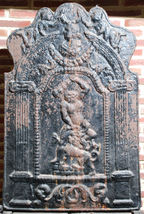
46
Description: Ionic columns supporting a semi-circular arch, in the centre of which the bust of a man has a floral swag beneath; below is a quasi-arched rectangle of beads within which is the figure of Hercules, wielding a club, slaying the Nemean Lion; beneath are floral scrolls; on top of the main arch two kneeling putti hold a wreath over the bust.
Notes: Not the standard 'Dutch' type, which may indicate a different origin.
Copies of this fireback are known.
- Decoration tags:
- 'Dutch' (shape)
- fillet (edging)
- whole carved pattern
- pictorial
- mythological
- animals
- humans
- objects
Manufactured: in the early- to mid-18th century in England.
Current location: in private hands, Cuckfield, West Sussex, England.
- Attached to series:
- Late pictorial series (all)
- Late pictorial series 6
-
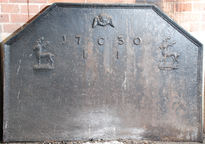
47
Description: Rectangular with canted top corners; ovolo-moulded edging (except base); top centre, cherub face and wings; below, date separated by initials in triad on either side of which a stag statant on a chapeau.
Notes: The cherub is similar, but not identical to those on a fireback, of 1713, from Ashburnham, and the layout and edging are also similar.
Inscription: 17 ICI [triad] 30
- Decoration tags:
- rectangular with canted top corners (shape)
- ovolo (edging)
- carved stamps
- individual letters
- individual numbers
- heraldic
- text
- animals
- humans
Manufactured: in 1730 possibly at Ashburnham Furnace in the Weald area of England.
Current location: in private hands, Cuckfield, West Sussex, England.
- Attached to series:
- Date & initials firebacks
- Miscellaneous stamp firebacks
-
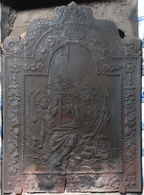
42
Description: Arched rectangular shaped central panel with bead edging; pictorial scene of a seated female figure resting against a hurdle, holding an anchor, a child on each side of her, the one on the left standing clutching corn stalks, the one on the right sitting also holding the anchor and a circular object; a bird sits on a post; arched rectangular shaped border with fillet edging, containing floral swags suspended from a wreath; on top, a scallop shell between two dolphins.
Notes: The figure represents Hope. The theft in 1699 from a Thames-side warehouse of several firebacks, including '3 of Hope with an Anchor' may refer to this type (Post Boy 11-14 Nov. 1699).
Copies of this fireback are known.
- Decoration tags:
- 'Dutch' (shape)
- fillet (edging)
- whole carved pattern
- pictorial
- allegorical
- animals
- humans
- objects
Manufactured: in the mid- to late-17th century in the Siegerland area of Germany.
Current location: in private hands, Cuckfield, West Sussex, England.
- Attached to series:
- 'Dutch' Miscellaneous Firebacks
- Hope firebacks
-
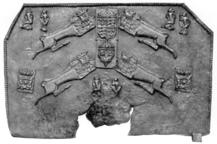
267
Description: Rectangular; twisted rope edging (top and sides); top centre, crowned Tudor royal shield (over-pressed) between a leopard passant guardant sinister (on the left) and a leopard passant (on the right); below, crowned shield bearing initials, KH, above a fleur-de-lys, between two further leopards, styles as above; below the lower shield, two 'imp' figures, the left one with both arms lowered, the right with its right arm raised; outside each lower leopard, a crowned rose (over-pressed); each top corner, a pair of ‘imp’ figures styles as before.
Notes: One of the 'Royal' series. Illustration from Dawson 1903. Formerly in the collection of Dr C. Prince, of Crowborough, Sussex. Further deterioration at the bottom of the casting has caused some loss of metal.
Inscription: KH
Arms: Tudor royal arms of England
- Decoration tags:
- rectangular with canted top corners (shape)
- rope (edging)
- carved stamps
- heraldic
- armorial
- animals
- humans
- plants
Manufactured: in the mid-16th century in the Weald area of England.
Current location: Leeds Castle, Leeds, Kent, England.
Citation: Balcomb, J. T., Nov. 1886, 'An Extinct Sussex Art', The Art Journal, pp. 337-340.
Citation: Dawson, C., 1903, 'Sussex Iron Work and Pottery', Sussex Archaeological Collections, 46, pp. 1-54.
Citation: Gardner, J. S., 1898, 'Iron Casting in the Weald', Archaeologia, 56, 1, pp. 133-164.
- Attached to series:
- Royal series
-
893
Description: Rectangular with complex quasi-arched rectangular top; ovolo moulded edging; shield with Royal arms of France in a swirled cartouche, initials inserted at top of shield; above, an English crown; below to right and left, a prancing stag.
Notes: The combination of the English crown and French arms is common and may relate to the marriage of Charles I and Princess Henrietta Maria of France in 1625; although the framing of the pattern is very similar to others of the same basic design, the style suggests a different pattern maker. A recasting of an earlier back with inserted initials.
Copies of this fireback are known.
Inscription: IT
Arms: France modern
- Decoration tags:
- rectangular with round arch (shape)
- ovolo (edging)
- whole carved pattern
- armorial
- text
- animals
Manufactured: in the early- to mid-17th century possibly in the Weald area of England.
Current location: not known.
- Attached to series:
- Anglo-French armorial firebacks
-
271
Description: Arched rectangular shaped central panel with top corners cavetto canted, bead-and-pellet edging on a wide fillet; hanging drapery with central tassels over three low-arched cubicles, the two outer smaller than the centre, with Tuscan columns and overlapping scales behind; on a plinth of overlapping scales with a scallop shell behind, the standing figure of Neptune/Poseidon, holding a trident in his right hand; water issues from by his feet and from the waves below him disport two ‘sea horses’ and three dolphins; arched rectangular shaped border with top corners cavetto canted, fillet edging: suspended symmetrical beads with tassel ends decorated with sea shells; between two looped 'W' figures, the inscription separating halves of the date along the bottom; above, a central scallop shell with symmetrical floral scrolls on each side.
Notes: From a design in 'Nouveaux livres de ...Statues [etc.]' (La Haye & Amsterdam 1702-5), by Daniel Marot. The inscription, translated as 'GOD is our strength', is a paraphrase of Psalm 46: 1; the original wooden pattern is in Museum Rotterdam (no. 931}; an identical inscription and date is found on several firebacks. All incorporate the looped 'W' motif which may be intended to identify the pattern maker. Formerly at Dogwells Farmhouse, Corscombe, Dorset; other examples are at Leith Hill Place, Surrey, and Lower Brockhampton farmhouse, Herefordshire, the latter having originally been in Dunster Castle, Somerset.
Copies of this fireback are known.
Inscription: 17 DVW Ydyw Ein Cadernid 24
- Decoration tags:
- 'Dutch' (shape)
- fillet (edging)
- whole carved pattern
- pictorial
- mythological
- architectural
- text
- animals
- humans
- objects
Manufactured: in 1724 in England.
Current location: Dorset County Museum, Dorchester, Dorset, England.
(part of the Dorset County Museum museum group)
- Attached to series:
- 1724 series
- Welsh inscription series
- British 'Dutch' style firebacks
 23-10-12 686x.jpg)