-
415
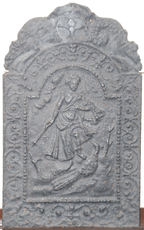
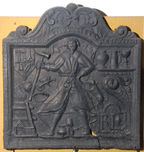
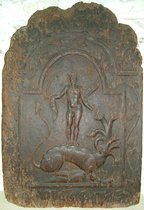
Description: Arched rectangular central panel with bead-and-pellet edging on a broad fillet; figure of Hera/Juno, a sceptre in her right hand, with a peacock below to her left, clouds above left; arched rectangular border with fillet edging; symmetrical arrangement of wire-work swirls; on top, two mirrored serpents.
Notes: Similarities in the design and execution of the pattern suggest the work of the pattern-maker identified as ‘N’. Said to have been cast by Thomas Prickett (1727-95) at Gloucester Furnace, Lamberhurst.
Copies of this fireback are known.
- Decoration tags:
- 'Dutch' (shape)
- fillet (edging)
- whole carved pattern
- pictorial
- mythological
- animals
- humans
Manufactured: in the early-18th century probably at Gloucester Furnace, Lamberhurst in the Weald area of England.
Current location: Anne of Cleves House, Southover High Street, Lewes, East Sussex, England.
Museum number: LH000.948 (part of the Sussex Archaeological Society museum group)
Citation: Dawson, C., 1903, 'Sussex Iron Work and Pottery', Sussex Archaeological Collections, 46, pp. 1-54.
- Attached to series:
- British 'Dutch' style firebacks
-
416
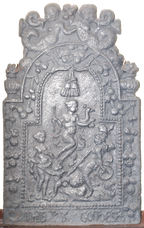
Description: Arched rectangular central panel with bead edging; with tassel at top; three nude female figures: on top, Juno/Hera with a peacock, to the left Venus/Aphrodite, the young cupid/Eros at her feet, to the right Minerva/Athena with spear and shield; arched rectangular border with fillet edging; the heads of two putti and from them two suspended festoons of fruit and leaves; at the bottom, the inscription, THE 3 GODDESES, widely spaced. On top, two figures of Triton blowing seashells. On each shoulder of the fireback, a fluted vase with flowers issuing.
Notes: The three eponymous goddesses are those whose beauty was the subject of the Judgement of Paris. The composition is copied from an engraving by Adriaen Collaert (c1560-1618). This fireback is an instance of a continental back which has been copied in England, the opportunity being taken to insert an English inscription in place of the customary date and pattern maker's monogram. Formerly part of the J. H. Every collection.
Copies of this fireback are known.
Inscription: THE 3 GODDESES [sic]
- Decoration tags:
- 'Dutch' (shape)
- fillet (edging)
- whole carved pattern
- pictorial
- mythological
- text
- animals
- humans
Manufactured: in the late-17th century in England.
Current location: Anne of Cleves House, Southover High Street, Lewes, East Sussex, England.
Museum number: 1944.24.074 (part of the Sussex Archaeological Society museum group)
- Attached to series:
- 'Dutch' NDW series
- Judgement of Paris firebacks
-
426
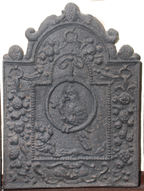
Description: Arched rectangular central panel with bead edging; suspended from the top, by a ribbon, a ring with a popinjay, or parrot, perched thereon, biting a twig in its right claw; below left is a seated child; around this panel is an arched rectangular border with fillet edging containing floral swags hung on ribbons suspended from rings; on top, two serpents.
Notes: A common design among firebacks produced in Germany for the Dutch market. Formerly part of the J. H. Every collection.
Copies of this fireback are known.
Manufactured: in the mid- to late-17th century in the Siegerland area of Germany.
Current location: Anne of Cleves House, Southover High Street, Lewes, East Sussex, England.
Museum number: 1944.24.072 (part of the Sussex Archaeological Society museum group)
- Attached to series:
- 'Dutch' Miscellaneous Firebacks
- 'Dutch' Bird on perch firebacks
-
427
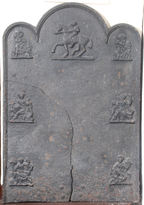
Description: Rectangular with three sem-circular arches on top, the middle arch higher and wider than the others; ovolo-moulded edging (top and sides); top centre, equestrian figure stamp; six small stamps of iconic figures down the sides, arranged in two columns.
Notes: An unusual fireback with stamps about 90mm high; the stamps are likely to have been cast from brass or iron mantelpiece ornaments, popular in the Victorian period. Formerly part of the J. H. Every collection.
- Decoration tags:
- rectangular with three arches (shape)
- ovolo (edging)
- carved stamps
- pictorial
- animals
- humans
Manufactured: in the 19th century in England.
Current location: Anne of Cleves House, Southover High Street, Lewes, East Sussex, England.
Museum number: 1944.24.089 (part of the Sussex Archaeological Society museum group)
- Attached to series:
- Ornament stamp firebacks
- Metalware stamp firebacks
-
429
Description: Arched rectangular shape with symmetrical floral scrolls on top; three horizontal plank lines; ovolo moulding all round edge of main panel; inscription along top edge of panel; central figure of a bearded man wearing knee-length coat, belted at waist, and holding a sledge hammer in his right hand, his left arm akimbo; both feet pointing to his right; various ‘tools’ of his trade arranged about him; (clockwise from top left) shield, the quarters containing a masonry hammer, a firedog, a weight, and a pair of pincers; the date split on either side of his head; a floral console supporting a shelf bearing a flagon, a tankard and a goblet; a fireback bearing the letters RL and a diamond shape; from the top of the fireback a dog leaping up at its master; between the man's legs a long-handled ladle, a weight and a cooking pot; a ringer, used to pull slag off molten iron; part of the elevation of a blast furnace, with wooden framework, casting house, and flames issuing from the top; an ore basket, wheelbarrow and a charcoal clamp
Notes: The 'Lenard' fireback; a much-copied plate. Items relating to the founder's working life are displayed to the left of the figure, those to the right reflecting his domestic life. Its individualistic design and naïve figuration are the key to identifying a distinct group of firebacks, all probably made at Brede. A pastiche of this fireback also exists (no. 668), with which it is sometimes confused.
Copies of this fireback are known.
Inscription: RICHARD LENARD FOVNDER AT BRED FOVRNIS [each D is reversed] / 1636 / RL
- Decoration tags:
- rectangular with round arch (shape)
- ovolo (edging)
- whole carved pattern
- planklines
- pictorial
- historical
- text
- animals
- humans
- objects
Manufactured: in 1636 at Brede Furnace in the Weald area of England.
Current location: Anne of Cleves House, Southover High Street, Lewes, East Sussex, England.
Museum number: LH000.906 (part of the Sussex Archaeological Society museum group)
Citation: Anon., 30 Dec 1911, 'Sussex Backs and their Story', The Ironmonger.
Citation: Dawson, C., 1903, 'Sussex Iron Work and Pottery', Sussex Archaeological Collections, 46, pp. 1-54.
Citation: Gardner, J. S., 1898, 'Iron Casting in the Weald', Archaeologia, 56, 1, pp. 133-164.
- Attached to series:
- Brede group
- Personal firebacks
-
442
Description: Fragment: right part only; rectangular; twisted rope edging; lion passant with rose stamped twice above and below rear end, crowned rose below fore end; bottom right corner, two small walking figures, one with both arms down, the other with right arm raised.
Notes: One of a series with the same and other stamps.
- Decoration tags:
- rectangular (shape)
- rope (edging)
- carved stamps
- heraldic
- royal
- animals
- humans
- plants
Manufactured: in the mid-16th century in the Weald area of England.
Current location: Anne of Cleves House, Southover High Street, Lewes, East Sussex, England.
Museum number: LH001.005 (part of the Sussex Archaeological Society museum group)
- Attached to series:
- Royal series
-
450
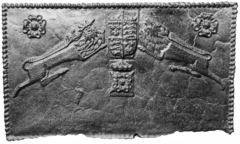
Description: Rectangular; twisted rope edging; central crowned Tudor shield with lion passant guardant sinister to the left, and lion passant to right; four-petalled rose in right and left corners; crowned, barbed, four-petalled rose below shield.
Notes: One of a large series bearing some or all of the same stamps.
Arms: Tudor royal arms of England
- Decoration tags:
- rectangular (shape)
- rope (edging)
- carved stamps
- heraldic
- armorial
- animals
Manufactured: in the mid-16th century in the Weald area of England.
Current location: Barbican House, High Street, Lewes, East Sussex, England.
Museum number: LH000.800 (part of the Sussex Archaeological Society museum group)
Citation: Dawson, C., 1903, 'Sussex Iron Work and Pottery', Sussex Archaeological Collections, 46, pp. 1-54.
- Attached to series:
- Royal series
-
451
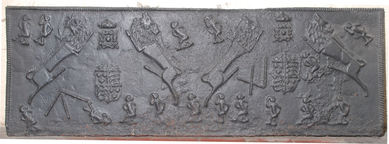
Description: Rectangular; twisted rope edging (top and sides); basic arrangement of crowned Tudor rose above a crowned Tudor royal shield, all between a crowned lion passant guardant sinister and lion passant, both per bend, repeated on both halves of the plate; irregularly arranged, mainly along the top and bottom, are sixteen small figures, alternately with right arm raised or lowered; bottom left and centre right are two different arrangements of a length of twisted rope in 'V' and 'I'.
Notes: The stamps used on this large fireback are encountered on several firebacks indicating their common source; previously at Legh Manor, Cuckfield, Sussex.
Arms: Tudor royal arms of England
- Decoration tags:
- rectangular (shape)
- rope (edging)
- simple stamps
- carved stamps
- heraldic
- apotropaic
- armorial
- animals
- humans
- objects
Manufactured: in the mid-16th century in the Weald area of England.
Current location: Anne of Cleves House, Southover High Street, Lewes, East Sussex, England.
Museum number: LH000.937 (part of the Sussex Archaeological Society museum group)
- Attached to series:
- Royal series
-
854
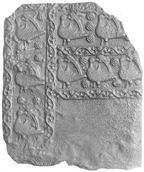
Description: Sub-rectangular fragment; undulating vine tendril strip repeated twice vertically from left edge with a bird stamp (probably a swan, a Lancastrian badge) repeated three times between, interspersed with a grape cluster stamp repeated seven times; vine tendril stamp repeated twice horizontally at right angles to rightmost vertical strip, three bird stamps between strips and two above, interspersed with seven grape cluster stamps.
Notes: This fragment incorporates common elements from a large series of firebacks.
- Decoration tags:
- rectangular (shape)
- trailing vine (edging)
- carved stamps
- animals
- plants
Manufactured: in the mid- to late-16th century possibly at Pounsley Furnace, Framfield in the Weald area of England.
Current location: Anne of Cleves House, Southover High Street, Lewes, East Sussex, England.
Museum number: LH000.924 (part of the Sussex Archaeological Society museum group)
- Attached to series:
- Pounsley series
- Vine strip series
- Swan series
- Furniture stamp firebacks
-
927
Description: Carved wooden fireback pattern. Arched rectangular central panel, astragal and fillet edge, pictorial, Hercules, sword in hand, preparing to slay the Hydra; arched rectangular border, fillet edge, ivy leaves and tendrils, monogram at bottom; swirled foliage on top.
Notes: Unusually for a pattern, it was carved from a single piece of wood; formerly in the custody of William Hobday (d. 1883), last surviving ironworker at Ashburnham furnace, this pattern was given to the Sussex Archaeological Society by the Revd. J. Bickersteth.
Inscription: TAN
- Decoration tags:
- 'Dutch' (shape)
- fillet (edging)
- whole carved pattern
- pictorial
- mythological
- text
- animals
- humans
Manufactured: in the early-18th century in England.
Current location: Anne of Cleves House, Southover High Street, Lewes, East Sussex, England.
(part of the Sussex Archaeological Society museum group)
Citation: Dawson, C., 1903, 'Sussex Iron Work and Pottery', Sussex Archaeological Collections, 46, pp. 1-54.
- Attached to series:
- Patterns
- TAN series