-
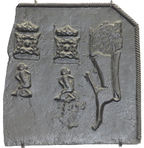
748
Description: Fragment; right part only; canted rectangle; twisted rope edging; lion passant positioned vertically along right side; rose and crown stamp repeated twice (both over-pressed), each above an ‘imp’ figure with both arms lowered.
Notes: A particularly clear casting; the right rear leg of the lion (missing on some variants of this series) has been replaced by a short length of twisted rope.
- Decoration tags:
- rectangular with canted top corners (shape)
- rope (edging)
- carved stamps
- heraldic
- animals
Manufactured: in the mid-16th century in the Weald area of England.
Current location: Victoria & Albert Museum, Cromwell Road, Kensington & Chelsea, Greater London, England.
Museum number: 897.1901 (part of the Victoria & Albert Museum museum group)
- Attached to series:
- Royal series
-
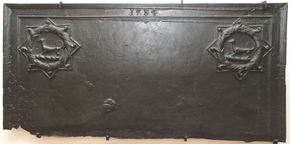
752
Description: Rectangular; cavetto moulded edging on top and sides, with astragal and fillet inside; talbot crest within wreath and eight-pointed star, repeated at top corners; date top centre between mouldings.
Notes: The crest is probably that of the Parker family, of Ratton, near Eastbourne, Sussex. The base board appears to have been repositioned prior to the wreath stamps being impressed in the mould. Acquired from Marle Green Farm, Hellingly, Sussex, in 1896.
Inscription: 1584
- Decoration tags:
- rectangular (shape)
- carved stamps
- individual numbers
- heraldic
- text
- animals
- objects
Manufactured: in 1584 in the Weald area of England.
Current location: Victoria & Albert Museum, Cromwell Road, Kensington & Chelsea, Greater London, England.
Museum number: 780.1896 (part of the Victoria & Albert Museum museum group)
- Attached to series:
- Royal series
- Royal (wreath) series
-
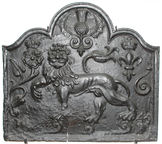
763
Description: Quasi-Arched rectangular shape with cyma reversa shoulders; ovolo edging; stylised lion passant guardant; crowned rose with leaf and stem on left, crowned fleur de lys on right, thistle with leaves above centre; three right-facing scrolls at base; down-facing scroll, with staple, on right side; date split between bottom corners; initials below date, bottom right.
Notes: Blatantly Royalist in its symbolism, a variant (no. 901) is dated (perhaps more convincingly) 1641. Numeral style, initials, leaf depiction and the stapled scroll are typical features of firebacks made from patterns by the same maker. A later version of the same subject, but with a different shaped plate and without the fleur-de-lys, is also known (see 'Royalist series'). M. A. Lower writes of firebacks of this design of being cast at Waldron Furnace in Sussex (Lower, 1849, p.219).
Copies of this fireback are known.
Inscription: 16 49 / IM
- Decoration tags:
- rectangular with round arch (shape)
- ovolo (edging)
- whole carved pattern
- heraldic
- royal
- text
- animals
Manufactured: in 1649 possibly at Brede Furnace in the Weald area of England.
Current location: Victoria & Albert Museum, Cromwell Road, Kensington & Chelsea, Greater London, England.
Museum number: 492.1901 (part of the Victoria & Albert Museum museum group)
Citation: Lloyd, N., 1925, 'Domestic Ironwork I', Architectural Review, 58, pp. 58-67.
- Attached to series:
- IM series
- Hooked '1' series
- Stapled scroll series
- Brede group
-
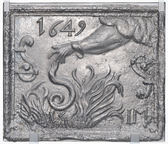
769
Description: Rectangular; cavetto-moulded edge; a snake rises from a fire and bites the middle finger of the hand of a sleeved left arm that descends from a top right corner cloud; left and right, ‘S’ scrolls appear strapped to the edge of the fireback; the date, top left of centre; initials, bottom right corner.
Notes: An illustration of the New Testament episode (Acts 28: 3) when St Paul, shipwrecked in the island of Malta, was putting sticks on a fire and a viper bit him. The distinctive shape of the ‘1’ in the date and the initials, ‘IM’, together with the ‘S’ scrolls, parallel such features in other firebacks. The design is an adaptation of an illustration in 'Devises Heroiques' by Claudius Paradin (1557) which was translated into English by Geoffrey Whitney as 'The Book of Emblemes' (1586).
Copies of this fireback are known.
Inscription: 1649 / IM
- Decoration tags:
- rectangular (shape)
- cavetto (edging)
- whole carved pattern
- biblical
- text
- animals
- humans
Manufactured: in 1649 possibly at Brede Furnace in the Weald area of England.
Current location: Victoria & Albert Museum, Cromwell Road, Kensington & Chelsea, Greater London, England.
Museum number: M.119-1984 (part of the Victoria & Albert Museum museum group)
Citation: Hamling, T., 2010, Decorating the 'Godly' Household (New Haven, Yale), pp. 251-2.
- Attached to series:
- IM series
- Hooked '1' series
- New Testament firebacks
- Brede group
-
1140
Description: Arched rectangular shape with arch on top; rebated fillet edging; below mirrored putti holding crossed fronds, the figure of St George slaying the dragon; on each side a flame-topped column.
Notes: The central panel of what would otherwise have been a typical bordered fireback intended for the Dutch market.
- Decoration tags:
- rectangular with arch above arch (shape)
- whole carved pattern
- pictorial
- historical
- animals
- humans
Manufactured: in the mid- to late-17th century in the Siegerland area of Germany.
Current location: Victoria & Albert Museum, Cromwell Road, Kensington & Chelsea, London, England.
Museum number: 797-1899 (part of the Victoria & Albert Museum museum group)
- Attached to series:
- 'Dutch' Miscellaneous Firebacks
-
1227
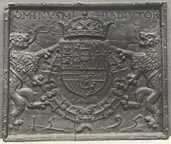
Description: Rectangular shape with ovolo-moulded edging; within the collar of the Order of the Golden Fleece, a central shield of the arms of Spain: quarterly Castile and Leon, Aragon and Aragon-Sicily, with an escutcheon of Portugal; in base Austria, Burgundy ancient, Burgundy modern and Brabant with an escutcheon of Flanders impaling Tyrol; above, a crown; supporters: two golden lions rampant; below the shield, the date, 1595; above the crown, the inscription: Dominus mihi adiutor (the Lord is my helper).
Notes: The arms of King Philip II of Spain following the unification with Portugal, as used in the Spanish Netherlands. Part of the bequest to the Victoria and Albert Museum by Lieut. Colonel G. B. Croft-Lyons in 1926.
Copies of this fireback are known.
Inscription: DOMINVS MIHI ADIVTOR
Arms: King Philip II of Spain (Spanish Netherlands)
- Decoration tags:
- rectangular (shape)
- ovolo (edging)
- whole carved pattern
- heraldic
- armorial
- royal
- text
- animals
Manufactured: in 1595 possibly in the Ardennes area of Belgium.
Current location: Science Museum, Exhibition Road, Kensington & Chelsea, London, England.
Museum number: M.624.1926 (part of the Victoria & Albert Museum museum group)
- Attached to series:
- Foreign armorial firebacks
-
895
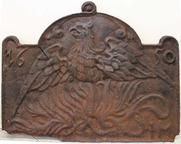
Description: Quasi-arched rectangular shape, semi-circular protrusions on top corners; cavetto-moulded edging looped at top; two mirrored scrolls inside arch; a phoenix in flames, its wings displayed and inverted; date, in two parts, in top corners; initials in bottom right corner.
Notes: On a copy (no. 590) the loop at the top is missing and the date and the initials have been erased.
Copies of this fireback are known.
Inscription: 16 50 / IM
- Decoration tags:
- rectangular with round arch (shape)
- cavetto (edging)
- whole carved pattern
- pictorial
- mythological
- text
- animals
Manufactured: in 1650 possibly at Brede Furnace in the Weald area of England.
Current location: not known.
- Attached to series:
- Hooked '1' series
- IM series
- Loop edged firebacks
- Brede group
- Phoenix firebacks
-
300
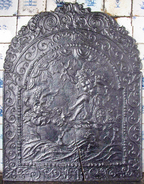
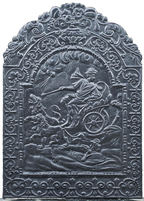
Description: Arched rectangular shaped central panel with bead-and-pellet edging on a broad fillet; Jupiter in his chariot drawn by eagles; above are clouds, below is a landscape; arched rectangular shaped border with fillet edging, with a symmetrical scrolled wire design; the monogram, SHR, bottom centre; above is a symmetrical design of scrolled floral tendrils.
Notes: The design is derived from a personification of the planet, Jupiter, in 'Planetarum effectus et eorum in signis zodiaci', by Marten de Vos (1585). Two editions of engravings of de Vos's drawings are known, by Jan Sadeler, dated 1585, and by Gregor Fentzel in about 1650.
Copies of this fireback are known.
Inscription: SHR
- Decoration tags:
- 'Dutch' (shape)
- fillet (edging)
- whole carved pattern
- pictorial
- mythological
- monogram
- animals
- humans
- objects
Manufactured: in the late-17th to early-18th century in England.
Current location: Powis Castle, Welshpool, Powys, Wales.
Museum number: 1180886 (part of the National Trust museum group)
Citation: Dawson, C., 1903, 'Sussex Iron Work and Pottery', Sussex Archaeological Collections, 46, pp. 1-54.
Citation: Gardner, J. S., 1898, 'Iron Casting in the Weald', Archaeologia, 56, 1, pp. 133-164.
- Attached to series:
- SHR series
- British 'Dutch' style firebacks
- De Vos Planets series
-
992
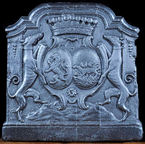
Description: Ogee-arched rectangular shape, centred by a scroll-edged cartouche enclosing a pair of armorial ovals, the left cast with a crowned lion rampant, the right with a salamander surrounded by flames, all between a pair of greyhound supporters and edged with bellflower-decorated pilasters.
Notes: The heraldic design depicting the marriage of Paul de Chabannes (1686-1769), comte de Chabannes de Vergers, with Marie-Madeleine Sallonyer on 1st July 1715 (whose shield is a golden salamander bedded in red hot fire on a blue shield).
Copies of this fireback are known.
- Decoration tags:
- rectangular with canted top corners and round arch (shape)
- whole carved pattern
- planklines
- armorial
- animals
Manufactured: in the early-18th century in France.
Current location: not known.
Citation: Palasi, P., 2014, Plaques de Cheminées Héraldiques (Paris, Éditions Gourcuff-Gradenigo).
- Attached to series:
- Foreign armorial firebacks
-
626
Description: Arched rectangular central panel; bead-and-pellet edging; pictorial scene of a male figure seated in a chariot, his left arm resting on the side of the chariot, his right hand holding a sceptre at arm’s length, the chariot drawn by two lions across a ground with small bushes; clouds above with the personification of the wind blowing to the left; arched rectangular border with fillet edging; repeated, linked scroll-work on all sides; on top a vase of fruit between two mirrored serpents. A recasting.
Notes: Similar to other designs incorporating figures in chariots, though not from the same series; a recasting has the date, 1702, superimposed.
Copies of this fireback are known.
- Decoration tags:
- 'Dutch' (shape)
- fillet (edging)
- whole carved pattern
- pictorial
- mythological
- text
- animals
- humans
- objects
Manufactured: in the late-17th to early-18th century in England.
Current location: Westland Ltd, St Leonards Church, Leonard Street, Shoreditch, London, England.
- Attached to series:
- British 'Dutch' style firebacks