-
981
Description: Arched rectangular shape; fillet edging; broad, fillet-edged central panel with pictorial landscape and battle scene; on top, above a cone of laurel leaves, a crown supported by two putti, each holding a plant stem; on each side, a flower and fruit festoon suspended on a ribbon from a ring; at the bottom , inscription on a scroll.
Notes: The pictorial scene is alleged to be the Siege of Namur of 1695 in which British and Dutch forces, under the leadership of William III, defeated the French forces of Louis XIV, however details of the scene more closely resemble those seen in images of the Siege of Vienna in 1683, an iconic victory of the Christian powers over the Ottoman Turks.
Copies of this fireback are known.
Inscription: NON[...]ROSEDARMIS / N ANNO 1695 L
- Decoration tags:
- 'Dutch' (shape)
- fillet (edging)
- whole carved pattern
- individual letters
- pictorial
- text
- animals
- humans
- plants
- objects
Manufactured: in 1695 possibly in the Siegerland area of Germany.
Current location: Swakeley's House, Ickenham, Middlesex, England.
Citation: Godfrey, W. H., 1933, Survey of London Monograph 13, Swakeleys, Ickenham (London, HMSO).
- Attached to series:
- 'Dutch' 1695 Crown series
-
345
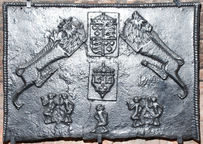
Description: Rectangular; twisted rope edging (top and sides); from top, crowned Tudor royal shield (stamp overpressed) above crowned shield bearing initials, KH in Lombardic lettering, above a fleur de lys (stamp overpressed); to left, diagonal lion passant guardant sinister; to right, diagonal lion passant; at base, single 'imp' figure, arms to side, moving left but facing right, between two pairs of 'imp' figures (separately stamped), one moving left, right arm raised, the other moving right, right arm raised.
Notes: One of the 'Royal' series.
Arms: Tudor royal arms of England
- Decoration tags:
- rectangular (shape)
- rope (edging)
- carved stamps
- heraldic
- armorial
- animals
- humans
Manufactured: in the mid-16th century in the Weald area of England.
Current location: Ightham Mote, Ightham, Kent, England.
Museum number: 825393 (part of the National Trust museum group)
- Attached to series:
- Royal series
-
843
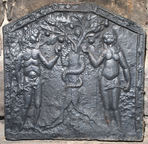
Description: Canted rectangular shape; double fillet edging (top and sides) with alternating roses and diamonds between the fillets; pictorial scene of Adam and Eve, both naked, taking fruit from the Tree of Knowledge, between them, around which is entwined the serpent.
Notes: Boldly sculpted, stylised figures; the serpent is shown with a human face.
Copies of this fireback are known.
- Decoration tags:
- rectangular with canted top corners (shape)
- double fillet (edging)
- whole carved pattern
- planklines
- pictorial
- biblical
- animals
- humans
- plants
Manufactured: in the late-16th to early-17th century possibly in the Lorraine area of France.
Current location: Old Manor House, Ilkley, West Yorkshire, England.
(part of the Bradford Museums and Art Galleries museum group)
- Attached to series:
- Old Testament & Apocrypha firebacks
- Adam & Eve firebacks
-
354
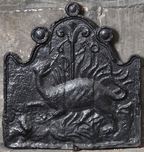
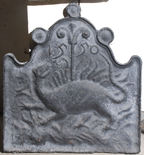
Description: Quasi-arched rectangular shaped; unique, cavetto moulded edging, which loops upon itself three times. A mythical salamander shown in the flames which legend states it is able to resist; behind is what appears to be a palm tree, on either side of which the date is stamped. Two plank-lines.
Notes: Whole pattern with added date; one of a series of firebacks where the number ‘1’ is hooked at both ends. Damage and subsequent repair to the bottom right corner has obliterated a letter 'M' seen on another casting; presumably part of 'IM'. A variant, at Lewes, is incorrectly dated 1550.
Copies of this fireback are known.
Inscription: 1650
- Decoration tags:
- rectangular with ornate arch (shape)
- cavetto (edging)
- whole carved pattern
- individual numbers
- planklines
- pictorial
- mythological
- text
- animals
Manufactured: in 1650 possibly at Brede Furnace in the Weald area of England.
Current location: East Riddlesden Hall, Keighley, Yorkshire, England.
Museum number: NT/ERH/M/40 (part of the National Trust museum group)
Citation: Schubert, H. R., 1957, 'A Forgery in Iron', Journal of the Iron & Steel Institute, 165, p. 125.
- Attached to series:
- Hooked '1' series
- Loop edged firebacks
- Brede group
-
358
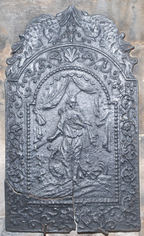
Description: Arched rectangular central panel with bead edging on a broad fillet; standing on a ground with a peacock behind her, a classically-dressed figure of a female, wearing a crown and holding a sceptre in her right hand, her left hand across her chest; above her, swagged drapery; arched rectangular border with fillet edging; central scallop shell at the top with a descending arrangement of swirled and interlinked lines; at bottom centre, a cartouche bearing the letter ‘N’; on top, two mirrored serpents.
Notes: The figure is that of Hera/Juno. The pattern maker identified as ‘N’ is likely to have been working in collaboration with pattern makers whose fireback designs are identified with the initials, SHR and EB, and with the maker responsible for patterns made in 1724, some of which bore inscriptions in Welsh.
Inscription: N
- Decoration tags:
- 'Dutch' (shape)
- fillet (edging)
- whole carved pattern
- pictorial
- mythological
- text
- animals
- humans
Manufactured: in the early-18th century in England.
Current location: Baddesley Clinton Hall, Knowle, Warwickshire, England.
Museum number: 342886 (part of the National Trust museum group)
- Attached to series:
- N series
- British 'Dutch' style firebacks
-
365
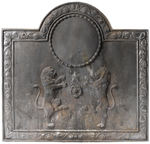
Description: Arched rectangular shape; astragal edging with parallel astragal enclosing a border of undulating convolvulus vine, leaves and flowers; bead and disc circle in arch, above a pair of lions rampant facing each other, between which are a five-pointed star above a rose.
Notes: A fireback in a retro-Regency style. Sotheby's auction, 27 Oct 2010, lot 209 (£2,500)
Copies of this fireback are known.
- Decoration tags:
- rectangular with round arch (shape)
- astragal (edging)
- whole carved pattern
- heraldic
- animals
Manufactured: in the late-19th to early-20th century in England.
Current location: in private hands, Lambourn, Berkshire, England.
- Attached to series:
- Miscellaneous pattern firebacks
-
841
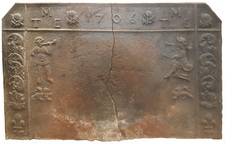
Description: Canted rectangle; cavetto-moulded edging (top and sides); single horizontal fillet below canted corners and vertical fillet parallel to each side, dividing the fireback into two side panels, two top corner panels, top panel and main central panel; corner panels, ‘daisy’ plant stamp; top panel, date between ‘daisy’ stamps, between initials in triad at each end; side panels, swirling foliage stamp repeated each side above a fleur-de-lys; centre panel, stamp of ‘Indian’ smoking a pipe at top left, stamp of seated ‘gentleman’ smoking a pipe and holding another, at top right; below each, a lion passant stamp, facing right on the left and facing left on the right; initials IB in bottom corners of centre panel.
Notes: The 'daisy' stamp is identical to those on similar firebacks dated between 1703 and 1721, and probably indicating the same founder whose initials IB are at the bottom; the use of stamps relating to tobacco smoking may suggest an origin near Bristol, the main entry port for the tobacco trade at that time. Previously noted at Little Faringdon House, near Lechlade. Bishop & Miller auction, Stowmarket, Suffolk, 25 May 2022, lot 293 (ns).
Inscription: TME [triad] 1706 TME [triad] / I B
- Decoration tags:
- rectangular with canted top corners (shape)
- cavetto (edging)
- carved stamps
- individual letters
- individual numbers
- heraldic
- text
- animals
- humans
- plants
Manufactured: in 1706 in the Forest of Dean area of England.
Current location: not known.
- Attached to series:
- IB series
- Date & initials firebacks
-
407
Description: Quasi-arched rectangular shaped; unique, cavetto moulded edging, which loops upon itself three times. A mythical salamander shown in the flames which legend states it is able to resist; behind is what appears to be a palm tree, on either side of which the date is stamped.
Notes: The fireback has been incorrectly dated 1550 instead of 1650, which Schubert, following W. R. Lethaby, asserted was a forgery claiming indications that a ‘6’ had been erased. Undoubtedly the first '5' is more prominent than the other figures though the exact method by which it has been substituted is not clear. Corrosion to the bottom right corner may have obliterated a letter 'M' seen on another casting; presumably part of 'IM'.
Inscription: 1550
- Decoration tags:
- rectangular with ornate arch (shape)
- cavetto (edging)
- whole carved pattern
- individual numbers
- pictorial
- mythological
- text
- animals
Manufactured: in 1650 possibly at Brede Furnace in the Weald area of England.
Current location: Anne of Cleves House, Southover High Street, Lewes, East Sussex, England.
Museum number: LH000.901 (part of the Sussex Archaeological Society museum group)
Citation: Dawson, C., 1903, 'Sussex Iron Work and Pottery', Sussex Archaeological Collections, 46, pp. 1-54.
Citation: Gardner, J. S., 1898, 'Iron Casting in the Weald', Archaeologia, 56, 1, pp. 133-164.
Citation: Lethaby, W. R., 1 Oct 1926, 'English Cast Iron - I', The Builder, 131, no. 4365, pp. 537-8.
Citation: Schubert, H. R., 1957, 'A Forgery in Iron', Journal of the Iron & Steel Institute, 165, p. 125.
- Attached to series:
- Hooked '1' series
- Loop edged firebacks
- Brede group
-
409
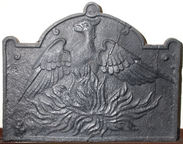
Description: Quasi-arched rectangular shape, semi-circular protrusions on top corners; circular loop at top of arch; fillet edging with small twists inside arch, and curls inside and below top corners; a phoenix in flames, its wings displayed and inverted.
Notes: The use of the loop in the edging draws comparisons with other firebacks, and may indicate the same source. Formerly part of the J. H. Every collection.
- Decoration tags:
- rectangular with round arch (shape)
- fillet (edging)
- whole carved pattern
- planklines
- pictorial
- mythological
- animals
Manufactured: in the mid- to late-17th century possibly in the Weald area of England.
Current location: Anne of Cleves House, Southover High Street, Lewes, e, England.
Museum number: 1944.24.061 (part of the Sussex Archaeological Society museum group)
- Attached to series:
- Loop edged firebacks
- Phoenix firebacks
-
414
Description: Rectangular central panel with elongated arch; bead edging; semi-nude figure of Poseidon/Neptune, a trident in his right hand, standing on two hippocampi (mythical sea horses). Rectangular border with elongated arch; fillet edging; two suspended festoons of fruit and leaves; at the bottom, the date and monogram. On top, two scrolls of foliage. On each shoulder of the fireback, a basket with fruit
Notes: A number of images of Poseidon on firebacks bear more than a passing similarity to fountain statuary. This is just such an example although the source of the design has yet to be identified. Formerly part of the J. H. Every collection.
Copies of this fireback are known.
Inscription: 16 NDW 97
- Decoration tags:
- 'Dutch' (shape)
- fillet (edging)
- whole carved pattern
- pictorial
- mythological
- monogram
- text
- animals
- humans
Manufactured: in 1697 in the Siegerland area of Germany.
Current location: Anne of Cleves House, Southover High Street, Lewes, East Sussex, England.
Museum number: 1944.24.075 (part of the Sussex Archaeological Society museum group)
- Attached to series:
- 'Dutch' NDW series