-
595
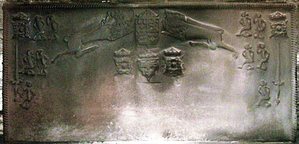
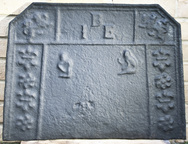
Description: Rectangular; twisted rope edging (top and sides); top centre; crowned Tudor royal shield with angled lion passant guardant sinister to the left, and an angled lion passant to the right; below, a crowned shield with a fleur-de-lys below initials (over-pressed), between two four-petalled, crowned roses; the same crowned rose repeated in each top corner, below each a vertical dagger, point upwards; inside the roses and daggers, two tiered pairs of ‘imp’ figures, one of each with arm raised, above a single figure, its arms lowered.
Notes: Each dagger, which is seen on two other firebacks (no. 660 and no. 1100), is approx. 35cm long.
Copies of this fireback are known.
Inscription: KH
Arms: Tudor royal arms of England
- Decoration tags:
- rectangular (shape)
- rope (edging)
- carved stamps
- heraldic
- armorial
- royal
- animals
- humans
Manufactured: in the mid-16th century in the Weald area of England.
Current location: in private hands, Wigmore, Herefordshire, England.
- Attached to series:
- Royal series
- Knife & Dagger stamp firebacks
-
1146
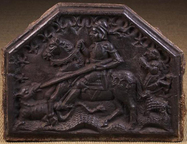
Description: Canted rectangular shape; astragal edging with repeated fleurs-de-lys inside top and side edges; figure of St George impaling a dragon to the left with a lance over an undulating ground, with a kneeling figure above a sheep to the right.
Notes: The mould for this unusual fireback may have been formed using a redundant carved, medieval wooden panel, perhaps from a church. Wilkinson's Auctioneers, Doncaster, 24 June 2018, lot 132.
- Decoration tags:
- rectangular with canted top corners (shape)
- astragal (edging)
- whole carved pattern
- pictorial
- mythological
- animals
- humans
Manufactured: in the 16th century in England.
Current location: not known.
- Attached to series:
- Miscellaneous pattern firebacks
-
827
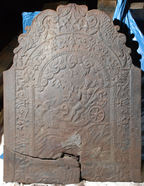
Description: Arched rectangular central panel with bead-and-pellet edging on a broad fillet; pictorial scene of a figure in a chariot drawn by birds, above a ground, and with clouds over; arched rectangular border with fillet edging; alternating acanthus leaves with symmetrical curled lines, possible initial centre bottom; on top, two mirrored sea serpents; plain extension panels to each side.
Notes: The figure is that of Jupiter, holding a bolt of lightning, who is sometimes portrayed in a chariot drawn by eagles; width without extension panels - 477mm.
Inscription: [?]N
- Decoration tags:
- 'Dutch' (shape)
- fillet (edging)
- whole carved pattern
- extension panels
- pictorial
- mythological
- monogram
- text
- animals
- humans
- objects
Manufactured: in the early-18th century in England.
Current location: Westgate, Winchester, Hampshire, England.
Museum number: WINCM:LH 5705 (part of the Winchester Museums museum group)
- Attached to series:
- British 'Dutch' style firebacks
- N series
-
943
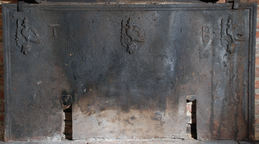
Description: Rectangular shape; ogee moulded edging (top and sides); crowned falcon stamp repeated three times and spaced evenly along the top; separated initials close inside outer falcon stamps; two andiron slots.
Notes: The stamp, which was originally a badge of Queen Anne Boleyn, and first used in the letters patent of her Marquisate of Pembroke, comprises a falcon with a crown upon its head and holding a sceptre, standing upon a tree stump, from which extends a sprig of red and white roses. The badge was later adopted by Queen Elizabeth I. The probability must exist that the initials TB relate to a member of the Boleyn family.
Inscription: T B
- Decoration tags:
- rectangular (shape)
- cyma reversa/ogee (edging)
- carved stamps
- individual letters
- heraldic
- historical
- text
- animals
- plants
- objects
Manufactured: in the 16th or 17th century in the Weald area of England.
Current location: in private hands, Woodchurch, Kent, England.
- Attached to series:
- Miscellaneous stamp firebacks
- Andiron slot firebacks
-
1204
Description: Arched rectangular shape; ovolo moulded edging; date in arch; below arch two parallel, vertical straps, each with a buckle at the top and six prong holes; initials left and right of centre; in top corners, rectangular framed stamp with inset bird; top centre, to left and right of buckle, circular 'butter mould' stamp with stylised fleur-de-lys design, the left one angled top to left; between each initial and strap, rectangular framed stamp with inset deer with antlers, and star in top left corner; below this, adjacent to each strap end, a circular stamp with symmetrical pattern; to left and right of this, a rectangular stamp with an unidentified animal, possibly a dog..
Notes: The buckles, the date and the initials all appear to be separate stamps but attached to the base board before being impressed to form the mould, as they are identically positioned on all castings. The buckles suggest a connection with the Pelham family; the initials may relate to Sir Thomas Pelham, Bt. (1597-1654) who owned and operated ironworks at Waldron in Sussex. This would appear to be a casting of the original pattern with the addition of five pairs of stamps. The circular stamp with the symmetrical pattern is probably the same stamp that has been noted on an otherwise unrelated fireback (no. 733). Some of the stamps are seen in greater profusion on a fireback formerly at Huggetts Farm, Waldron, Sussex (no. 966) and drawn by Edward Hughes, of Heathfield, in a scrapbook of images compiled by J. Starkie Gardner. Nicholson's auction, Fernhurst, 3 Jul 2021, lot 100 (£5); Bellman's auction, Wisborough Green, 18 Feb 2025, lot 746 (£600).
Inscription: 1642 / T P
- Decoration tags:
- rectangular with round arch (shape)
- ovolo (edging)
- carved stamps
- whole carved pattern
- planklines
- text
- animals
- objects
Manufactured: in 1642 probably at Waldron Furnace in the Weald area of England.
Current location: not known.
- Attached to series:
- 1642 Pelham series
- Food mould stamp firebacks
- Pelham family firebacks
-
1304
Description: Canted rectangular shape with inclined sides; cavetto-moulded edging (top and sides); horizontal fillet parallel to the top edge divided by two further fillets, in the centre the initials in capitals in triad, and at each end a lion rampant stamp facing inwards and inclined upwards towards the centre; below the lions, two inclined vertical fillets, parallel to the sides of the plate, each enclosing down the sides a double fleur-de-lys stamp and a flowerhead stamp repeated twice on each side and arranged alternately; in the panel below the initials, two different animal figures of indeterminate type, possibly monkeys.
Notes: The rampant lion, double fleur and flowerhead stamps have all been noted on other firebacks in a series identified on most backs with the initials I and B at the base of the plate. The initials are not present on this casting although the inclusion of I and B in the triad at the top could suggest that this fireback was personal to the founder and his wife. Of note are the impressions of the lions which overstamp the fillet below, indicating that they were placed after the fillet. Unlike the other backs in this series this example is undated. Wincanton Auctions, 24 Oct 2024, lot 540 (£35); Bellmans Auction, Wisborough Green, 13 May 2025, lot 562 (£60).
Inscription: IBE [triad]
- Decoration tags:
- rectangular with canted top corners (shape)
- cavetto (edging)
- carved stamps
- individual letters
- heraldic
- text
- animals
- plants
Manufactured: in the late-17th to early-18th century in the Forest of Dean area of England.
Current location: not known.
- Attached to series:
- IB series