-
1094
Description: Rectangular; twisted rope edging (top and sides); top centre, crowned Tudor royal shield between a lion passant on the right and a lion passant guardant sinister on the left; in each top corner a crowned four-petal rose, below which, to the right, a left-facing 'imp' with both arms lowered; below the armorial, a crowned shield bearing initials, KH, in Lombardic lettering, above a fleur-de-lys; a much-corroded imp figure may be below the right-hand lion.
Notes: A heavily corroded variant of a type bearing Henrician heraldic elements.
Arms: Tudor royal arms of England
- Decoration tags:
- rectangular (shape)
- rope (edging)
- carved stamps
- heraldic
- armorial
- animals
- humans
Manufactured: in the mid-16th century in the Weald area of England.
Current location: Smallhythe Place, Small Hythe Road, Tenterden, Kent, England.
Museum number: 1117950 (part of the National Trust museum group)
- Attached to series:
- Royal series
-
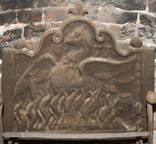
1079
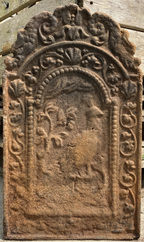
Description: Quasi-arched rectangular shape; fillet edging, indented on the inner edge; pictorial representation of a phoenix rising from flames, date split either side of its neck; the lateral edges are wide in relation to the top, from which the arch rises from two loop and is surmounted by a fleur-de-lys; above each shoulder of the plate, a roundel.
Notes: The looped fillet edging is rarely seen and does not seem to be diagnostic of a particular pattern-maker.
Inscription: 16 77
- Decoration tags:
- rectangular with ornate arch (shape)
- fillet (edging)
- whole carved pattern
- pictorial
- mythological
- text
- animals
Manufactured: in 1677 possibly in the Staffordshire area of England.
Current location: Ford Green Hall, Ford Green Road, Smallthorne, Stoke-on-Trent, Staffordshire, England.
(part of the Stoke-on-Trent Museums museum group)
- Attached to series:
- Miscellaneous pattern firebacks
- Phoenix firebacks
- Loop edged firebacks
-
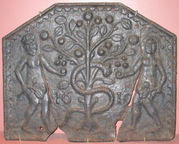
697
Description: Canted rectangle; embattled, cavetto moulded edging; central tree with fruit and leaves, a snake, facing right, with a human face in profile entwined, in ‘S’ shape, around the trunk and lower branches; to the left, a naked, bearded male figure holding an apple in his left hand and a branch in his right for modesty; to the right a naked female figure with apple and branch also; the date split either side of the snake and tree trunk.
Notes: Similarities with an armorial in the date, numerals and edging suggest a common pattern-maker.
Copies of this fireback are known.
Inscription: 16 19
- Decoration tags:
- rectangular with canted top corners (shape)
- embattled cavetto (edging)
- whole carved pattern
- pictorial
- biblical
- text
- animals
- humans
- plants
Manufactured: in 1619 in England.
Current location: Stroud District Museum, Stroud, Gloucestershire, England.
Museum number: STGC 2371 (part of the Stroud Museum museum group)
- Attached to series:
- 1619 series
- Old Testament & Apocrypha firebacks
- Adam & Eve firebacks
-
698
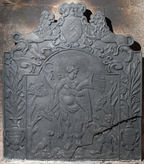
Description: Arched rectangular central panel with nutshell edging on a broad fillet; pictorial scene of a figure in a chariot drawn by birds, above a ground, and with clouds over; arched rectangular border with fillet edging; alternating acanthus leaves with swirled tendrils; on top, two mirrored sea serpents.
Notes: Similarities in the design and execution of the pattern suggest the work of the pattern-maker identified as ‘N’.
- Decoration tags:
- 'Dutch' (shape)
- fillet (edging)
- whole carved pattern
- pictorial
- mythological
- animals
- humans
- objects
Manufactured: in the early-18th century in England.
Current location: Sulgrave Manor, Sulgrave, Northamptonshire, England.
- Attached to series:
- British 'Dutch' style firebacks
-
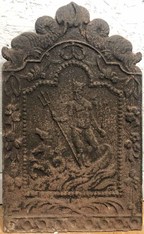
1224
Description: Arched rectangular shaped central panel with canted, concave top corners and bead edging; naked, crowned figure of Neptune holding a trident in his right hand, standing amid waves and with two hippocampi to his right; same-shaped border with fillet edging and suspended ribbons with floral bunches; at base, symmetrical reeds tied with ribbon; base panel with nine linked rings; symmetrical serpents on top.
Notes: Other firebacks have the same distinctive central panel and border shape, suggesting the same pattern maker.
- Decoration tags:
- 'Dutch' (shape)
- fillet (edging)
- whole carved pattern
- pictorial
- mythological
- animals
- objects
Manufactured: in the early-18th century possibly in the Weald area of England.
Current location: not known.
- Attached to series:
- Mayfield 'Dutch' series
- British 'Dutch' style firebacks
-
1257
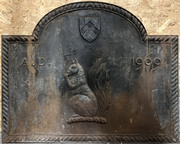
Description: Arched rectangular shape, edged with simulated twisted rope between two fillets; in the arch, a shield: argent on a chevron gules three roses of the field, a canton gules for difference; beneath the shield a crest: on a wreath a squirrel sejant gules cracking a nut gules, charged on the shoulder with a cross crosslet gold for difference; inscription split either side of the head of the squirrel.
Notes: A finely modelled and cast modern fireback with the arms and crest of a direct descendant of John Davies Gilbert (1811-54) who had played a major role in the development of the town of Eastbourne and also developed Trelissick Garden in Feock, Cornwall.
Inscription: A.D. 1969
Arms: Gilbert, of Eastbourne, Sussex, and Trelissick, Cornwall
- Decoration tags:
- rectangular with round arch (shape)
- fillet (edging)
- whole carved pattern
- heraldic
- armorial
- text
- animals
Manufactured: in 1969 in England.
Current location: noit known.
- Attached to series:
- Personal armorial firebacks
-
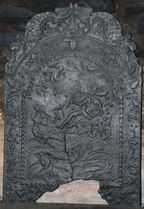
1297
Description: Arched rectangular shaped central panel with bead-on-fillet edging; a peacock, facing right, standing on a plinth, with foliage to the left and clouds above; arched rectangular shaped border with fillet edging, symmetrical floral fronds descending from a scallop shell, top centre, with a scallop shell inside each shoulder; at base, detail mostly obscured by corrosion but the numerals '17 24' are faintly visible in the bottom corners; on top, a pair of mirrored, stylised sea serpents with a central arrangement of foliage.
Notes: The image of the peacock may be an adaptation of an engraving (1654-62) by Wenceslaus Hollar, after Francis Barlow, in which a peacock also stands on a plinth. The small size of this fireback makes it likely that it was intended to be fixed to the back of a grate. A copy of a fireback of this design features in Gleanings from Old English Firesides by Arthur Todhunter.
Copies of this fireback are known.
Inscription: 17 24
- Decoration tags:
- 'Dutch' (shape)
- fillet (edging)
- whole carved pattern
- animals
Manufactured: in 1724 in England.
Current location: Authentic Reclamation, Lymden Lane, Ticehurst, East Sussex, England.
Citation: Todhunter, A., c.1910, Gleanings from Old English Firesides (New York, Arthur Todhunter), p. 3.
- Attached to series:
- British 'Dutch' style firebacks
- 1724 series
-
700
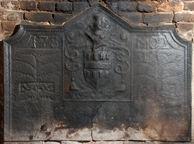
Description: Cavetto-canted rectangle with central pediment; cyma-reversa moulded edging; central pedimented panel, fillet edged, with shield, helm, crest and mantling of the May family; on either side, an incised floral pattern of a stem and six branches, rising from a rectangular, low-relief panel of two images of horsemen; above, the inscription in low relief.
Notes: The arms of May: Gules, a fess between eight billets Or; crest: Out of a ducal coronet Or, a lion’s head gules bezanty; the same armorial stamp appears to have been used on an unnamed iron graveslab in Ticehurst church. The initials are probably those of Susanna May (c1653-1718), heir to Pashley, in Ticehurst, who had married her distant cousin, Sir Robert May, in 1686. The May family had been involved in the iron industry in the 16th and early 17th centuries, but were no longer active a century later. Incised decoration on firebacks is uncommon, the decoration probably having been incised into the pattern board.
Inscription: 17S M02
Arms: May of Pashley, Ticehurst
- Decoration tags:
- rectangular with canted top corners and triangular arch (shape)
- cyma reversa/ogee (edging)
- carved stamps
- whole carved pattern
- armorial
- text
- animals
- humans
Manufactured: in 1702 in the Weald area of England.
Current location: in private hands, Ticehurst, East Sussex, England.
- Attached to series:
- Personal armorial firebacks
-
701
Description: Arched, rectangular central panel with fillet edging; figure of Abundance holding a sickle and a Horn of Plenty, a child, also holding a sickle, to the right, a seated dog to the left, framed by trees; fillet-edged border with a plant pot each side, lilies issuing therefrom; above an oval shield of arms, a grotesque face above, supported by two lions.
Notes: Abundance was one of many allegorical figures to feature in the Iconologia, first published by Cesare Ripa in 1593. The style of the fireback derives from those produced in the Siegenland of NW Germany for the Dutch market, but this example may be a pastiche produced for the French market.
Copies of this fireback are known.
- Decoration tags:
- 'Dutch' (shape)
- fillet (edging)
- whole carved pattern
- pictorial
- allegorical
- armorial
- animals
- humans
- plants
Manufactured: in the late-17th to early-18th century possibly in the Lorraine area of France.
Current location: Tiverton Castle, Tiverton, Devon, England.
- Attached to series:
- 'Dutch' Miscellaneous Firebacks
-
1160
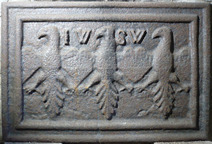
Description: Rectangular, with double astragal edging; three eaglets, their wings outspread, side by side; the initials IW and SW, respectively, to left and right of the central eaglet's head.
Notes: The design is based on the arms of Wynn, of Gwydir Castle in the Conwy valley of North Wales, the blazon of which is Vert, three eagles displayed in fess or. The initials relate to Sir John Wynn (1553-1626/7) who, c.1576, married Sydney Gerrard (d.1632), dating the fireback to c.1576-1626. The conjoined wings of the eagles appear to form heart shapes.
Inscription: IW SW
Arms: Wynn of Gwydir
- Decoration tags:
- rectangular (shape)
- astragal (edging)
- whole carved pattern
- individual letters
- heraldic
- text
- animals
Manufactured: in the late-16th to early-17th century in England.
Current location: Gwydir Castle, Trefriw, Conwy, Wales.
- Attached to series:
- Personal firebacks
- Welsh armorial firebacks