-
82
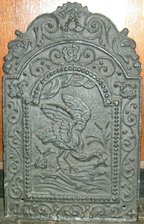
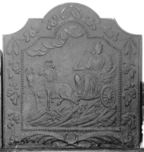
Description: 'Dutch' style; arched rectangular shaped central panel, bead on fillet edging, naturalistic scene of a heron with wings extended catching a fish, water below, clouds above, plants in background; arched rectangular shaped border, fillet edging, symmetrical scrolled tendril pattern; at bottom, two looped 'W' figures between date split corners; on top, symmetrical scrolled foliage. A single central vertical plankline.
Notes: The image of the heron is taken from a print, by Wenceslaus Hollar c.1658, of an etching by Francis Barlow (c.1626-1704); the style of the date suggests a similar pattern maker to a series of firebacks, of the same date, some bearing a Welsh inscription. All incorporate the looped 'W' motif which may be intended to identify the pattern maker. The small size of this fireback makes it likely that it was intended to be fixed to the back of a grate.
Copies of this fireback are known.
Inscription: 17 24
- Decoration tags:
- 'Dutch' (shape)
- fillet (edging)
- whole carved pattern
- planklines
- pictorial
- text
- animals
Manufactured: in 1724 in England.
Current location: Guildford Museum, Guildford, Surrey, England.
Museum number: G.487 (part of the Guildford Museum museum group)
- Attached to series:
- 1724 series
- British 'Dutch' style firebacks
-
91
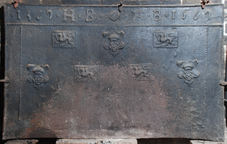
Description: Rectangular; twisted rope edging (top and sides); narrow top panel and two narrow side panels, each separated by twisted rope; top panel with symmetrical inscription line begun and ended with a stamp formed of four spots in square, the same stamps separating the date, each of the initials and a central rose stamp, the date being repeated at each end; plain side panels; central panel comprising three shields bearing a rose and crown, one on the top line between two rectangles, each bearing a griffin passant, and two shields on the ends of the lower line with two rectangles with griffins between, the bottom half of the plate is plain.
Notes: The shield and griffin stamps appear on two firebacks at Hastings Museum, in each of which the shields are inverted.
Inscription: 1569 HB AB 1569
- Decoration tags:
- rectangular (shape)
- rope (edging)
- simple stamps
- carved stamps
- individual letters
- individual numbers
- heraldic
- text
- animals
- plants
Manufactured: in 1569 in the Weald area of England.
Current location: in private hands, Hadlow Down, East Sussex, England.
- Attached to series:
- Griffin series
- Date & initials firebacks
-
87
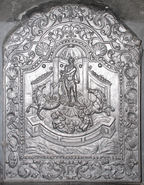
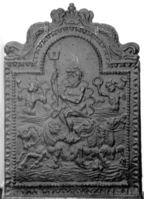
Description: 'Dutch' style; cavetto-canted arched rectangular shaped central panel, double fillet and bead edging, figure of Poseidon/Neptone, trident in right hand, standing on three scallop shells, within a niche with a demi-hemispherical roof and two sloping supporting walls, on either side is a mythical seahorse, below is a walled fountain base with two mermaids at the front; cavetto-canted arched rectangular shaped border with scallop and clam shells separated by swirled foliage, monogram at base between scrolled foliage; on top, scrolled foliage.
Notes: From a design in 'Nouveaux livres de ...Statues [etc.]' (La Haye & Amsterdam 1702-5), by Daniel Marot.
Copies of this fireback are known.
Inscription: EB
- Decoration tags:
- 'Dutch' (shape)
- fillet (edging)
- whole carved pattern
- pictorial
- mythological
- monogram
- text
- animals
- humans
- objects
Manufactured: in the early-18th century in England.
Current location: Hampton Court, Richmond, Greater London, England.
Museum number: 1098 (part of the Royal Collection museum group)
- Attached to series:
- EB series
- British 'Dutch' style firebacks
-
309
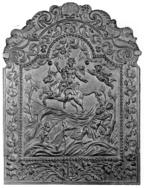
Description: Central panel, cavetto-canted rectangle with arch; bud and annulet edging (in alternate threes); pictorial panel portraying Europa being carried to sea by Zeus, disguised as a bull; two female attendants wave from the right shore; two putti attend, one below with a bow and arrow; trees to right and left; clouds and sun above. Same shaped, fillet-edged border with floral scrolls top and sides; at the bottom, a cartouche bearing EB monogram between oak leaf and acorn fronds; on top, central scallop shell between floral scrolls with dolphin’s heads.
Notes: The central design is closely based on an illustration by Bernard Salomon, first published in a 1557 edition of Ovid’s Metamorphoses and copied in subsequent editions by Virgil Solis (1514-62). The initials, EB, are likely to be those of the pattern maker. The similarity between the execution of this picture and those on firebacks bearing the SHR monogram suggests the possibility of a common source. Ten rivets are the result of later repair.
Copies of this fireback are known.
Inscription: EB
- Decoration tags:
- 'Dutch' (shape)
- fillet (edging)
- whole carved pattern
- pictorial
- mythological
- monogram
- text
- animals
- humans
Manufactured: in the early-18th century in England.
Current location: Hampton Court Palace, Richmond, Greater London, England.
Museum number: 1107 (part of the Royal Collection museum group)
- Attached to series:
- EB series
- British 'Dutch' style firebacks
-
96
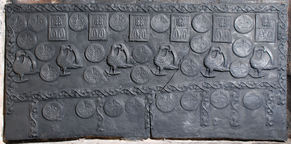
Description: Rectangular; undulating vine tendril edging (top and upper sides); eight circular, fleur-de-lys butter mould stamps alternating (except at left end) with six rectangular, fleur-de-lys and leaf shortbread or gingerbread stamps, in a line along the top; six bird stamps (wings displayed and inverted) alternating with five pairs of butter mould stamps, as above; continuous line of horizontal vine strips; six descending vine strips, interspaced unevenly with eight butter mould stamps, in pairs except for rightmost two.
Notes: The bird (probably a swan, a Lancastrian badge) and vine strip stamps are encountered on several firebacks. In 1868 this fireback was recorded at Tickeridge, West Hoathly, Sussex.
- Decoration tags:
- rectangular (shape)
- trailing vine (edging)
- simple stamps
- carved stamps
- animals
- plants
- objects
Manufactured: in the mid- to late-16th century possibly at Pounsley Furnace, Framfield in the Weald area of England.
Current location: Nymans, Staplefield Road, Handcross, Slaugham, West Sussex, England.
Museum number: 1206011 (part of the National Trust museum group)
Citation: Stenning, J. C., 1868, 'Notes on East-Grinstead', Sussex Archaeological Collections, 20, pp. 151-2.
-
110
Description: Arched rectangular shaped central panel with fillet and bead edging, Neptune/Poseidon, holding a trident in his right hand, sitting in a scallop shell drawn by four mythical sea horses, behind are two mermaids; arched rectangular shaped border with ovolo egg and dart edging; above, two symmetrical dolphins with a clam shell between.
Notes: Typical type of firebacks produced in Germany for the Dutch market; the central panel was made separately for insertion into different borders; this border is a relatively simple type. Formerly part of the Ade Collection (from Grove Hill, Hellingly, Sussex).
Copies of this fireback are known.
- Decoration tags:
- 'Dutch' (shape)
- ovolo, egg and dart (edging)
- carved pattern panels
- mythological
- animals
- humans
Manufactured: in the mid- to late-17th century possibly in the Siegerland area of Germany.
Current location: Hastings Museum and Art Gallery, John's Place, Bohemia Road, Hastings, East Sussex, England.
Museum number: HASMG: 1952.51.36 (part of the Hastings Museum museum group)
Citation: Lloyd, N., 1925, 'Domestic Ironwork I', Architectural Review, 58, pp. 58-67.
- Attached to series:
- 'Dutch' Miscellaneous Firebacks
- 'Dutch' Dolphin series
-
117
Description: Rectangular with triangular pediment; stepped fillet and ogee moulded edge to pediment; twisted rope sides; date in portico; medallion with dog crest stamped twice in top left and right corners.
Notes: It may be that the date and portico form a separate panel, as the position of the date appears to be the same on the three known castings where it is found.
Inscription: 1586
- Decoration tags:
- triangular arched (shape)
- rope (edging)
- carved stamps
- date stamp
- text
- animals
Manufactured: in 1586 in the Weald area of England.
Current location: Hastings Museum and Art Gallery, John's Place, Bohemia Road, Hastings, East Sussex, England.
Museum number: HASMG: 1917.196.5 (part of the Hastings Museum museum group)
- Attached to series:
- 1586 series
-
126
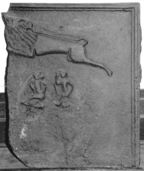
Description: Fragment; rectangular; astragal and fillet edging (top and sides); oblique lion passant above two left facing 'imps', one with right arm raised, the other with both arms lowered.
Notes: One of the legs of the leopard is missing, suggesting that the stamp, which appears complete on many firebacks, was well used and had been damaged; this suggests a relatively late use of this stamp.One of a large series all bearing royal heraldic stamps, but unusual in the use of moulded edging, twisted rope being normally used for this series. The surviving elements were probably mirrored on the missing half. Formerly part of the Ade Collection (from Grove Hill, Hellingly, Sussex).
- Decoration tags:
- rectangular (shape)
- astragal & fillet (edging)
- carved stamps
- heraldic
- animals
- humans
Manufactured: in the mid- to late-16th century in the Weald area of England.
Current location: Hastings Museum and Art Gallery, John's Place, Bohemia Road, Hastings, East Sussex, England.
Museum number: HASMG: 1952.51.12 (LA 760) (part of the Hastings Museum museum group)
- Attached to series:
- Royal series
-
127
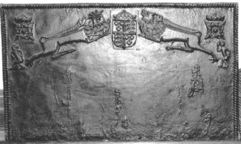
Description: Rectangular; twisted rope edging (top and sides); top centre, crowned Tudor royal shield between a lion passant on the right and a lion passant guardant sinister on the left; in each top corner a crowned four-petal rose, below which, to the right, a left-facing 'imp' with right arm raised, and to the left, a left-facing 'imp' with both arms lowered.
Notes: One of a large series bearing heraldic stamps.
Arms: Tudor royal arms of England
- Decoration tags:
- rectangular (shape)
- rope (edging)
- carved stamps
- heraldic
- armorial
- animals
- humans
Manufactured: in the mid-16th century in the Weald area of England.
Current location: Hastings Museum and Art Gallery, John's Place, Bohemia Road, Hastings, East Sussex, England.
Museum number: HASMG: 1925.3 (part of the Hastings Museum museum group)
- Attached to series:
- Royal series
-
143
Description: Central panel of arched rectangular shape with cavetto canted corners and bead edging; crowned female figure holding a sceptre in her right hand, seated in a chariot drawn by two caparisoned ponies, a cornucopia at their feet; below, sloping ground with plants, clouds with rain above; identically shaped border with fillet edging and symmetrical swags of flowers and drapery suspended from ribbons; at the base two symmetrical palm fronds tied with a ribbon.
Notes: The figure may represent Ceres, goddess of plenty. The fireback is one of a series designed and made in England, copying the prevailing 'Dutch' style. Its style echoes that of a fireback pattern preserved at Rottingdean Grange, Sussex. Formerly part of the Ade Collection (from Grove Hill, Hellingly, Sussex).
Copies of this fireback are known.
- Decoration tags:
- rectangular with canted top corners and round arch (shape)
- fillet (edging)
- whole carved pattern
- mythological
- animals
- humans
Manufactured: in the early-18th century possibly in the Weald area of England.
Current location: Hastings Museum and Art Gallery, John's Place, Bohemia Road, Hastings, East Sussex, England.
Museum number: HASMG: 1952.51.63 (part of the Hastings Museum museum group)
- Attached to series:
- Mayfield 'Dutch' series
- British 'Dutch' style firebacks