-
928
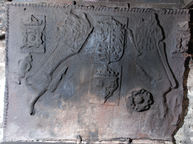
Description: Carved wooden fireback pattern. Arched rectangular central panel with astragal and fillet edging; Phaëton riding Apollo’s chariot across the skies, the sun to the left behind clouds, a lion on ground below, between two trees; arched rectangular border with fillet edging; trailing convolvulus leaves surround the central panel.
Notes: The illustration upon which the design has been based has not been identified, save that it figures in book II of Ovid's Metamorphoses. The convolvulus border is a common feature of this series of firebacks; given to the Sussex Archaeological Society by the Rev. J. Bickersteth.
- Decoration tags:
- 'Dutch' (shape)
- fillet (edging)
- whole carved pattern
- planklines
- pictorial
- mythological
- animals
- humans
- objects
Manufactured: in the early-18th century in England.
Current location: Anne of Cleves House, Southover High Street, Lewes, East Sussex, England.
(part of the Sussex Archaeological Society museum group)
Citation: Baines, J. M., 1958, Wealden Firebacks (Hastings Museum).
Citation: Dawson, C., 1903, 'Sussex Iron Work and Pottery', Sussex Archaeological Collections, 46, pp. 1-54.
- Attached to series:
- Patterns
- TAN series
-
463
Description: Fragment; rectangular; twisted rope edging (top and side); top centre, crowned Tudor royal shield (over-pressed) above a crowned shield (over-pressed) bearing initials above a fleur-de-lys; to left, a leopard passant guardant sinister diagonally position with its rear toward the bottom left corner; to right, a leopard passant, also diagonally positioned, its rear towards the bottom right; in the top corners, a crowned four-petalled rose (over-pressed); below the left rose, a left-directed ‘imp’ figure looking right, its arms lowered; bottom right, a left-directed ‘imp’ figure, its left arm raised; to right of the lower shield, a four-petalled rose askew.
Notes: One of the ‘Royal’ series.
Arms: Tudor royal arms of England
- Decoration tags:
- rectangular (shape)
- rope (edging)
- carved stamps
- heraldic
- armorial
- royal
- animals
- humans
Manufactured: in the mid-16th century in the Weald area of England.
Current location: in private hands, Little Horsted, East Sussex, England.
- Attached to series:
- Royal series
-
469
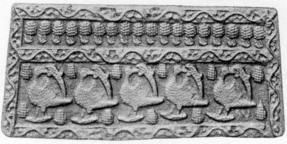
Description: Quasi-rectangular; edging formed of repeated bordered strip with undulating vine with fruit and leaves; horizontal line of two uneavenly repeated vine strips dividing the plate into two compartments, the upper comprising a grape bunch repeated eighteen times, the lower comprising a bird (probably a swan, a Lancastrian badge), its head turned to its left and one visible wing displayed and inverted, repeated five times with a grape bunch repeated twelve times at the ends and between each swan on the top and bottom of the compartment.
Notes: The vine strip, swan and grape bunch stamps feature on many firebacks indicating a common source. Illustration from Lloyd, 1925.
- Decoration tags:
- rectangular (shape)
- trailing vine (edging)
- simple stamps
- carved stamps
- heraldic
- animals
- plants
- objects
Manufactured: in the mid- to late-16th century possibly at Pounsley Furnace, Framfield in the Weald area of England.
Current location: not known.
Citation: Lloyd, N., 1925, 'Domestic Ironwork I', Architectural Review, 58, pp. 58-67.
- Attached to series:
- Pounsley series
- Vine strip series
- Swan series
- Furniture stamp firebacks
-
1005
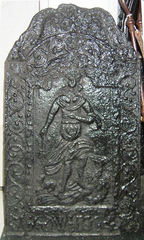
Description: Arched rectangular central panel within double fillet foliate edging; pictorial scene of a crudely modelled clothed female figure holding a wand? in the right hand; indistinct pictorial element to bottom right; arched rectangular border with fillet edging containing repeated swirled decoration; on top, two mirrored sea monsters.
Notes: A crude pastiche of the 'Dutch' style of fireback; the central figure may be Hera with a peacock. Formerly at the Raleigh Trevelyan estate, St Cadix, Cornwall.
Inscription: WHC[?]
- Decoration tags:
- 'Dutch' (shape)
- fillet (edging)
- whole carved pattern
- pictorial
- mythological
- text
- animals
- humans
Manufactured: in the early-18th century in England.
Current location: Deja Vu Antiques, 31 Fore Street, Lostwithiel, Cornwall, England.
- Attached to series:
- British 'Dutch' style firebacks
-
474
Description: Fragment; arched rectangular shape with rounded corners; ovolo within fillet moulding all round; oval Tudor royal shield with garter surrounding, topped with a royal crown; dragon and greyhound supporters; initials split by crown; inscription on a fillet between legs of supporters, behind garter finial; motto on an Ionic plinth at bottom; left hand rectangular extension panel with twisted rope edging on top and side: initials in top left corner, ‘dragon’s head’ in top right corner, rose-en-soleil stamp in centre, rose stamp bottom centre.
Notes: The letters on the extension panel are the same form and size as those on the top of the armorial pattern, indicating that they were added to the armorial, perhaps to indicate a change of reign. The letter 'E' has also been noted on another fireback of the same series. The rose-en-soleil was the badge of King Edward IV and, thus, a Yorkist symbol; it is seen on other firebacks. From a house in Chailey, Sussex. Illustration from Lower (1849).
Inscription: E R / E / R / HONY SOIT QUE MAL Y PAYNCE / Made in Sussex by John Harvo / DV ET MOVN DR...
Arms: Tudor royal
- Decoration tags:
- rectangular with round arch (shape)
- complex individual (edging)
- carved stamps
- whole carved pattern
- individual letters
- armorial
- royal
- text
- animals
- plants
Manufactured: in the mid- to late-16th century in the Weald area of England.
Current location: not known.
- Attached to series:
- Pounsley series
- John Harvo series
- Rose-en-soleil series
-
476
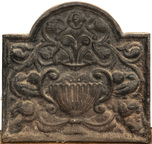
Description: Arched rectangular central panel with bead edging; pictorial scene of a stork dipping its beak into a tall pot, a fox close by, a tree to the right; arched rectangular border with fillet edging; at top, a double clasp with descending ribbon on each side from which are suspended, via rings, a shield, trumpets and an armoured torso; at the bottom, an oval cartouche between two blocks; on the top, a central pomegranate between two descending sea serpents, and a pomegranate on each shoulder of the plate.
Notes: The scene illustrates one of Aesop's Fables.
- Decoration tags:
- 'Dutch' (shape)
- fillet (edging)
- whole carved pattern
- pictorial
- mythological
- animals
- objects
Manufactured: in the mid- to late-17th century in the Siegerland area of Germany.
Current location: Maidstone Museum, St Faith's Street, Maidstone, Kent, England.
(part of the Maidstone Museum museum group)
- Attached to series:
- 'Dutch' Miscellaneous Firebacks
-
1036
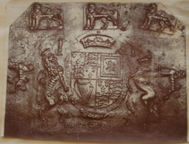
Description: Canted rectangular shape; no edging; lower centre, carved pattern panel of Stuart Royal arms: shield, garter, crown, motto, supporters and initials, RI separated by crown; lion statant guardant stamp repeated five times, three across top, one each side feet to left.
Notes: The impression of the decorative elements is irregular, with the achievement of arms under-pressed and the three lion stamps along the top over-pressed; the distinctive feature of the unicorn's horn in front of the initial R has been seen on a small number of other firebacks. The Stuart arms in the same style are seen on another fireback (no. 406). From a photograph in the J. Starkie Gardner Collection, Victoria & Albert Museum, Archive of Art and Design (AAD/2014/8).
Inscription: I R
Arms: English Stuart royal - James I
- Decoration tags:
- rectangular with canted top corners (shape)
- none (edging)
- carved stamps
- carved pattern panels
- heraldic
- armorial
- royal
- text
- animals
Manufactured: in the early-17th century possibly in the Weald area of England.
Current location: Maidstone Museum, St Faith's Street, Maidstone, Kent, England.
(part of the Maidstone Museum museum group)
-
1189
Description: Arched rectangular shape; cavetto-moulded edging; central, two handled, gadrooned vase with swirled, fruited vines issuing from the neck, and a bird on each side perched within the vines; out of the neck, a naïve human figure with arms outstretched, grasping vines on each side.
Notes: The figure emerging from the vase has a symbolism which has yet to be explained; more than one version of this fireback exists. Mallams auction, Abingdon, 28 Jun 2023, lot 219 (£60).
Copies of this fireback are known.
- Decoration tags:
- rectangular with round arch (shape)
- cavetto (edging)
- whole carved pattern
- animals
- humans
- plants
- objects
Manufactured: in the mid-17th century in the Weald area of England.
Current location: not known.
- Attached to series:
- Gadrooned vase firebacks
-
481
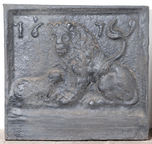
Description: Rectangular; cavetto edging all round; seated lion on right, its tail rising above its back and its head turned to face the viewer; a seated sheep on the left; at the bottom, a plain rectangular extension panel; date split across top.
Notes: Intended to represent the saying, ‘The lion shall lie down with the lamb’, a popular misquotation of Isaiah 11: 6.
- Decoration tags:
- rectangular (shape)
- cavetto (edging)
- whole carved pattern
- individual numbers
- extension panels
- pictorial
- biblical
- text
- animals
Manufactured: in 1679 in the Weald area of England.
Current location: in private hands, Maresfield, East Sussex, England.
- Attached to series:
- Small cavetto series
- Old Testament & Apocrypha firebacks
-
672
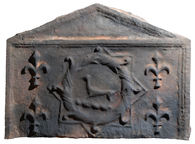
Description: Rectangular with pediment; ovolo moulded edging inside top of pediment and inside top and sides of rectangle; central talbot crest within wreath and eight-pointed star, between four fleurs-de-lys.
Notes: The wreath and talbot crest are identical to those on a 1584 fireback in the Victoria & Albert Museum; one of the ‘Royal’ series.
- Decoration tags:
- triangular arched (shape)
- ovolo (edging)
- carved stamps
- heraldic
- animals
Manufactured: in the late-16th century in the Weald area of England.
Current location: Middle House Hotel, High Street, Mayfield, East Sussex, England.
- Attached to series:
- Royal series
- Royal (wreath) series