-
1300
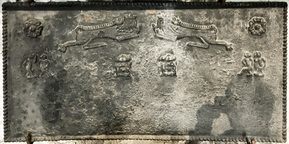
Description: Rectangular shape; twisted rope edging; top centre, a lion passant on the right and a lion passant guardant sinister on the left; in each top corner, a four-petalled Tudor rose; below each rose, two 'imps', one with right arm raised, the other with both arms lowered, the pair on the left facing to the right and the pair on the right facing to the left; below each lion, a crowned, four-petalled Tudor rose.
Notes: A spurious fireback based on, and probably adapted from, a 16th century English back, this and its copies include remodelled rope edging, lions and 'imp' figures, all probably dating from the restoration of Bunratty Castle in the 1960s.
Copies of this fireback are known.
- Decoration tags:
- rectangular (shape)
- rope (edging)
- carved stamps
- heraldic
- animals
- humans
- plants
Manufactured: in the mid-20th century in Ireland.
Current location: Bunratty Castle, Bunratty, County Clare, Republic of Ireland.
- Attached to series:
- Royal series
-
24
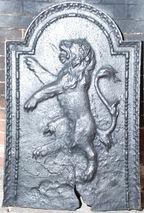
Description: Arched rectangular shaped with fillet and cavetto dentil moulding, and paternost bead edging inside; a lion rampant
Notes: Whole pattern. An unusually tall fireback in relation to its width.
Copies of this fireback are known.
- Decoration tags:
- rectangular with round arch (shape)
- cavetto dentil (edging)
- whole carved pattern
- heraldic
- animals
Manufactured: in the 18th century in England.
Current location: Bateman's, Burwash, East Sussex, England.
Museum number: 761107 (part of the National Trust museum group)
- Attached to series:
- Miscellaneous pattern firebacks
-
222
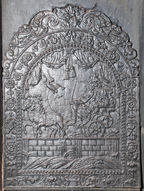
Description: Arched rectangular central panel with ‘nutshell’ edging on a broad fillet; crowned figure, holding a sceptre in his right hand, sitting in a chariot drawn to the left by two horses with ostrich feather head-dresses; the whole upon a causeway with pilasters and masonry, and waves beneath; a heron flying to the left; above, swagged drapery with two tassels hanging from the centre; arched rectangular shaped border with fillet edging, symmetrical, flower bunches, descending from a ribbon loop; monogram centre bottom, between plant tendrils; on top, symmetrical scrolled plant tendrils.
Notes: The design is derived from a personification of Europe, one of a set of playing cards entitled 'Jeu de la Géographie', designed by Stefano della Bella (1677); a similarity with Queen Anne may not be coincidental; the flying heron has been copied from a print by Wenceslaus Hollar c.1658.
Copies of this fireback are known.
Inscription: SHR
- Decoration tags:
- 'Dutch' (shape)
- fillet (edging)
- whole carved pattern
- pictorial
- allegorical
- monogram
- text
- animals
- humans
- objects
Manufactured: in the late-17th to early-18th century in England.
Current location: Canons Ashby House, Canons Ashby, Northamptonshire, England.
Museum number: NT/L/CAN/M/79 (part of the National Trust museum group)
- Attached to series:
- SHR series
- British 'Dutch' style firebacks
-
125
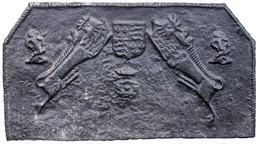
Description: Canted rectangle; twisted rope edging (top and sides); top centre, Tudor royal shield between lion passant guardant to right and lion passant guardant sinister to left, both diagonally placed; below, a crowned rose; to left and right, an 'imp' with arms down, facing left.
Notes: One of a large series incorporating royal heraldic stamps. Canterbury Auction Galleries sale, 29 Nov 2017, lot 939 (£300).
Copies of this fireback are known.
Arms: Tudor royal arms of England
- Decoration tags:
- rectangular with canted top corners (shape)
- rope (edging)
- carved stamps
- heraldic
- armorial
- animals
- humans
Manufactured: in the mid-16th century in the Weald area of England.
Current location: not known.
Citation: Lloyd, N., 1925, 'Domestic Ironwork I', Architectural Review, 58, pp. 58-67.
- Attached to series:
- Royal series
-
226
Description: Arched rectangular shaped central panel with bead-and-pellet edging on a wide fillet; central pedestal with a wyvern fountain ringed with water, and a swan and a duck swimming, plants rising from the waves; above, swags of drapery with two central tassels; arched rectangular shaped border with fillet edging, symmetrical floral fronds descending from a rose, top centre, with a looped 'W' in each shoulder; inscription at base, between date; on top, symmetrical scrolled plant tendrils. A single vertical plankline right of centre.
Notes: One of a group of firebacks all of the same date, some of which have the same Welsh inscription which translates as 'God is our strength'. All incorporate the looped 'W' motif which may be intended to identify the pattern maker. The design is taken from 'Livres de Fontaines' by Daniel Marot (1661-1752) (La Haye & Amsterdam 1701). The swan and the duck swimming may have been copied from etchings or paintings by Francis Barlow (c.1624-1709), whose images of birds have been used incidentally on other firebacks. Formerly at Allt-y-ferin, Nantgaredig, Carmarthenshire.
Copies of this fireback are known.
Inscription: 17 DVW Ydyw Ein Cadernid 24
- Decoration tags:
- 'Dutch' (shape)
- fillet (edging)
- whole carved pattern
- planklines
- pictorial
- architectural
- text
- animals
- plants
- objects
Manufactured: in 1724 in England.
Current location: National History Museum, St Fagans, Glamorgan, Wales.
Museum number: 62.156 (part of the Welsh National History Museum museum group)
- Attached to series:
- 1724 series
- Welsh inscription series
- British 'Dutch' style firebacks
-
233
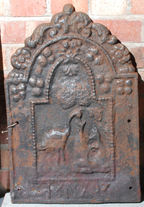
Description: Arched rectangular central panel, bead edging, a stork, to the left, its beak in the top of a tall vase, a fox seated to the right, a tree behind; arched rectangular border, fillet edging, swags of fruit bunches (missing at the sides) suspended from ribbon, inscription below central panel; on top, symmetrical floral swirls and flowers.
Notes: The scene is drawn from 'The Fox and the Stork', one of Aesop's fables. A recasting. Formerly at Ffynnon Deilo, Pendoylan, Glamorgan.
Copies of this fireback are known.
Inscription: 16 NDW 97
- Decoration tags:
- 'Dutch' (shape)
- fillet (edging)
- whole carved pattern
- pictorial
- mythological
- text
- animals
- objects
Manufactured: in 1697 in the Siegerland area of Germany.
Current location: National History Museum, St Fagans, Glamorgan, Wales.
Museum number: 59.461 (part of the Welsh National History Museum museum group)
- Attached to series:
- 'Dutch' NDW series
-
238
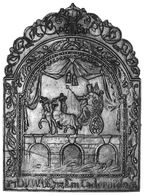
Description: Arched rectangular shaped central panel with bead-and-pellet edging on a wide fillet; crowned figure, holding a sceptre in his right hand, sitting in a chariot drawn to the left by two, caparisoned horses with ostrich feather head-dresses; the whole upon a three-arched bridge with keystones and a string course, waves beneath; above, swagged drapery with two tassels hanging from the centre; arched rectangular shaped border with fillet edging, symmetrical, descending oak leaf and acorn branches, with a looped 'W' in each shoulder; inscription at base; on top, symmetrical scrolled plant tendrils and berries. A single central vertical plankline.
Notes: One of a series produced in the same year. All incorporate the looped 'W' motif which may be intended to identify the pattern maker. The design is derived from a personification of Europe, one of a set of playing cards entitled Jeu de la Géographie, designed by Stefano della Bella for Louis XIV. The inscription translates as 'God is our strength'.
Copies of this fireback are known.
Inscription: 17 DVW Ydyw Ein Cadernid 24
- Decoration tags:
- 'Dutch' (shape)
- fillet (edging)
- whole carved pattern
- planklines
- pictorial
- allegorical
- text
- animals
- humans
- objects
Manufactured: in 1724 in England.
Current location: Tredegar House, Pencarn Way, Duffryn, Newport, Gwent, Wales.
Museum number: F81.233 (part of the Welsh National History Museum museum group)
- Attached to series:
- 1724 series
- Welsh inscription series
- British 'Dutch' style firebacks
-
240
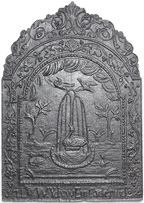
Description: Arched rectangular shaped central panel with bead-and-pellet edging on a wide fillet; ground with birds, and trees behind; in the centre a circular fountain rim with a swan on a plinth surrounded by water, with jets of water rising from the swan’s mouth and descending on either side; above, a heron and a goose fly to the left; under the arch, swags of drapery; arched rectangular shaped border with fillet edging, symmetrical floral fronds descending from a scallop shell, top centre, with a looed 'W' in each shoulder; inscription at base between date; on top, symmetrical scrolled plant tendrils. A single central vertical plankline.
Notes: One of a group of firebacks, all of the same date, some of which have the same Welsh inscription which translates as 'God is our strength'. All incorporate the looped 'W' motif which may be intended to identify the pattern maker. The design is adapted from an illustration of fountain no. XXXIX, 'Les Cannes et le Petit Barbet' in Labyrinthe de Versailles by Sébastien le Clerc (1677); the flying heron and duck are copied from illustrations by Francis Barlow (c1626-1704) or from engravings of his work by Wenceslaus Hollar (1607-77).
Copies of this fireback are known.
Inscription: 17 DVW Ydyw Ein Cadernid 24
- Decoration tags:
- 'Dutch' (shape)
- fillet (edging)
- whole carved pattern
- planklines
- pictorial
- architectural
- text
- animals
- objects
Manufactured: in 1724 in England.
Current location: Newton House, Dinefwr, Llandeilo, Carmarthenshire, Wales.
Museum number: F83.116 (part of the Welsh National History Museum museum group)
Citation: Lloyd, N., 1925, 'Domestic Ironwork I', Architectural Review, 58, pp. 58-67.
- Attached to series:
- 1724 series
- Welsh inscription series
- British 'Dutch' style firebacks
-
855
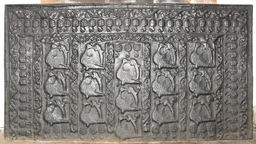
Description: Rectangular; twisted rope edging (top and sides); inner border of repeated strips of undulating vine tendril, inside of which are stamped panels of repeated grape bunches, totalling 27 along the upper edge and 13 down each side; inside them is a further border of vine strips within which are five columns of a bird stamp (probably a swan, a Lancastrian badge). each repeated three times, below each of which are three further grape bunch stamps except the middle column, where the grape bunches are above the swans.
Notes: A complex and well executed design incorporating three stamps found on many other firebacks.
- Decoration tags:
- rectangular (shape)
- rope (edging)
- carved stamps
- animals
- plants
Manufactured: in the late-16th century possibly at Pounsley Furnace, Framfield in the Weald area of England.
Current location: in private hands, Butleigh, Somerset, England.
- Attached to series:
- Pounsley series
- Vine strip series
- Swan series
- Furniture stamp firebacks
-
244
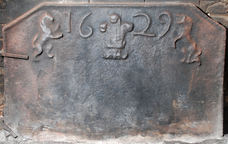
Description: Canted rectangle; twisted rope edging (top and sides); stamp of three ostrich feathers within a coronet, between the two parts of the date, with lion and unicorn supporters outside date.
Notes: The ostrich feathers are the badge of the Prince of Wales. There is no known significance of the year 1629 with that title, the birth of the prince (later Charles II) being in the following year. The date was probably added to a recasting of the plate. The lack of detail in the modelling indicates this has been recast several times.
Copies of this fireback are known.
Inscription: 16 29
- Decoration tags:
- rectangular with canted top corners (shape)
- rope (edging)
- carved stamps
- individual numbers
- heraldic
- text
- animals
Manufactured: in 1629 in the Weald area of England.
Current location: in private hands, Chailey, East Sussex, England.
Citation: Lloyd, N., 1925, 'Domestic Ironwork I', Architectural Review, 58, pp. 58-67.
- Attached to series:
- Prince of Wales' feathers series
- Prince of Wales firebacks