-
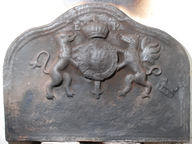
839
Description: Fragment (left quarter missing - symmetrical design assumed); rectangular; twisted rope edging (top and sides); top centre, crowned Tudor shield between two lions passant, the left lion guardant sinister; below each lion, two leftward heading ‘imp’ stamps, the left one of each with arms down and head facing right, the right with right arm raised; in the top corner(s), a crowned rose stamp with a ‘daisy’ stamp towards the middle.
Notes: Assuming the crowned shield is central, the fireback would have originally measured 1160mm wide; one of the ‘Royal’ series.
Arms: Tudor royal arms of England
- Decoration tags:
- rectangular (shape)
- rope (edging)
- carved stamps
- heraldic
- armorial
- animals
- plants
Manufactured: in the mid-16th century in the Weald area of England.
Current location: in private hands Battle, East Sussex, England.
- Attached to series:
- Royal series
-
648
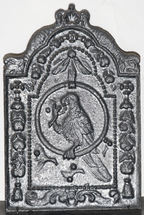
Description: Arched rectangular central panel with arch and bead-on-fillet edging; pictorial representation of a popinjay, or parrot, perched on a ring suspended by a ribbon from a bow, the bird is clutching an olive twig, other sprigs are below; arched rectangular border with arch and fillet edging; mirrored festoons of flowers and fruit suspended from roses, scrolled foliage at the bottom; on top, central scallop shell between descending dolphins.
Notes: The parrot on the ring perch is a popular design on Dutch firebacks.
Copies of this fireback are known.
Manufactured: in the mid- to late-17th century in the Siegerland area of Germany.
Current location: Eastgate House, High Street, Rochester, Kent, England.
Museum number: A3491 (part of the Rochester Guildhall Museum museum group)
- Attached to series:
- 'Dutch' Bird on perch firebacks
- 'Dutch' Miscellaneous Firebacks
-
657
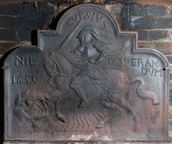
Description: Rectangular with curved top corners; Arched rectangular extension on top; ovolo edging; mounted figure in 17th cent. armour riding down a dragon to the left and below, sword in hand; inscription across top and either side of horseman; date below left; initials below right.
Notes: Probably a representation of St George and the Dragon, with political undertones, given the date. Cursius may be a mis-spelling of Marcus Curtius, who sacrificed himself for the good of Rome. Nil Desperandum - Despair not. Other firebacks also bear the initials, IM, which probably relate to the pattern maker, some with a similar style of lettering.
Copies of this fireback are known.
Inscription: CVRSIVS / NIL DESPERANDVM / 1650 / IM
- Decoration tags:
- rectangular with round arch (shape)
- ovolo (edging)
- whole carved pattern
- pictorial
- allegorical
- text
- animals
- humans
Manufactured: in 1650 possibly at Brede Furnace in the Weald area of England.
Current location: in private hands, Rolvenden, Kent, England.
- Attached to series:
- IM series
- Hooked '1' series
- Brede group
-
890
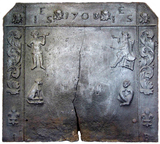
Description: Canted rectangle; cavetto moulded edging (top and sides); single horizontal fillet below canted corners and vertical fillet parallel to each side, dividing the fireback into two side panels, two top corner panels, top panel and main central panel; corner panels, ‘daisy’ plant stamp; top panel, date between ‘daisy’ stamps, between initials in triad at each end; side panels, swirling foliage stamp repeated each side above a fleur-de-lys, above initial 'I' on left and 'B' on right; centre panel, stamp of ‘Indian’ smoking a pipe at top left, stamp of seated ‘gentleman’ smoking a pipe and holding another, at top right; below each, a seated monkey stamp, that on the left seated facing right, its paws in front of it and its tail below, that on the right seated facing left, its tail drawn across its chest.
Notes: The IB initials are identical to those on similar firebacks dated between 1703 and 1721, probably indicating the same founder. The number 3 of the date and the fleur-de-lys on the lower left side have been over-pressed showing the backs of the stamps. The use of stamps relating to tobacco smoking may suggest an origin near Bristol, the main entry port for the tobacco trade at that time.
Inscription: IES [triad] 1703 IES [triad] / I B
- Decoration tags:
- rectangular with canted top corners (shape)
- fillet (edging)
- carved stamps
- heraldic
- text
- animals
- humans
- plants
Manufactured: in 1703 in the Forest of Dean area of England.
Current location: Greys Court, Rotherfield Greys, Oxfordshire, England.
Museum number: 196857 (part of the National Trust museum group)
- Attached to series:
- IB series
- Date & initials firebacks
-
931
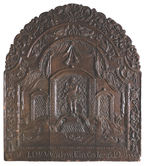
Description: Carved wooden fireback pattern. Arched rectangular shaped central panel with top corners cavetto canted, bead-and-pellet edging on a wide fillet; hanging drapery with central tassels over three low-arched cubicles, the two outer smaller than the centre, with Tuscan columns and overlapping scales behind; on a plinth of overlapping scales with a scallop shell behind, the standing figure of Neptune/Poseidon, holding a trident in his right hand; water issues from by his feet and from the waves below him disport two 'sea horses' and three dolphins; arched rectangular shaped border with top corners cavetto canted, fillet edging: suspended symmetrical beads with tassel ends decorated with sea shells; at the bottom, between looped 'W' figures, the inscription separating halves of the date along the bottom; above, a central scallop shell with symmetrical floral scrolls on each side. Two vertical planklines left and right of centre.
Notes: Carved on three vertical oak planks, battened together, from a design in 'Nouveaux livres de ...Statues [etc.]' (La Haye & Amsterdam 1702-5), by Daniel Marot. The inscription, translated from the Welsh as 'GOD is our strength', is a paraphrase of Psalm 46: 1; an identical inscription and date is found on several firebacks. All incorporate the looped 'W' motif which may be intended to identify the pattern maker. A casting made from this pattern is no. 271.
Inscription: 17 DVW Ydyw Ein Cadernid 24
- Decoration tags:
- 'Dutch' (shape)
- fillet (edging)
- whole carved pattern
- planklines
- pictorial
- mythological
- architectural
- text
- animals
- humans
- objects
Manufactured: in 1724 in England.
Current location: Rotterdam, Netherlands.
Museum number: 35437 (part of the Museum Rotterdam museum group)
- Attached to series:
- 1724 series
- Welsh inscription series
- Patterns
-
930
Description: Carved wooden fireback pattern. Arched rectangular central panel with cavetto-canted shoulders and bead edging on a broad fillet; seated female figure in a chariot drawn by armadillos, symmetrical hanging drapery above right; same-shaped border with fillet edging at top, and suspended ribbons with floral bunches; at base, symmetrical palm leaves tied with ribbon; symmetrical serpents on top their tails intertwined.
Notes: The design is derived from a personification of America, on one of a set of playing cards entitled Jeu de la Géographie, designed by Stefano della Bella (1677); reputedly from Mayfield; presented to Brighton Museum by Henry Willetts. A casting from this pattern is no. 215.
- Decoration tags:
- 'Dutch' (shape)
- whole carved pattern
- planklines
- pictorial
- allegorical
- animals
- humans
- objects
Manufactured: in the late-17th to early-18th century in England.
Current location: Rottingdean Grange, Rottingdean, East Sussex, England.
Museum number: R3341/7 (part of the Brighton Museum museum group)
Citation: Dawson, C., 1903, 'Sussex Iron Work and Pottery', Sussex Archaeological Collections, 46, pp. 1-54.
Citation: Hughes, G. B., 1960, Collecting Antiques (London, Country Life), pp. 85-93.
Citation: Hughes, G. B., 21 Apr 1955, 'Old English Firebacks', Country Life, 117, pp. 1056-60.
- Attached to series:
- Patterns
- Mayfield 'Dutch' series
-
806
Description: Rectangle with curved shoulders and low arch joined with concave curves; fillet and ogee moulded edging; central Tudor royal shield surrounded by garter, with crown above and lion and dragon supporters; royal initials either side of crown; lower right, inclined rectangular stamp of a dog; extended variant.
Notes: On clearer examples the garter motto has ‘EQVI’ instead of ‘HONI’, making it meaningless; possibly ‘EQVI’ was a mis-transcription of ‘HONI’; the crown is distinctly continental in form; a much-copied fireback.
Copies of this fireback are known.
Inscription: E R [Garter motto illegible]
Arms: Tudor royal - Elizabeth I
- Decoration tags:
- rectangular with round arch (shape)
- fillet and ogee (edging)
- carved stamps
- individual letters
- armorial
- royal
- text
- animals
Manufactured: in the mid- to late-16th century possibly in the Forest of Dean area of England.
Current location: in private hands, Salfords, Surrey, England.
-
1031
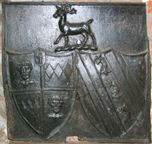
Description: Rectangular; astragal and fillet edging; two heater-shaped shields side by side, with a stag trippant crest above centre.
Notes: The dexter shield: quarterly first and fourth - Mostyn baronet - Gules a saracen's head erased proper wreathed about the temples sable and argent; second and third, within a bordure a fess fusily (or three lozenges in fess); a baronet's inescutcheon in the centre chief. The sinister shield - Sale - Argent on a bend cotised three gryphons' heads erased. Crest (Mostyn), a stag trippant proper.
Arms: Left: Mostyn with unknown quartering; right: Sal, Sale, Salle or Salley
- Decoration tags:
- rectangular (shape)
- astragal & fillet (edging)
- carved stamps
- heraldic
- armorial
- animals
- humans
Manufactured: in the 19th century in England.
Current location: in private hands, Saxtead, Suffolk, England.
- Attached to series:
- Personal armorial firebacks
-
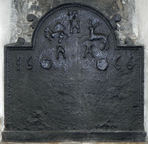
974
Description: Arched rectangular shape on a plain plinth; scalloped cavetto-moulded edging (top and sides); initials in triad within arch; date split in top corners; unidentified stamp top centre; hound stamp above letter 'R', stag stamp above letter 'A'; annulet stamp repeated inside each half of the date; flat scrolled protuberance on each side of arch; smaller protuberance above each shoulder.
Notes: The initials are likely to be those of a husband and wife, the stag and hound possibly associated with the husband's occupation. The protuberances are seen in different forms on few firebacks of the same period.
Inscription: RHA / 16 66
- Decoration tags:
- rectangular with round arch (shape)
- scalloped cavetto (edging)
- carved stamps
- individual letters
- individual numbers
- text
- animals
- objects
Manufactured: in 1666 in England.
Current location: Bishop's House, Norton Lees Lane, Sheffield, South Yorkshire, England.
(part of the Museums Sheffield museum group)
- Attached to series:
- Miscellaneous stamp firebacks
- Date & initials firebacks
- Loop edged firebacks
-
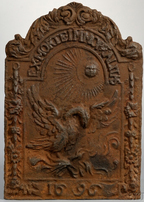
1082
Description: Arched rectangular central panel; fillet edging; pictorial scene of a phoenix rising from a fire; above right, a human mask at the centre of a sunburst; arched rectangular border with fillet edging, the date between initials along the bottom; down each side, a floral festoon hanging from a ring; over the arch, the inscription; on top, floral scrolls.
Notes: The inscription translates as 'out of death, immortality'; the initials NL are likely to be those of the pattern maker. Skinner's, Marlborough, Massachusetts, auction 14 Aug 2016 lot 226.
Inscription: EX MORTE IMMORTALITAS / N 1696 L
- Decoration tags:
- 'Dutch' (shape)
- fillet (edging)
- carved pattern panels
- pictorial
- mythological
- text
- animals
Manufactured: in 1696 possibly in the Siegerland area of Germany.
Current location: not known.
- Attached to series:
- 'Dutch' 1696 NL series
- Phoenix firebacks

.jpg)