-
714
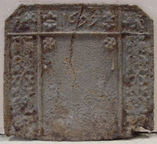
Description: Canted rectangle; cavetto moulded edging (top and sides); single horizontal fillet below canted corners and vertical fillet parallel to each side, dividing the fireback into two side panels, two top corner panels, top panel and main central panel; corner panels, lion passant stamp, left facing in right corner, right facing in left corner; top panel, date between double fleurs-de-lys stamps; side panels, suspended vine stamp repeated each side; centre panel, flower head stamp in each top corner.
Notes: The lion, flower head and double fleur stamps and linear division are identical to those on a group of firebacks, some of which are identified by the initials IB. The vine stamp in the side panels is not seen on other backs in the series.
Inscription: 1699
- Decoration tags:
- rectangular with canted top corners (shape)
- cavetto (edging)
- carved stamps
- individual numbers
- heraldic
- text
- animals
- plants
Manufactured: in 1699 in the Forest of Dean area of England.
Current location: not known.
- Attached to series:
- IB series
- Date only firebacks
-
848
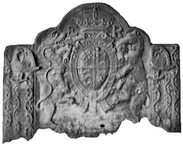
Description: Arched rectangular shape with rounded corners; ovolo within fillet moulding all round; oval Tudor royal shield with garter surrounding, topped with a royal crown; dragon and greyhound supporters; initials split by crown; inscription on a fillet between legs of supporters, behind garter finial; motto on an Ionic plinth at bottom; two rectangular side panels, each with a bird stamp (probably a swan, a Lancastrian badge) above a vine strip stamp repeated three times vertically.
Notes: One of two known variants of the John Harvo fireback incorporating extension panels with vine strips and 'swans'; the positions of the swans vary slightly between the two variants. Formerly at the old post office, Ticehurst, Sussex.
Inscription: E R / HONY SOIT QUE MAL Y PAYNCE
Arms: Tudor royal - prob. Edward VI
- Decoration tags:
- rectangular with round arch (shape)
- carved pattern panels
- whole carved pattern
- extension panels
- armorial
- royal
- animals
- objects
Manufactured: in the mid- to late-16th century possibly at Pounsley Furnace, Framfield in the Weald area of England.
Current location: not known.
-
901
Description: Quasi-Arched rectangular shape with cyma reversa shoulders; ovolo edging; stylised lion passant guardant; crowned rose with leaf and stem on left, crowned fleur de lys on right, thistle with leaves above centre; three right-facing scrolls at base; down-facing scroll, with staple, on right side; date split between bottom corners; initials below date, bottom right.
Notes: Blatantly Royalist in its symbolism, a variant (no. 763) is dated (perhaps less convincingly) 1649. Numeral style, initials, leaf depiction and the stapled scroll are typical features of firebacks made from patterns by the same maker. A later version of the same subject, but with a different shaped plate and without the fleur-de-lys, is also known (see 'Royalist series'). M. A. Lower writes of this design of fireback being cast at Waldron Furnace in Sussex (Lower, 1849, p.219).
Copies of this fireback are known.
Inscription: 16 41 / IM
- Decoration tags:
- rectangular with round arch (shape)
- ovolo (edging)
- whole carved pattern
- heraldic
- royal
- text
- animals
Manufactured: in 1641 possibly at Brede Furnace in the Weald area of England.
Current location: in private hands, Wandsworth, London, England.
- Attached to series:
- IM series
- Hooked '1' series
- Stapled scroll series
- Brede group
-
904
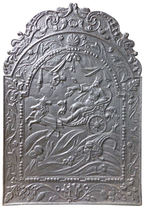
Description: Arched rectangular shaped central panel with five-bead and open pellet edging; pictorial: regal figure in his chariot drawn by two horses, a sceptre in his right hand; above, a putto descends from swagged curtains and a pair of tassels; below is a landscape with a cornucopia; arched rectangular shaped border with fillet edging, a scallop shell top centre with symmetrical arrangement of ivy and acanthus leaves and tendrils; the initial, N, in a cartouche bottom centre, between symmetrical oak fronds, leaves and acorns; above is a symmetrical design of scrolled floral tendrils terminating in sea monsters.
Notes: Very similar in design and execution to firebacks of the SHR and EB series, suggesting designs emanating from the same source and with a similar inspiration. The figure in the chariot may be an allegory of the Sun. Apollo is traditionally drawn by horses.
Copies of this fireback are known.
Inscription: N
- Decoration tags:
- 'Dutch' (shape)
- fillet (edging)
- whole carved pattern
- allegorical
- animals
- humans
- plants
- objects
Manufactured: in the early-18th century in England.
Current location: not known.
- Attached to series:
- N series
- British 'Dutch' style firebacks
-
984
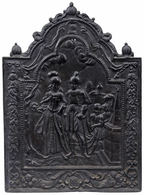
Description: Arched rectangular central panel with additional arch above; bead and fillet edging; pictorial scene of, on the left, a tree next to a female and, in the centre, a male figure, both in eastern dress, a page behind holding a train, and to the right a short obelisk surmounted by a crescent, behind which is the head of a figure with a camel; behind is a small building also surmounted by a crescent, with clouds above; the word, ASIA, is centre bottom; identical shaped border with cavetto-moulded edging; a pomegranate on top with descending swags of drapery; at the sides, overlapping bunches of foliage suspended from ribbon bows; at the bottom, a central cartouche between fruit bunches; on top, a pomegranate with a descending serpent on each side, and a pomegranate on each shoulder of the plate.
Notes: A pastiche of the EUROPA design based on an engraving c.1642 of Friedrich Wilhelm, Elector of Brandenburg, and his wife, Luise Henriette of Oranje-Nassau, by Mathias Czwiczek, with the figures adopting very similar poses in an oriental setting; one of series depicting allegories of the four continents, in this instance Asia. A recasting.
Copies of this fireback are known.
Inscription: ASIA / MB
- Decoration tags:
- 'Dutch' (shape)
- fillet (edging)
- whole carved pattern
- pictorial
- allegorical
- monogram
- text
- animals
- humans
Manufactured: in the mid- to late-17th century possibly in the Siegerland area of Germany.
Current location: not known.
- Attached to series:
- 'Dutch' Arched arch types
- 'Dutch' Continents firebacks
-
726
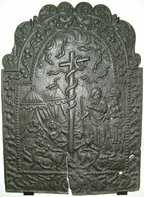
Description: Arched rectangular central panel with bead-on-fillet edging; pictorisl scene of a central cross-shaped pillar entwined with a snake; two pavilions to the left with human figures lying before them; two standing figures to the right, one holding a staff; above, clouds with snakes descending from the sky; arched rectangular border with fillet edging; on each side, descending festoons of fruit entwined with ribbon; at the bottom, a central cartouche between palm fronds; on top, foliate swirls.
Notes: The scene is an illustration of the plague of serpents visited upon the children of Israel by God (Numbers 21: 6).
Copies of this fireback are known.
Manufactured: in the mid-17th century possibly in the Siegerland area of Germany.
Current location: Victoria & Albert Museum, Cromwell Road, Kensington & Chelsea, Greater London, England.
Museum number: 291-1893 (part of the Victoria & Albert Museum museum group)
Citation: Anon., 2 Dec 1905, 'Old Kent and Sussex Fire-backs', Country Life, pp. 767-768.
- Attached to series:
- 'Dutch' Miscellaneous Firebacks
- Old Testament & Apocrypha firebacks
-
729
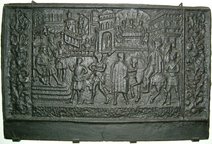
Description: Rectangular; flanged edge; central pictorial panel illustrating Mordecai arriving before King Ahasuerus, Haman hanging from the gallows behind; two floral side panels, at the top of each a monogram within a cartouche: on the left KS, on the right H?D; plain extension panel at bottom.
Notes: Stoveplate; the scene illustrates a scene from Esther 7: 10 and 8: 1.
Copies of this fireback are known.
Inscription: KS H[?]D
- Decoration tags:
- rectangular (shape)
- flanged (edging)
- whole carved pattern
- extension panels
- pictorial
- biblical
- architectural
- text
- animals
- humans
Manufactured: in the late-16th to early-17th century possibly in the Eifel area of Germany.
Current location: Victoria & Albert Museum, Cromwell Road, Kensington & Chelsea, Greater London, England.
Museum number: M.112-1953 (part of the Victoria & Albert Museum museum group)
- Attached to series:
- Stoveplates
- Esther stoveplates
-
732
Description: Rectangular; cavetto edging all round; seated lion on right, its tail rising above its back and its head turned to face the viewer; a seated sheep on the left.
Notes: Intended to represent the saying, ‘The lion shall lie down with the lamb’, a popular misquotation of Isaiah 11: 6. Some variants are dated 1679 (see no. 481).
Copies of this fireback are known.
- Decoration tags:
- rectangular (shape)
- cavetto (edging)
- whole carved pattern
- pictorial
- biblical
- animals
Manufactured: in the mid- to late-17th century in the Weald area of England.
Current location: Victoria & Albert Museum, Cromwell Road, Kensington & Chelsea, Greater London, England.
Museum number: 894.1901 (part of the Victoria & Albert Museum museum group)
- Attached to series:
- Small cavetto series
- Old Testament & Apocrypha firebacks
-
735
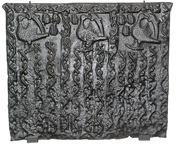
Description: Rectangular; three birds (probably swans, a Lancastrian badge) turned to the left, their heads facing right, and the front edge of their left wing extended and inverted; vine pattern strips, one horizontal along the top, and 14, of varied length, vertically across the rest of the fireback; seven ‘grape bunch’ shapes with criss-cross markings, arranged in three groups — 3-1-3 — adjacent to the birds.
Notes: The same vine strips are found on several firebacks, including some of the ‘Anne Forster’ series; the birds are also seen on a number of firebacks; the ‘grape bunch’ shapes may be the same as those on the ‘Anne Forster’ graveslab in Crowhurst church, Surrey. John Starkie Gardner and later writers attributed the birds to an association with the Fowle family; this is unlikely to be correct as the Fowles came to prominence in the iron industry towards the end of the sixteenth century and had their own distinctive decorative emblems. Formerly in the collection of Lady Dorothy Nevill.
- Decoration tags:
- rectangular (shape)
- complex, furniture-derived (edging)
- simple stamps
- carved stamps
- animals
- objects
Manufactured: in the mid- to late-16th century possibly at Pounsley Furnace, Framfield in the Weald area of England.
Current location: Victoria & Albert Museum, Cromwell Road, Kensington & Chelsea, Greater London, England.
Museum number: M.120-1914 (part of the Victoria & Albert Museum museum group)
Citation: Dawson, C., 1903, 'Sussex Iron Work and Pottery', Sussex Archaeological Collections, 46, pp. 1-54.
Citation: Gardner, J. S., 1898, 'Iron Casting in the Weald', Archaeologia, 56, 1, pp. 133-164.
Citation: Straker, E., 1931, Wealden Iron (London, Bell).
- Attached to series:
- Pounsley series
- Vine strip series
- Swan series
- Furniture stamp firebacks
-
739
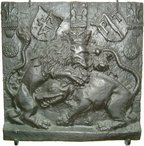
Description: Rectangular; a crowned lion fighting a boar in high relief on a raised bottom panel; above, a stamp formed from a fleur-de-lys on a bracket repeated three times, centre left and right corners; two angled shields and two sunburst discs.
Notes: The shields probably signify civic or personal allegiance; the symbolism of the fighting beasts is not known. Part of the bequest to the Victoria and Albert Museum by Lieut. Colonel G. B. Croft-Lyons in 1926.
Inscription: P T
- Decoration tags:
- rectangular (shape)
- none (edging)
- whole carved pattern
- heraldic
- armorial
- text
- animals
Manufactured: in the late-16th to early-17th century in Germany.
Current location: Victoria & Albert Museum, Cromwell Road, Kensington & Chelsea, Greater London, England.
Museum number: M.576-1926 (part of the Victoria & Albert Museum museum group)
- Attached to series:
- Foreign armorial firebacks