-
1273
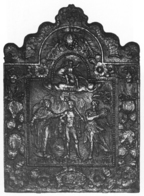
Description: Arched rectangular central panel with bead on fillet edging, pictorial scene of Hercules standing, right arm akimbo and left hand holding a club that rests on his shoulder; to his right the allegorical female figure of Virtue, clothed and resting her left hand on Hercules's right shoulder; to his left the female allegorical figure of Volupta, the pair symbolising the 'crossroads' where Hercules has to decide which path in life to take; below them the text VIRTUS HERCULES VOLUPTA; above, seated above clouds, Jupiter surveys the scene, the word IVPITER below; arched rectangular border with fillet edging, from a central bunch of grapes at the top of the arch, a ribbon on each side suspends bunches of fruit and flowers; at the bottom a central cartouche containing the inscription 'L7G', with flowers on each side;; on top are two mirrored dolphins, their tails covering a bunch of grapes.
Notes: The pictorial scene is loosely based on The Judgement of Hercules, c.1636-7, by Nicholas Poussin. The inscription at the bottom indicates the style of border; other firebacks with the same inscription have the same border; similar inscriptions (e.g. L6C and L8G) indicate different borders. Image from von den Driesch (p. 512).
Copies of this fireback are known.
Inscription: IVPITER / VIRTVS HERCVLES VOLVPTA / L7C
- Decoration tags:
- 'Dutch' (shape)
- fillet (edging)
- whole carved pattern
- pictorial
- mythological
- allegorical
- text
- humans
Manufactured: in the mid- to late-17th century in the Siegerland area of Germany.
Current location: not known.
- Attached to series:
- 'Dutch' LC/G series
-
1329
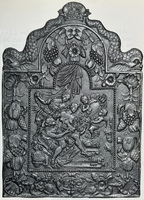
Description: Arched rectangular central panel with bead edging; pictorial scene of Venus sitting in a couch, with two other females, swathed in drapery, a putto holding an oval mirror to her left; Arched rectangular border with fillet edging; central cartouche at top, with festoons of fruit, flowers and leaves suspended on each side from ribbons supported by rings; at the bottom, swirled ribbon around an oval compartment bearing the inscription; on top, a central cartouche from which descend a cornucopia on each side of the arch.
Notes: The design is a copy of 'The Toilet of Venus' by Simon Vouet (c.1640); the image has been reversed. The inscription, L8G, indicates the style of border; other firebacks with the same inscription have the same border; similar inscriptions (e.g. L6C and L7C) indicate different borders. Image from von den Driesch, p.517.
Copies of this fireback are known.
Inscription: L8G
- Decoration tags:
- 'Dutch' (shape)
- fillet (edging)
- whole carved pattern
- pictorial
- mythological
- text
- humans
Manufactured: in the mid- to late-17th century in the Siegerland area of Germany.
Current location: not known.
- Attached to series:
- 'Dutch' LC/G series
-
1330
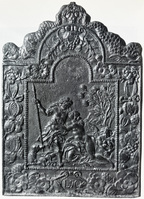
Description: Arched rectangular central panel with bead edging; pictorial scene of Venus, naked and kneeling, and Adonis, standing, holding a spear in his left hand, with Cupid to the left, and a hound and a quiver of arrows below to the right; arched rectangular border with fillet edging; descending swags of fruit and seashells enclosing the central panel; inscription in an oval cartouche at the bottom; on top, a Holy Roman Imperial crown between two mirrored dolphins, heads downward.
Notes: The scene is based on the painting (c.1635) of Venus and Adonis by Peter Paul Rubens; the initials, L7C, denote the style of border - other firebacks having the same inscription have the same border - and other borders are denoted by similar inscriptions (e.g. L6C and L8G). Image from von den Driesch, p.520.
Copies of this fireback are known.
Inscription: L7C
- Decoration tags:
- 'Dutch' (shape)
- fillet (edging)
- whole carved pattern
- pictorial
- mythological
- text
- animals
- humans
- plants
- objects
Manufactured: in the mid- to late-17th century in the Siegerland area of Germany.
Current location: not known.
- Attached to series:
- 'Dutch' LC/G series
- 'Dutch' Venus and Adonis firebacks
-
1276
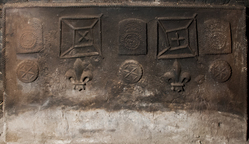
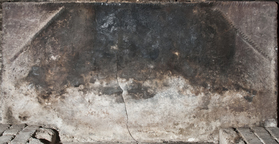
Description: Rectangular shape; twisted rope edging (top and sides only); along the top, two irregular arrangements of rope lengths forming a small quasi-square within a larger quasi-square, with the outer corners of the small square joined to the inner corners of the larger square, a short length of rope extending outwards from the top and bottom right corners of the larger square, and within the left small square a rope saltire, and in the right small square a rope cross; between and outside of these rope arrangements, an arched rectangular stamp, with indented edges, of a crowned rose-en-soleil impressed three times; below each rope pattern a fleur-de-lys; below each rose-en-soleil stamp, a circular, six-pointed-star-embossed stamp with beaded edging.
Notes: All of the stamps have been noted on a series of other firebacks together with variations of the rope arrangement. The clarity of the condition of the stamps suggests that this casting predates the others in the series.
- Decoration tags:
- rectangular (shape)
- rope (edging)
- simple stamps
- carved stamps
- heraldic
- royal
- objects
Manufactured: in the mid- to late-16th century possibly at Pounsley Furnace, Framfield in the Weald area of England.
Current location: in private hands, Wadhurst, East Sussex, England.
-
1277
Description: Rectangular; twisted rope edging (top and sides only); rope diagonally length across each top corner.
Notes: A very simple rope design seen in several variations on other firebacks.
- Decoration tags:
- rectangular (shape)
- rope (edging)
- simple stamps
Manufactured: in the late-16th to early-17th century in the Weald area of England.
Current location: in private hands, Wadhurst, East Sussex, England.
- Attached to series:
- Rope design firebacks
-
1278
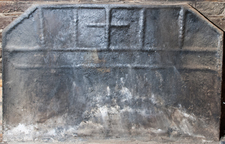
Description: Canted rectangular shape; twisted rope edging (top and sides only; two approximately parallel horizontal lines of twisted rope across the upper centre; from the upper line and starting at the top corners, five regularly-spaced vertical lines of twisted rope extending to the top edge, the centre one with a horizontal rope length formiong a cross.
Notes: A simple rope design with apotropaic significance.
- Decoration tags:
- rectangular with canted top corners (shape)
- rope (edging)
- simple stamps
- apotropaic
- objects
Manufactured: in the mid- to late-16th century possibly in the Weald area of England.
Current location: in private hands, Wadhurst, East Sussex, England.
- Attached to series:
- Rope design firebacks
-
1279
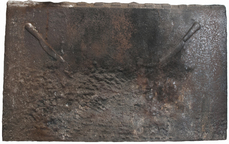
Description: Plain rectangular shape with chamfered and embattled top edge; impression of a utilitarian, domestic knife inclined, blade down, at an angle of about 45 degrees from inside the top corners; the knife measures about 20.5cm in length.
Notes: An unusual, if not unique, top edge. The form of the knife suggests a late-16th or early-17th century date. The uneven surface of the lower part of the fireback may have been caused by the pouring of the molten metal and the consequent disturbance of the casting sand of the mould.
- Decoration tags:
- rectangular (shape)
- none (edging)
- simple stamps
- objects
Manufactured: in the late-16th to early-17th century in the Weald area of England.
Current location: in private hands, Wadhurst, East Sussex, England.
- Attached to series:
- Metalware stamp firebacks
- Knife & Dagger stamp firebacks
-
1280
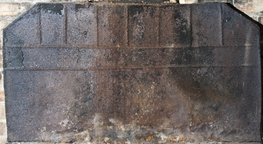
Description: Canted rectangular shape; twisted rope edging (top and sides); two approximately parallel horizontal lines of twisted rope across the upper centre; from the upper line and starting at the top corners, seven regularly spaced vertical lines of twisted rope extending to the top edge.
Notes: A simple rope design without apotropaic significance.
Copies of this fireback are known.
- Decoration tags:
- rectangular with canted top corners (shape)
- rope (edging)
- simple stamps
- objects
Manufactured: in the late-16th to early-17th century possibly in the Weald area of England.
Current location: in private hands, Wadhurst, East Sussex, England.
- Attached to series:
- Rope design firebacks
-
778
Description: Arched rectangular shape; cavetto/cyma recta moulded edging; plain rectangular panels at sides; top centre, bull’s head and neck issuing from a marquesal coronet, a baronial coronet above.
Notes: The crest of the Barons Bergavenny, although it should issue from a ducal, rather than a marchesal, coronet, and the rose normally placed on the neck is missing. The carved crest was affixed to a board of similar shape but smaller dimensions to the board with the moulded edging, indicating that the moulded board could have been used for other firebacks. Believed to have formerly been at Maresfield Park, Sussex.
- Decoration tags:
- rectangular with round arch (shape)
- complex individual (edging)
- carved stamps
- carved pattern panels
- extension panels
- heraldic
Manufactured: in the early-18th century in the Weald area of England.
Current location: in private hands, Waldron, East Sussex, England.
- Attached to series:
- Bergavenny firebacks
-
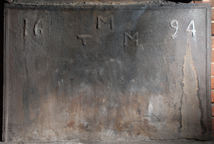
991
Description: Rectangular with fillet edging (top and sides) formed from separate strips, possible from furniture; date split by letters in triad; number '1' has a central knob.
Notes: The initials are believed to relate to Thomas and Mary Manser, who occupied the Star Inn, Waldron, East Sussex, in the seventeenth century.
Inscription: 16 TMM 94
- Decoration tags:
- rectangular (shape)
- fillet (edging)
- simple stamps
- carved stamps
- text
Manufactured: in 1694 in the Weald area of England.
Current location: The Star Inn, Waldron, East Sussex, England.
- Attached to series:
- Date & initials firebacks