-
81
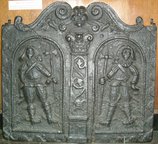
Description: Rectangular with two mirrored scrolls on top, a lion’s face between; bas-relief semi-circle edging (sides and bottom); central pilaster with vine scrolling, Corinthian capital, initials on the pedestal; on either side, an arched alcove, each with a halberdier in mid-17th century clothes, their feet pointing to the middle.
Notes: Stylistically similar to the Lenard fireback (no. 429), the initials also appear on other firebacks. All known examples of this fireback are poorly modelled and cast. A rare version (no. 400) has different edging and lacks the pattern-maker’s initials. Inferior copies of this fireback were advertised in Kings Worthy Foundry's (Winchester) catalogue in the mid-20th century.
Copies of this fireback are known.
Inscription: IM
- Decoration tags:
- rectangular with ornate arch (shape)
- fillet (edging)
- whole carved pattern
- planklines
- pictorial
- architectural
- text
- humans
Manufactured: in the early- to mid-17th century possibly at Brede Furnace in the Weald area of England.
Current location: Guildford Museum, Guildford, Surrey, England.
Museum number: S.7108 (part of the Guildford Museum museum group)
Citation: Lloyd, N., 1925, 'Domestic Ironwork I', Architectural Review, 58, pp. 58-67.
- Attached to series:
- IM series
- Brede group
-
82
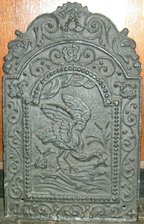
Description: 'Dutch' style; arched rectangular shaped central panel, bead on fillet edging, naturalistic scene of a heron with wings extended catching a fish, water below, clouds above, plants in background; arched rectangular shaped border, fillet edging, symmetrical scrolled tendril pattern; at bottom, two looped 'W' figures between date split corners; on top, symmetrical scrolled foliage. A single central vertical plankline.
Notes: The image of the heron is taken from a print, by Wenceslaus Hollar c.1658, of an etching by Francis Barlow (c.1626-1704); the style of the date suggests a similar pattern maker to a series of firebacks, of the same date, some bearing a Welsh inscription. All incorporate the looped 'W' motif which may be intended to identify the pattern maker. The small size of this fireback makes it likely that it was intended to be fixed to the back of a grate.
Copies of this fireback are known.
Inscription: 17 24
- Decoration tags:
- 'Dutch' (shape)
- fillet (edging)
- whole carved pattern
- planklines
- pictorial
- text
- animals
Manufactured: in 1724 in England.
Current location: Guildford Museum, Guildford, Surrey, England.
Museum number: G.487 (part of the Guildford Museum museum group)
- Attached to series:
- 1724 series
- British 'Dutch' style firebacks
-
84
Description: Arched rectangular shape; ‘egg and dart’ ovolo moulding visible on top and sides; shield, helmet, crest, mantling and supporters of the Mohun family.
Notes: Cast from a finely carved pattern, the supporters denote these are the arms of a peer. The crest is: Gules, a maunch ermine, with a hand proper holding a fleur de lys or. Egg and dart moulding is rare and examples (at Maidstone and Burwash) may be the work of the same pattern maker. From Sidney Farm, Alfold, Surrey; Reginald Mohun (pron. Moon) of Dedisham, Slinfold, Sussex, was husband of Elizabeth Blounte of Dedisham c.1636. Bottom missing due to corrosion.
Copies of this fireback are known.
Arms: Mohun family, barons of Okehampton
- Decoration tags:
- rectangular with round arch (shape)
- ovolo, egg and dart (edging)
- whole carved pattern
- heraldic
- armorial
Manufactured: in the early- to mid-17th century in England.
Current location: Guildford Museum, Guildford, Surrey, England.
Museum number: G.7106 (part of the Guildford Museum museum group)
- Attached to series:
- Personal armorial firebacks
- Mohun series
-
85
Description: Rectangular; twisted rope edging; twisted rope arranged to form inscription across upper half of plate.
Notes: The double 'v' may have an apotropaic significance, invoking the Virgin Mary.
Inscription: +W+
- Decoration tags:
- rectangular (shape)
- rope (edging)
- simple stamps
- apotropaic
- objects
Manufactured: in the mid- to late-16th century possibly in the Weald area of England.
Current location: in private hands, Hadlow Down, East Sussex, England.
- Attached to series:
- Rope design firebacks
-
86
Description: Quasi-arched rectangular shape; fillet edging; central female figure with urn on head, above which is an oval cartouche (possibly a mirror); to left, fireplace with basket grate, above which a lobster and another (unidentified) creature bear a covered vase; to right a seated female figure stretches forth her left arm, behind her is a statue of a female figure on a plinth at the foot of a curving flight of stairs; the whole is surrounded by naturalistic rocks and trees, suggesting a grotto.
Notes: An unusually free pictorial decoration.
Copies of this fireback are known.
- Decoration tags:
- rectangular with ornate arch (shape)
- fillet (edging)
- whole carved pattern
- pictorial
- humans
- plants
- objects
Manufactured: in the early-18th century in England.
Current location: in private hands, Hadlow Down, East Sussex, England.
- Attached to series:
- Late pictorial series (all)
- Late pictorial series 4
-
91
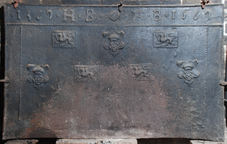
Description: Rectangular; twisted rope edging (top and sides); narrow top panel and two narrow side panels, each separated by twisted rope; top panel with symmetrical inscription line begun and ended with a stamp formed of four spots in square, the same stamps separating the date, each of the initials and a central rose stamp, the date being repeated at each end; plain side panels; central panel comprising three shields bearing a rose and crown, one on the top line between two rectangles, each bearing a griffin passant, and two shields on the ends of the lower line with two rectangles with griffins between, the bottom half of the plate is plain.
Notes: The shield and griffin stamps appear on two firebacks at Hastings Museum, in each of which the shields are inverted.
Inscription: 1569 HB AB 1569
- Decoration tags:
- rectangular (shape)
- rope (edging)
- simple stamps
- carved stamps
- individual letters
- individual numbers
- heraldic
- text
- animals
- plants
Manufactured: in 1569 in the Weald area of England.
Current location: in private hands, Hadlow Down, East Sussex, England.
- Attached to series:
- Griffin series
-
1006
Description: Rectangular shape with twisted rope edging (top and sides); date split between top corners.
Notes: The central button on the number 1 is consistent with a date in the first half of the seventeenth century. Hall's auction, Shrewsbury, 28 Oct 2015, lot 127 (£190).
Inscription: 16 37
- Decoration tags:
- rectangular (shape)
- rope (edging)
- individual numbers
- text
Manufactured: in 1637 possibly in the Shropshire area of England.
Current location: in private hands, Wigmore, Herefordshire, England.
- Attached to series:
- Date only firebacks
-
1239
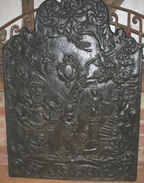
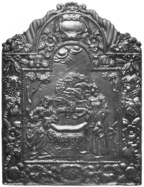
Description: Arched rectangular central panel with bead-on-fillet edging; pictorial scene of Jesus sitting at the well with the woman of Samaria standing opposite, a rural scene behind, trees on each side and clouds with sunrays above; arched rectangular border with fillet edging; central cartouche at top, with festoons of fruit, flowers and leaves suspended on each side from ribbons supported by rings; at the bottom, swirled ribbon around an oval compartment bearing the inscription 'L6C'; on top, a central cartouche from which descend a cornucopia on each side of the arch.
Notes: The scene, seen on many German firebacks and stoveplates, is from St John's gospel, chapter 4; the inscription at the bottom indicates the style of border; other firebacks with the same inscription have the same border; similar inscriptions (e.g. L7C and L8G) indicate different borders.
Copies of this fireback are known.
Inscription: L6C
Manufactured: in the mid- to late-17th century possibly in the Siegerland area of Germany.
Current location: Vreden, Nordrhein-Westfalen, Germany.
Citation: Elling, W. & Winkler-Borck, S., 1992, Ofen- und Kaminplatten (Vreden, Hamaland-Museum).
- Attached to series:
- 'Dutch' LC/G series
-
882
Description: Arched rectangular shape; simulated twisted rope edging (top & sides); symmetrical triad arrangement of fleurs de lys (two types - 2 and 1), diamond shapes (2) and cross-cut squares (4) includes the monogram in which the letters I and F are separated by a small, hollow diamond stamp, the M being above between I and reversed B; interspersed symmetrical arrangement of raised spots (8).
Notes: The initials, IMF, as with other triple-lettered forms, in which the middle letter is set apart from the other two, may relate to a married couple where their surname initial is M; a variant of the more common version but with additional letters I and B separately stamped. Life-size pencil drawing (anon.) in Historic England Record Centre, Swindon, Wiltshire (MD96/06202) of a fireback originally at 124 Heath Street (formerly the Upper Flask Tavern), Hampstead, London.
Inscription: 1613 / I M B / I F
- Decoration tags:
- rectangular with round arch (shape)
- simulated rope (edging)
- carved stamps
- carved pattern panels
- individual letters
- individual numbers
- heraldic
- text
Manufactured: in 1613 in the Weald area of England.
Current location: not known.
Museum number: MD96/06202 (part of the Historic England museum group)
- Attached to series:
- Diamond series
-
87
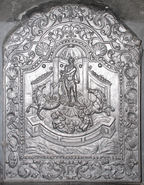
Description: 'Dutch' style; cavetto-canted arched rectangular shaped central panel, double fillet and bead edging, figure of Poseidon/Neptone, trident in right hand, standing on three scallop shells, within a niche with a demi-hemispherical roof and two sloping supporting walls, on either side is a mythical seahorse, below is a walled fountain base with two mermaids at the front; cavetto-canted arched rectangular shaped border with scallop and clam shells separated by swirled foliage, monogram at base between scrolled foliage; on top, scrolled foliage.
Notes: From a design in 'Nouveaux livres de ...Statues [etc.]' (La Haye & Amsterdam 1702-5), by Daniel Marot.
Copies of this fireback are known.
Inscription: EB
- Decoration tags:
- 'Dutch' (shape)
- fillet (edging)
- whole carved pattern
- pictorial
- mythological
- monogram
- text
- animals
- humans
- objects
Manufactured: in the early-18th century in England.
Current location: Hampton Court, Richmond, Greater London, England.
Museum number: 1098 (part of the Royal Collection museum group)
- Attached to series:
- EB series
- British 'Dutch' style firebacks


,_lot_127_28_oct_2015a.jpg)
.jpg)