-
646
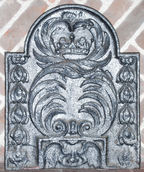
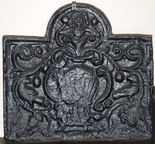
Description: Arched rectangular shape; fillet edging; bell-flower column repeated on each side; at bottom, central rectangular panel, fillet edged, enclosing outstretched wings; above, intertwined leaves in figure-of-eight, enclosing a crown at the top.
Notes: This fireback incorporates features of the ‘Dutch’ style but within an English form.
- Decoration tags:
- rectangular with round arch (shape)
- fillet (edging)
- whole carved pattern
- heraldic
- plants
Manufactured: in the mid- to late-17th century in England.
Current location: Eastgate House, High Street, Rochester, Kent, England.
Museum number: A3484 (part of the Rochester Guildhall Museum museum group)
- Attached to series:
- Miscellaneous pattern firebacks
-
647
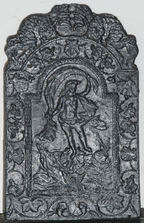
Description: Arched rectangular central panel with hollow bead-on-fillet edging; pictorial scene of a female figure standing on a scallop shell on a ground, holding wind-blown drapery aloft; arched rectangular border with fillet edging; top centre, a scallop shell with descending tendrils and alternating flowers and scallop shells, and swirled leaves at the bottom; on top, mirrored serpents.
Notes: The allegorical figure of Fortune; similar in many respects to other ‘Dutch’ style firebacks of the period. The theft in 1699 from a Thames-side warehouse of several firebacks, including '5 iron Chimney-Backs cast in the figure of Fortune standing naked on a Conchus in the Sea' may refer to this type (Post Boy 11-14 Nov. 1699).
Copies of this fireback are known.
- Decoration tags:
- 'Dutch' (shape)
- fillet (edging)
- whole carved pattern
- pictorial
- allegorical
Manufactured: in the early-18th century in England.
Current location: Eastgate House, High Street, Rochester, Kent, England.
Museum number: A3490 (part of the Rochester Guildhall Museum museum group)
- Attached to series:
- British 'Dutch' style firebacks
-
648
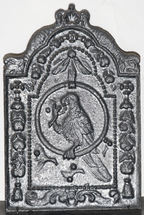
Description: Arched rectangular central panel with arch and bead-on-fillet edging; pictorial representation of a popinjay, or parrot, perched on a ring suspended by a ribbon from a bow, the bird is clutching an olive twig, other sprigs are below; arched rectangular border with arch and fillet edging; mirrored festoons of flowers and fruit suspended from roses, scrolled foliage at the bottom; on top, central scallop shell between descending dolphins.
Notes: The parrot on the ring perch is a popular design on Dutch firebacks.
Copies of this fireback are known.
Manufactured: in the mid- to late-17th century in the Siegerland area of Germany.
Current location: Eastgate House, High Street, Rochester, Kent, England.
Museum number: A3491 (part of the Rochester Guildhall Museum museum group)
- Attached to series:
- 'Dutch' Bird on perch firebacks
- 'Dutch' Miscellaneous Firebacks
-
649
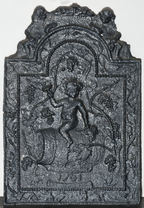
Description: Arched rectangular central panel with bead edging; pictorial scene of the young Bacchus, a cup and bunch of grapes in his hands, seated on a barrel, surrounded by grape vines and buches, the date below the barrel, initials below, left and right; arched rectangular border with fillet edging; undulating vine design all round; on top, indistinguishable shape between two seated figures.
Notes: The seated figures on top are an unusual feature.
Copies of this fireback are known.
Inscription: 1701 / A [?] AL
- Decoration tags:
- 'Dutch' (shape)
- fillet (edging)
- whole carved pattern
- pictorial
- mythological
- text
- humans
- plants
- objects
Manufactured: in 1701 possibly in the Siegerland area of Germany.
Current location: Eastgate House, High Street, Rochester, Kent, England.
Museum number: A3492 (part of the Rochester Guildhall Museum museum group)
- Attached to series:
- 'Dutch' Miscellaneous Firebacks
-
650
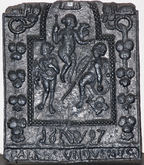
Description: Damaged; top missing; arched rectangular central panel with bead edging; with tassel at top; three nude female figures: on top, Juno/Hera with a peacock, to the left Venus/Aphrodite, the young cupid/Eros at her feet, to the right Minerva/Athena with spear and shield; border with fillet edging; two suspended festoons of fruit and leaves; date and monogram in rectangular panel below central panel; rectangular panel at the bottom, with the inscription, PALLAS VND VENVS.
Notes: The three goddesses are those whose beauty was the subject of the Judgement of Paris. The composition is copied from an engraving by Adriaen Collaert (c1560-1618). Examples of this fireback have been recast in England, the opportunity being taken to insert an English inscription in place of the customary date and pattern maker's monogram.
Inscription: 16 NDW 97 / PALLAS VND VENVS
- Decoration tags:
- 'Dutch' (shape)
- fillet (edging)
- whole carved pattern
- pictorial
- mythological
- text
- humans
Manufactured: in 1697 in the Siegerland area of Germany.
Current location: Eastgate House, High Street, Rochester, Kent, England.
Museum number: A3493 (part of the Rochester Guildhall Museum museum group)
- Attached to series:
- 'Dutch' NDW series
- Judgement of Paris firebacks
-
653
Description: Arched rectangular shape; cavetto-moulded edging; central, two handled, fluted vase with swirled, fruited vines issuing from the neck, and a bird on each side perched within the vines; out of the neck, a naïve human figure with arms outstretched, grasping vines on each side.
Notes: The figure emerging from the vase has a symbolism which has yet to be explained.
Copies of this fireback are known.
- Decoration tags:
- rectangular with round arch (shape)
- cavetto (edging)
- whole carved pattern
- pictorial
- plants
- objects
Manufactured: in the mid- to late-17th century in the Weald area of England.
Current location: Eastgate House, High Street, Rochester, Kent, England.
Museum number: A3496 (part of the Rochester Guildhall Museum museum group)
- Attached to series:
- Gadrooned vase firebacks
-
654
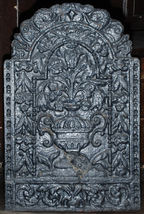
Description: Arched rectangular central panel with bead-and-pellet edging; S-scroll, two-handled, gadrooned vase with tulip stems, flowers and leaves; arched rectangular border with fillet edging and suspended flower bunches; along a rectangular bottom panel with fillet edging a symmetrical arrangement of swirled foliage; on top, two symmetrical, coiled serpents; narrow, curved shouldered side panels with beads in oval depressions.
Notes: The presence of tulips suggest a Dutch origin for the pattern of this fireback, although the presence of several examples in England suggest that it was produced here rather than on the Continent.
Copies of this fireback are known.
- Decoration tags:
- 'Dutch' (shape)
- fillet (edging)
- whole carved pattern
- extension panels
- pictorial
- plants
- objects
Manufactured: in the mid-17th century in England.
Current location: Eastgate House, High Street, Rochester, Kent, England.
Museum number: A3507 (part of the Rochester Guildhall Museum museum group)
- Attached to series:
- Flower Vase 'Dutch' types
- British 'Dutch' style firebacks
-
1015
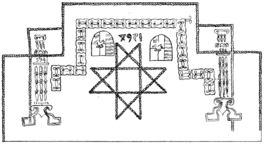
Description: Rectangular with two-stepped top; twisted rope edging (top and sides); twisted rope extensions enclosing intermediate step with rope continued parallel to sides; central rope octagram with reversed date above between repeated inverted shield shapes off-set (left higher than right); the shield blazon: barry wavy impaling quarterly, overlaid with a small bird stamp and an indistinct ?bird shape in the top left quarter as viewed; within the rope, a roughly parallel arrangement of 23 double-loop-patterned stamps, with the faint impression of an additional stamp in the top right corner of the arrangement; outside the loop stamps and partially overlying the vertical rope extensions, the impressions of two classically designed firedogs with Ionic capitals and fluted pilasters, bearing the date 1594, but with the '1' missing; the fluting on the pilasters has been overlaid by the repeated impression of a turned peg.
Notes: A large and remarkably elaborate fireback: the octagram, a device seen more commonly on French firebacks than on English ones, suggests an apotropaic purpose; the impression of the firedogs was clearly made after the laying of the rope lengths and impressed less deeply as the rope impression has not been obliterated by the firedog on the left side. A fireback with the same loop stamps bears the same date using the same numerals but impressed the correct way round. Currently obscured behind a wood stove.
Inscription: 4951 [5 reversed] / 594 594
- Decoration tags:
- stepped (shape)
- rope (edging)
- simple stamps
- carved stamps
- individual numbers
- apotropaic
- armorial
- text
- objects
Manufactured: in 1594 in the Weald area of England.
Current location: Fyning Manor, Rogate, West Sussex, England.
-
657
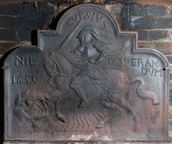
Description: Rectangular with curved top corners; Arched rectangular extension on top; ovolo edging; mounted figure in 17th cent. armour riding down a dragon to the left and below, sword in hand; inscription across top and either side of horseman; date below left; initials below right.
Notes: Probably a representation of St George and the Dragon, with political undertones, given the date. Cursius may be a mis-spelling of Marcus Curtius, who sacrificed himself for the good of Rome. Nil Desperandum - Despair not. Other firebacks also bear the initials, IM, which probably relate to the pattern maker, some with a similar style of lettering.
Copies of this fireback are known.
Inscription: CVRSIVS / NIL DESPERANDVM / 1650 / IM
- Decoration tags:
- rectangular with round arch (shape)
- ovolo (edging)
- whole carved pattern
- pictorial
- allegorical
- text
- animals
- humans
Manufactured: in 1650 possibly at Brede Furnace in the Weald area of England.
Current location: in private hands, Rolvenden, Kent, England.
- Attached to series:
- IM series
- Hooked '1' series
- Brede group
-
658
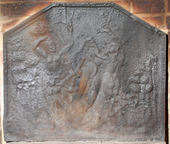
Description: Canted rectangular shape; stepped fillet edging; indistinct pictorial scene of two men on the prow of a sailing ship, their arms in the air, passing a naked figure, arms also in the air.
Notes: Possibly a representation of Odysseus and one of the Sirens.
- Decoration tags:
- rectangular with canted top corners (shape)
- stepped fillet (edging)
- whole carved pattern
- pictorial
- mythological
- humans
Manufactured: in the early-18th century in France.
Current location: in private hands, Rolvenden, Kent, England.
- Attached to series:
- Miscellaneous pattern firebacks